App Ranking Updates for Developers: Stop Chasing Hourly Spikes

App Ranking Updates for Developers: Stop Chasing Hourly Spikes
App stores refresh different surfaces at different speeds. Some views update hourly or daily, but durable rank changes usually take days or weeks to show up. Timing depends on the signals behind the ranking (text relevance, behavior, ratings, technical quality) and on how you measure. The platform docs and the monitoring playbook below show what to watch.
TL;DR:
- Apple and Google publish no exact search refresh schedule; charts typically move faster than search, whose behavioral signals are aggregated.
- Track hourly during experiments, daily for keywords, and weekly for strategy; sample markets, devices, and queries to avoid mistaking local movement for a broad shift.
- An ACM study found a 0.24% conversion lift from relevance labels produced by language models, with the strongest gains on rare queries lacking behavioral data.
- Use rolling medians and untouched control keywords to distinguish lasting changes from campaign spikes; check crash reports and rollout errors before changing metadata.
- Apps in the App Store’s top ten positions averaged one update every 83 days in February 2022, so frequent releases are unnecessary for strong rankings.
Table of Contents
- How often do rankings update on the App Store and Google Play?
- Which signals drive ranking updates?
- How should you monitor rank updates?
- Is it a short-term spike or a long-term shift?
- What schedule and alerts should you set up?
- Why chasing hourly volatility is the wrong game
- Put rank monitoring in one place with Apptenium
- FAQ
- Sources
How often do rankings update on the App Store and Google Play?
Neither Apple nor Google publishes a refresh schedule for search ranking, so “update time” depends on which surface you watch. Charts, search results and category lists each follow their own logic. Here is what the platforms document:
- Apple App Store search: Apple’s search guidance says results combine text relevance (title, subtitle, keywords, primary category) with behavior such as downloads, ratings and reviews. Behavioral inputs are aggregated, so a visible change can lag the event that caused it.
- Google Play search: Play Console documentation describes ranking from metadata, user feedback, app quality and behavioral signals, with different weights on different surfaces.
- Charts versus search: Top charts typically move on a faster, steadier cycle. Search rank depends on aggregated signals and tends to move more slowly and less predictably.
- Your own listing changes: New metadata can alter text relevance quickly, but the behavioral response to that change builds over time.
Treat any single snapshot as a reading of one surface at one moment, not a verdict on your visibility.
Which signals drive ranking updates?
Three families of signals decide how fast and how far your rank moves.
- Textual relevance: Title, subtitle, keywords and description set your initial match to a query. A metadata change can shift this part soon after it goes live.
- Behavioral relevance: Downloads, installs and conversions from search results are aggregated and feed back into ranking. This is why a keyword win often looks gradual rather than instant.
- Quality signals: Ratings, reviews, crash rates and technical performance affect both ranking and exposure, according to the Google Play documentation linked above.
- Learned relevance models: Large rankers are trained on labeled examples, and training data shapes how stable results are across queries.
That last point is worth a closer look. An ACM study on augmenting app-store ranking describes adding LLM-generated textual relevance labels to a production ranker. It found the biggest gains on tail queries, the rare searches with little behavioral data.
The study reported a +0.24% conversion-rate lift in a worldwide A/B test. Better labels mattered most where behavior alone gave the ranker too little to go on.
For you, that means long-tail keywords can behave differently from head terms. Their rankings lean more on text relevance and on how the model was trained, so they may shift when the ranker is retrained rather than when your own numbers change.
How should you monitor rank updates?
Match your cadence to your goal, then reduce noise with careful sampling. Here is a workable sequence:
- Set the goal first. Use hourly snapshots for short experiments, daily checks for ongoing keyword monitoring and weekly summaries for strategic reporting.
- Sample representative markets. Check several countries, device types and query variants. Many changes are region- or device-specific, and one search result page can mislead you when you track from a single location.
- Pair ranks with outcomes. Combine rank snapshots with impressions, product page views and conversion data from App Store Connect or Play Console. Apple specifically advises using App Analytics to judge the effect of listing changes.
- Use baselines and controls. Compare against rolling windows and a handful of control keywords you did not touch, so you can separate your effect from store-wide movement.
- Log every change. Record metadata edits, releases and campaigns with timestamps so a rank move can be traced to a cause.
Pro Tip: Keep three to five stable control keywords in every report; if they all move together, the cause is probably the store, not your listing.
Update frequency of your own app matters less than you might expect. Statista reports that as of February 2022, apps in the top 10 App Store positions were updated on average every 83 days, so frequent releases are not a prerequisite for strong rankings.

Is it a short-term spike or a long-term shift?
The same chart line can mean very different things, so classify the move before you react.
- Short-term spikes: These often trace back to promotions, paid campaigns or brief visibility tests, and they commonly fade within days. Do not rewrite your listing in response.
- Long-term shifts: These usually reflect sustained gains such as better retention, sharper metadata relevance or improved reviews. They hold across several weeks of data.
- Use medians, not single points: A rolling median smooths out short-term noise, and a comparison against control keywords shows whether the whole store moved.
- Check technical health first: Before touching ASO, review crash reports and rollout errors. A bad release can look like an ASO problem when it is an engineering one. A solid pre-launch QA checklist helps prevent regressions that cause sudden drops.
A useful rule: if a change persists across multiple median readings and your control keywords stayed flat, treat it as real and investigate the cause.
What schedule and alerts should you set up?
You can put a working setup in place with a few simple steps. Use these steps:
- Cadence: Take hourly snapshots during experiments, especially soon after a change. Switch to daily tracking for steady state and a weekly strategic summary.
- Rank alert: Flag keywords that fall sharply against their recent median. Calibrate this threshold to your own volatility.
- Conversion alert: Trigger on a sudden drop in product page conversion rate, since behavior feeds back into ranking.
- Technical alert: Trigger on crash-rate spikes after a release.
- Runbook when an alert fires: Confirm the analytics data is complete, check for recent metadata or campaign changes, apply device and region filters, and escalate to engineering if technical metrics moved.
Write the runbook down once so any teammate can run it without guessing.
Why chasing hourly volatility is the wrong game
Hourly rank wiggles are mostly noise, and teams that react to each one end up changing their listings so often that they cannot tell what worked. Favor the durable signals: conversion, retention, ratings and relevance. Decide your experiment window and success metric before you edit any metadata, then leave the change alone until the window closes. Finally, translate every rank movement into installs and revenue, because a gain on a keyword nobody searches is not a win. Work on the keywords that move money, and let the rest drift.
— Mike
Put rank monitoring in one place with Apptenium
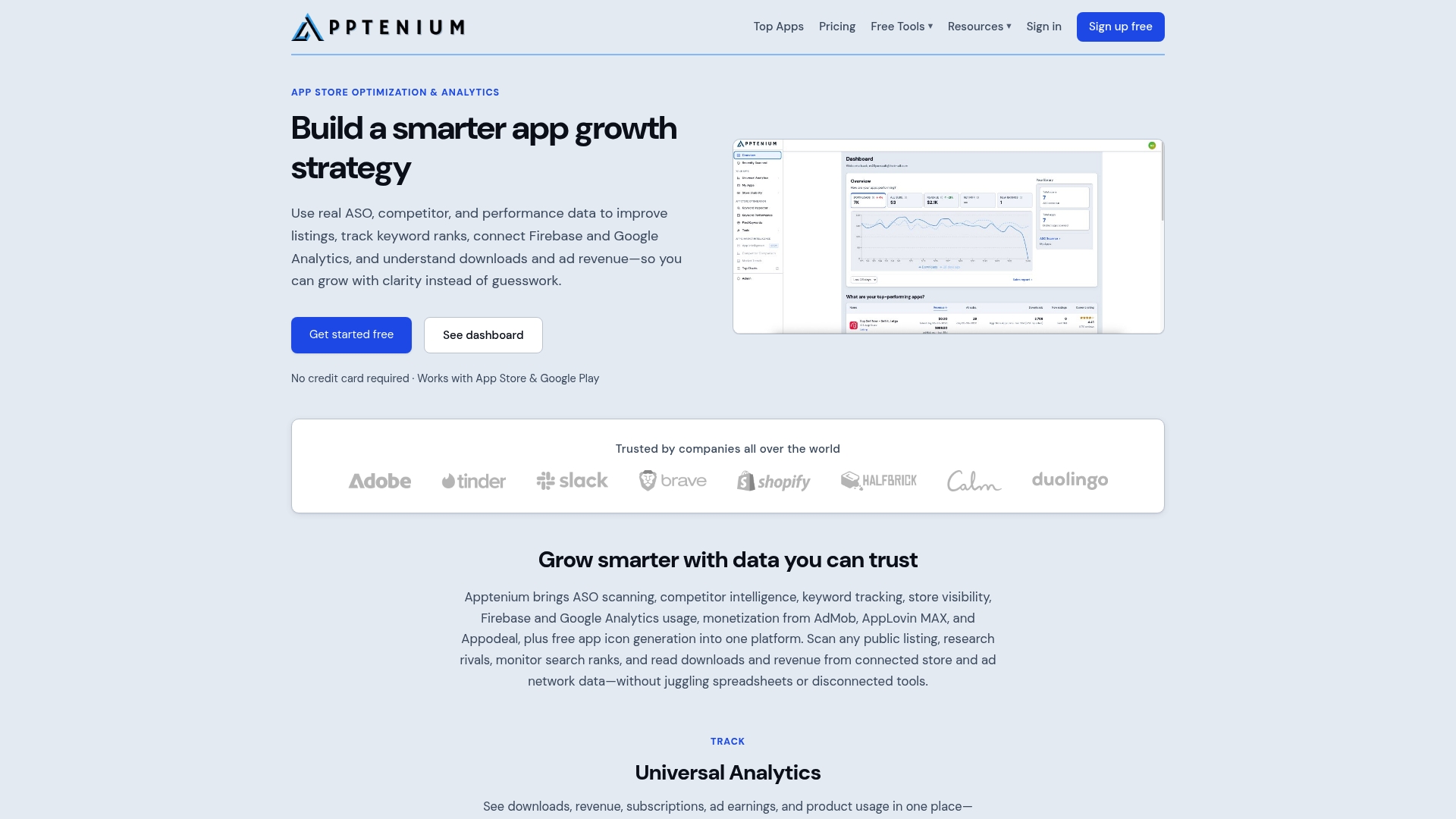
Rank snapshots, analytics and competitor data usually live in separate tools, which makes alerts hard to trust. We built Apptenium so you can see them together:
- ASO scanning and keyword tracking in one workspace, on our ASO tools
- Competitor intelligence beside your own rank data
- Firebase and Google Analytics integrations plus AI-powered listing recommendations
We offer a Free plan and a Pro plan at $9.99 per month. See both on our pricing page, and start with a scan of your listing.
FAQ
How often do app store rankings update?
It depends on the surface. Charts tend to refresh on a faster cycle, while search rank depends on aggregated signals and shifts more gradually. Neither store publishes an exact schedule, so measure it yourself with regular snapshots.
Do metadata changes affect rankings immediately?
Not always. Apple says keywords drive search visibility, and text relevance can respond soon after a change. The behavioral effect, such as conversion and downloads, builds over days or weeks, so judge results over a full window.
Why does my app rank differently in different countries?
Rankings are computed per market, and many changes are region- or device-specific. Sample several countries, devices and query variants before concluding that your visibility moved.
How often should I check my app’s rank?
Check hourly during experiments, daily for ongoing keyword monitoring and weekly for strategy reviews. Daily checks with a rolling median are enough for most teams, because hourly swings are mostly noise.