The Ultimate Guide to App Store Optimization (ASO) in 2026
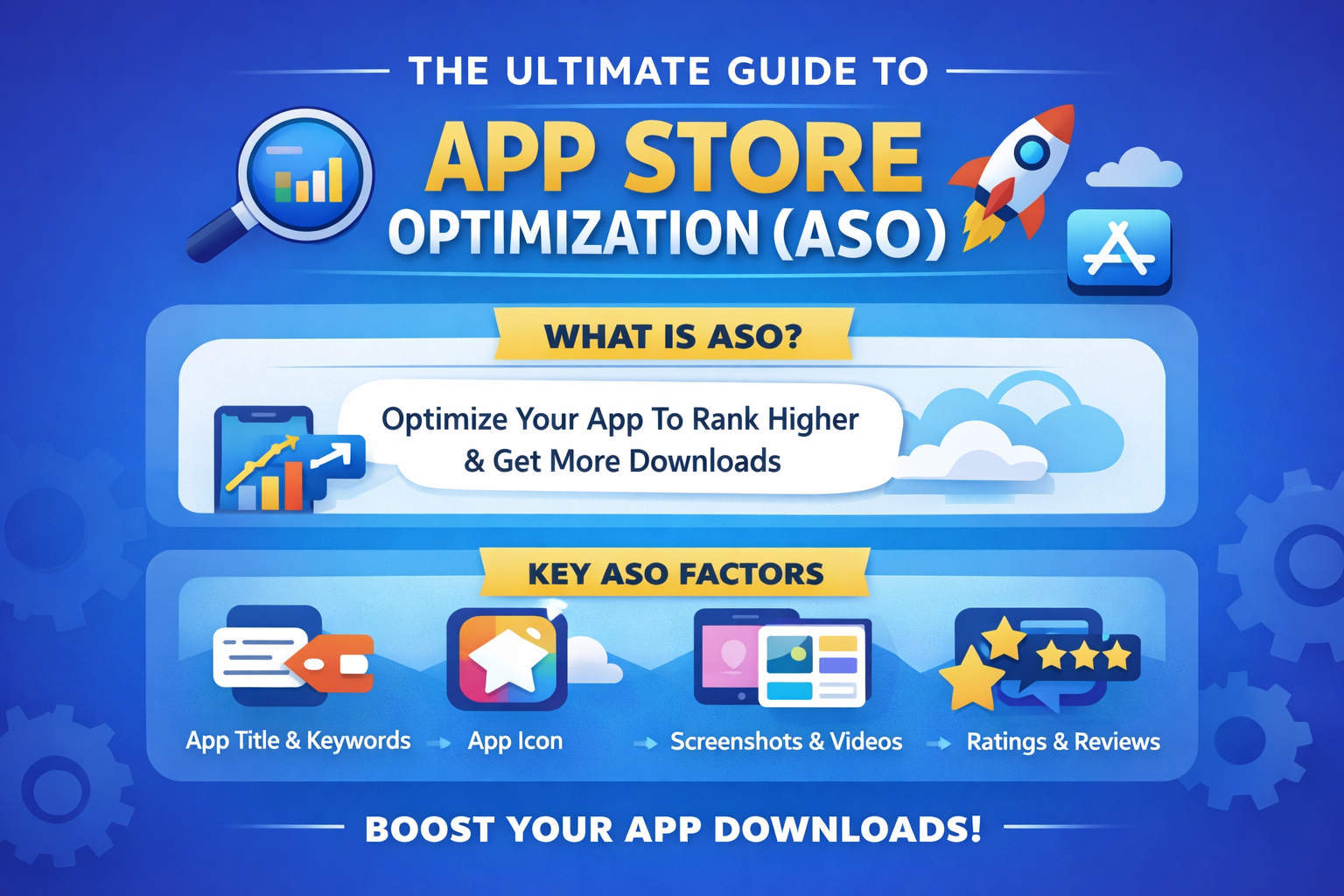
How to Rank Higher in the Apple App Store and Google Play
With millions of apps available in mobile marketplaces, standing out has become one of the biggest challenges for developers and companies. Creating a great app is only the first step—ensuring users can find it is equally important.
This is where App Store Optimization (ASO) becomes critical.
ASO is the process of optimizing your mobile app listing to improve visibility, rankings, and downloads in app store search results. Just like traditional SEO helps websites rank on search engines, ASO helps apps rank in the Apple App Store and Google Play Store.
In this complete guide, we’ll cover everything you need to know about App Store Optimization, including:
What ASO is and why it matters
How app store algorithms rank apps
Key ranking factors that affect visibility
Keyword research strategies for ASO
Conversion optimization techniques
Advanced strategies used by top apps
By the end of this guide, you’ll understand how to build a complete ASO strategy that drives consistent organic downloads.
What Is App Store Optimization (ASO)?
App Store Optimization is the process of improving an app’s listing so it ranks higher in app store search results and generates more organic installs.
ASO focuses on optimizing key elements such as:
The goal is simple: increase visibility and convert more users into downloads.
Most users discover apps through search. In fact, studies show that roughly 70% of mobile users use search to find new apps, making search optimization one of the most important growth strategies for mobile products.
Without ASO, even high-quality apps can struggle to gain visibility.
Why App Store Optimization Is Important
ASO is one of the most cost-effective ways to grow a mobile app.
Here are the key reasons developers invest in ASO.
1. Increased Organic Downloads
Higher rankings in search results expose your app to more users.
More visibility means more installs without spending money on ads.
2. Lower Customer Acquisition Costs
Paid user acquisition can be expensive. ASO allows you to attract users organically.
3. Higher Conversion Rates
Optimized listings encourage more users to download your app.
4. Sustainable Growth
Unlike advertising campaigns, ASO improvements can continue delivering traffic long-term.
Apps that implement strong ASO strategies often see major improvements in download growth and visibility.
How App Store Algorithms Work
Both the Apple App Store and Google Play use algorithms to determine how apps rank in search results.
These algorithms evaluate a wide range of signals to determine relevance and quality.
These signals fall into two main categories.
Metadata Ranking Factors
Metadata includes information developers provide when publishing their app.
These elements directly influence search relevance.
Examples include:
Optimizing these elements helps the algorithm understand what your app is about.
Performance Ranking Factors
Performance factors measure how users interact with your app.
These signals help determine whether users actually like the app.
Examples include:
Number of downloads
Download velocity
Ratings and reviews
Engagement metrics
Retention rates
Uninstall rates
Apps that demonstrate strong user engagement tend to rank higher in search results.
Apple App Store vs Google Play Optimization
Although ASO principles apply to both platforms, their ranking systems are different.
Apple App Store ASO
Apple focuses heavily on metadata fields.
Important ranking elements include:
Apple also weighs download velocity and ratings heavily.
Google Play ASO
Google Play uses a ranking system closer to traditional SEO.
Key factors include:
App title
Short description
Long description
Keyword relevance
Engagement signals
Backlinks and web presence
Because Google indexes description text, keyword optimization plays a larger role.
The Most Important ASO Ranking Factors
To succeed with ASO, you need to understand which elements carry the most weight.
Below are the most influential ranking signals.
1. App Title Optimization
The app title is one of the strongest ranking signals.
Including relevant keywords in the title can significantly improve search rankings.
Best practices:
Include your primary keyword
Keep the brand name clear
Avoid keyword stuffing
Stay within character limits
Example:
Bad:
Photo Editor
Better:
PhotoFix – AI Photo Editor
2. Subtitle or Short Description
This field helps explain what your app does in a short phrase.
Apple allows around 30 characters, while Google Play allows about 80 characters.
Best practices:
Highlight the core benefit
Include secondary keywords
Keep messaging clear
Example:
AI Photo Editor – Background Remover
3. Keyword Optimization
Keywords help app stores determine when your app should appear in search results.
Effective keyword strategies focus on:
Search volume
Competition level
Relevance to your app
Apple includes a hidden keyword field, while Google Play relies more on description text.
4. App Description Optimization
The app description helps both search algorithms and users understand your app.
For Google Play, the description is particularly important for keyword ranking.
A strong description should:
Explain the value of the app
Highlight key features
Include keywords naturally
Use formatting for readability
5. App Icon Optimization
Your app icon is often the first visual element users notice.
A strong icon can dramatically improve click-through rates.
Effective icons are:
Simple
Recognizable
Visually distinct
Many successful apps invest heavily in icon design and testing.
6. Screenshots and App Preview Videos
Screenshots showcase the app experience and help users understand its value.
Best practices include:
Highlight key features
Use captions to explain benefits
Place the most important screenshots first
Preview videos can also increase conversion rates by demonstrating how the app works.
7. Ratings and Reviews
Ratings and reviews influence both rankings and user trust.
Apps with higher ratings typically receive more downloads.
Encouraging satisfied users to leave reviews is an important part of ASO.
8. Download Velocity
Download velocity measures how quickly an app gains installs.
Apps that experience rapid growth often climb rankings quickly.
Marketing campaigns, influencer promotions, and launch strategies can help boost downloads.
Step-by-Step ASO Strategy
Implementing ASO requires a systematic approach.
Here’s a proven framework.
Step 1: Conduct Keyword Research
Start by identifying keywords users search for.
Common research methods include:
Focus on keywords with strong search demand and manageable competition.
Step 2: Optimize Your Metadata
Update key listing elements including:
Title
Subtitle
Description
Ensure your primary keywords appear in the most influential fields.
Step 3: Improve Visual Assets
Visual assets play a major role in conversion rates.
Focus on improving:
Clear visuals help users quickly understand the value of your app.
Step 4: Encourage Ratings and Reviews
Positive reviews increase credibility and rankings.
Best practices include:
Asking users after successful actions
Responding to negative reviews
Addressing user feedback through updates
Step 5: Monitor and Optimize
ASO is not a one-time task.
Successful apps continuously track:
Adjust your listing regularly based on performance data.
Advanced App Store Optimization Strategies
Once the basics are in place, advanced techniques can further improve results.
Localization
Translating your app listing into multiple languages can dramatically increase downloads.
Localization allows apps to reach users in different markets.
A/B Testing
Testing different variations of your listing can reveal what performs best.
Elements to test include:
Icons
Screenshots
Descriptions
Seasonal Updates
Updating screenshots and promotional text during holidays or events can increase relevance.
Examples include:
Holiday-themed graphics
Event promotions
Feature announcements
Competitor Analysis
Studying successful competitors can reveal valuable insights.
Analyze:
Keywords they rank for
Messaging strategies
Visual design choices
Use these insights to improve your own listing.
Common ASO Mistakes to Avoid
Many apps fail to reach their potential due to common mistakes.
These include:
Keyword stuffing
Ignoring visual optimization
Failing to update the app
Neglecting user reviews
Not tracking performance
Avoiding these mistakes can significantly improve your ASO performance.
The Future of App Store Optimization
ASO continues to evolve as mobile ecosystems grow.
Key trends shaping the future include:
AI-driven keyword analysis
Personalized search results
Greater focus on engagement metrics
Increased competition in major categories
Apps that combine excellent user experience with strong ASO strategies will continue to dominate search rankings.
Final Thoughts
App Store Optimization is one of the most powerful strategies for growing a mobile app organically.
By optimizing your:
You can dramatically increase your app’s visibility and downloads.
The most successful apps treat ASO as an ongoing optimization process rather than a one-time task.
When implemented correctly, ASO becomes a long-term growth engine that continuously brings new users to your app.