80 and 250 Character Prompts: AI App Descriptions for App Marketers

80 and 250 Character Prompts: AI App Descriptions for App Marketers
AI app descriptions are listing texts: your title, subtitle, short description, and long description, drafted or refined with an AI model and then tightened by a human editor for accuracy and store compliance. Your first move is simple: generate a short promo line under 80 characters and a 250-character visible snippet, then review both for policy risk before you publish. We built our workflow around exactly that sequence, and AI recommendations are designed to support it at every stage.
TL;DR:
- Prioritize editing the first 250 characters of your app description, as they significantly influence ranking and user decisions on both Apple and Google Play.
- Use a structured workflow that involves AI to generate multiple variants, followed by human review for accuracy, policy compliance, and localization.
- Test description changes with staged experiments to measure their impact on install rates, search rank, and retention, while accounting for external factors.
- Avoid ranking claims, promotional pricing, and unverifiable assertions in your metadata to prevent rejection during review processes.
- Leverage AI for scaling initial drafts but ensure experienced editors refine descriptions to maintain accuracy and brand voice.
Table of Contents
- What app stores actually index and show searchers
- A repeatable AI to human workflow for ASO-safe descriptions
- Prompts and templates for short text, snippets, and long descriptions
- How to test and measure whether new descriptions actually work
- Policy pitfalls AI tends to create, and a pre-submit checklist
- When AI should write and when a human has to lead
- Try Apptenium for AI-assisted ASO
- FAQ
- Sources
What app stores actually index and show searchers
Before you write a word, you need to know which fields matter where. Apple and Google treat your metadata differently, and conversion often comes down to the first few lines a searcher actually sees.
- Apple allows up to 4,000 characters in the description field, but subtitle and promotional text are capped much tighter and appear directly under your app name in search results.
- Google Play separates a short description (shown in search and at the top of your listing) from a longer description, and its store listing policy requires both to stay accurate and free of keyword stuffing.
- Search relevance on both platforms draws heavily on your title, subtitle or short description, and keyword fields, so the words in those first lines carry double duty: they rank you and they sell you.
The practical takeaway is that your top 250 characters do more work than the rest of your listing combined. That is where AI drafting and human editing should spend the most time, not the paragraphs further down the page.
A repeatable AI to human workflow for ASO-safe descriptions
Treat description writing as a pipeline, not a one-off task. Here is the sequence we recommend for teams shipping updates regularly.
- Seed the brief. Gather your positioning statement, top 5 to 8 target keywords, and any confirmed features or claims you can legally back up.
- Generate three AI variants. Ask for a conversion-led version, a feature-led version, and a benefit-led version so you have real stylistic range to compare.
- Human edit for accuracy and policy. A reviewer checks every factual claim, removes anything that sounds like a ranking or pricing promise, and confirms tone matches your brand voice.
- Localize. Adapt the approved version for each target market rather than running a flat machine translation, since idiom and local search behavior both shift results.
- Deploy and experiment. Publish through a controlled test rather than a blanket rollout so you can isolate the impact of the copy change.
Assign clear roles at each stage: a marketer owns the brief and keyword list, a developer confirms technical claims are current, and a reviewer signs off on policy compliance before anything goes live. Before submission, run three checks every time: does the visible snippet read well on its own, is every claim verifiable, and does the copy pass basic profanity and accessibility screening.
This is where measurement tools earn their keep. ASO scanning flags risky phrasing and missed keyword opportunities in a draft, and with integrations to Firebase and Google Analytics, you can trace a description change through to installs and retention without stitching together separate reports.
Pro Tip: Keep a shared log of every AI-generated variant you reject and why. It trains your prompts and your reviewers at the same time.

Prompts and templates for short text, snippets, and long descriptions
Good prompts save you editing time later. Here are three patterns for your 80-character short promo text.
- Conversion-led: “Write a 75-character app promo line for [app name], a [category] app, focused on driving installs. Avoid superlatives, pricing, or ranking claims.”
- Feature-led: “Write an 80-character line naming the single most distinctive feature of [app name] in plain language.”
- Benefit-led: “Write a 70-character line describing the outcome a user gets from [app name], not the mechanism behind it.”
For the 250-character visible snippet, a workable prompt reads: “Write a 240-character app store description opening for [app name] that states the core benefit in the first sentence, includes [primary keyword] naturally, and avoids any claim we cannot verify.” A reasonable output might read: “Track your workouts, meals, and sleep in one place. [App name] turns daily habits into clear weekly trends, so you always know what is working.” Try a second variant that leads with the keyword instead of the benefit, then compare both in testing.
Research shows that description length, title length, and screenshot count are important metadata features that correlate with app success in large-sample studies of store listings. App publication strategy research
For the long description, structure matters more than word count: a one-sentence lead with your core value proposition, a short bullet list of features, any technical notes (device compatibility, permissions), and a brief “what’s new” line for your current version. When you localize, do not just translate the long description, adjust tone and idiom for each market, since a direct phrase can read as stiff or even confusing outside its original language.
How to test and measure whether new descriptions actually work
Your primary KPI is listing conversion rate, installs divided by listing page visits. Secondary signals worth tracking include organic search rank for your target keywords and 7-day retention, since a description that overpromises can lift installs while quietly hurting retention.
- Apple’s custom product page experiments and Google Play’s staged listing experiments both let you split traffic and compare variants directly, rather than guessing from before-and-after data.
- Run each test long enough to collect a meaningful sample before drawing conclusions. A one or two day spike rarely survives a full week of traffic variation.
- Rule out confounders first: a paid campaign launch, a seasonal spike, or a competitor’s price change can all move your numbers independently of your new copy.
- Connecting your store console to Firebase or Google Analytics lets you follow a listing change through to downstream behavior, not just the install event itself.
Analytics integrations exist for this exact gap: tying a description change to the metrics that actually matter beyond the initial tap.
Policy pitfalls AI tends to create, and a pre-submit checklist
AI models are prone to a few specific mistakes worth watching for every time. Ranking claims like “#1 app” or “best in category” are flagged by Google Play’s policy on store listing content, and pricing or discount language in metadata risks the same rejection. Rephrase “best fitness tracker” as “a fitness tracker built for daily consistency,” and drop any promotional pricing text entirely.
- Verify every factual claim an AI draft makes, since models can generate confident-sounding details that are simply wrong.
- Check for unattributed quotes or testimonials, which stores treat as unverifiable social proof.
- Scan for keyword stuffing, repeated phrases that read naturally nowhere but a keyword list.
- Confirm screenshots and video match the current build, since Google Play guidance on store assets requires visuals to reflect real app behavior.
When AI should write and when a human has to lead
AI earns its place when you need scale: a dozen keyword-led variants to test, or a first-pass localization draft for a market you have not entered before. It has no place deciding what your app can legitimately claim, how your brand sounds, or whether a feature description is still accurate after your last release. Those calls need a person who knows the product.
The teams that get this right treat AI drafts as raw material, never as finished copy. Our ASO scanning and analytics connections speed up that review cycle by flagging risky language and tracking the results once a variant goes live, but the judgment call still sits with a human editor. Build that checkpoint into your process once, and scaling AI-assisted copy stops being a risk and starts being routine.
— Mike
Try Apptenium for AI-assisted ASO
The platform pairs ASO scanning with AI-powered listing recommendations, competitor intelligence, and keyword tracking, plus integrations with Firebase and Google Analytics so you can measure what your new descriptions actually do. 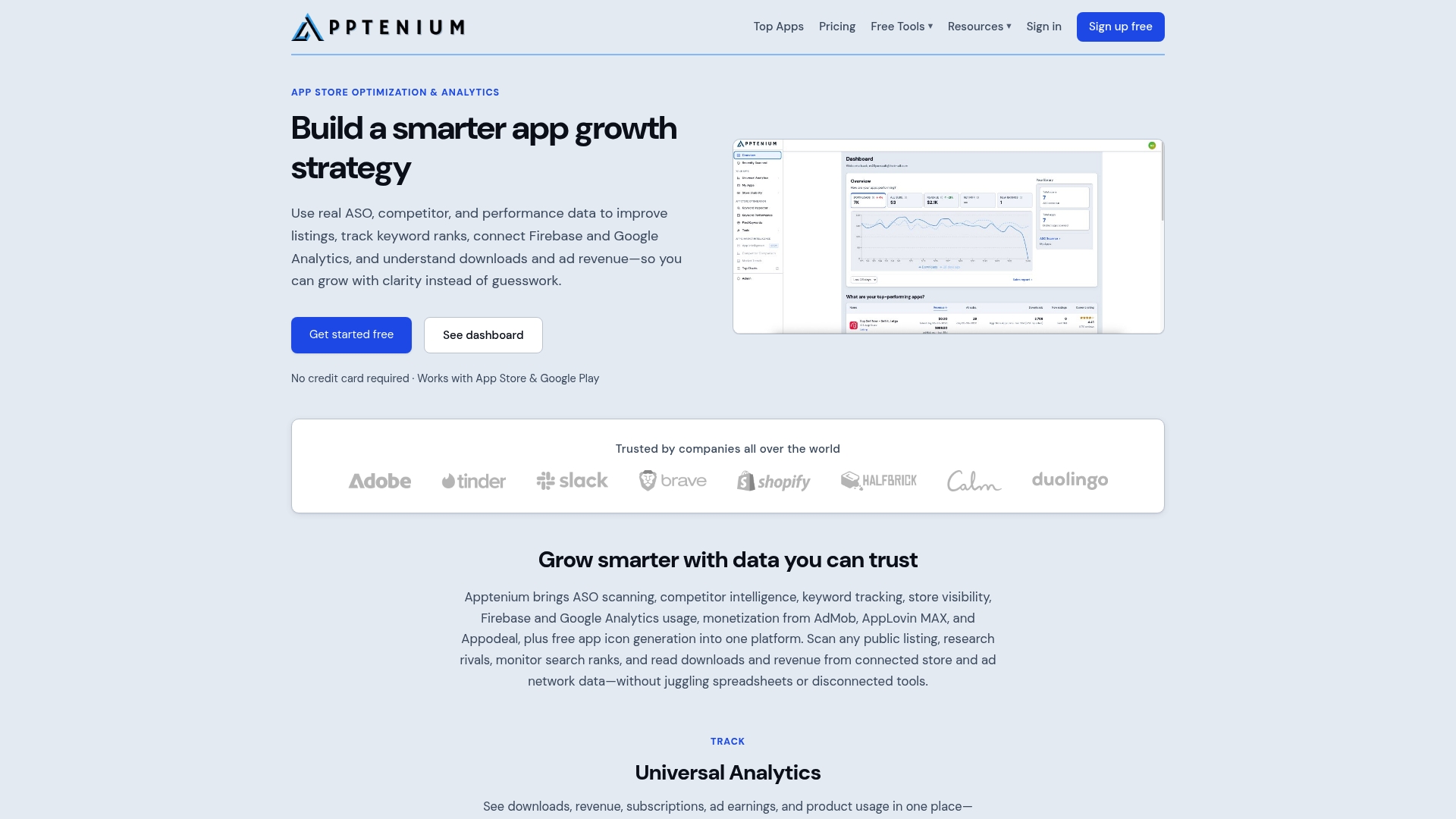
Start with our Free plan or move to Pro at $9.99 per month for unlimited scans, both available on our pricing page.

FAQ
What makes an app description “AI-optimized” versus just AI-written?
An AI-optimized description is drafted with ASO inputs, target keywords, character limits, and store policy rules, built into the prompt from the start, then edited by a human for accuracy. A plain AI-written description skips that structure and often needs far more rework to pass store review.
How long should an app’s short description be?
Google Play’s short description and Apple’s promotional text both have strict character caps, and the practical target is a line that reads clearly within about 80 characters. The store listing policy also requires that short text stay factual and free of keyword stuffing.
Can I use AI to translate my app description for other markets?
Yes, and Google Play Console now offers automatic translation features including AI-generated suggestions, but a human reviewer should still check tone and idiom before publishing. A direct translation can read as stiff or miss local search behavior entirely.
Does changing my app description actually affect installs?
Research on app metadata shows that description quality and length correlate with app ratings and discoverability, though no single change guarantees a lift. The safest way to confirm impact is a controlled experiment comparing your new description against the original rather than relying on before-and-after totals.
What phrases will get my app description rejected?
Ranking claims like “#1” or “best app,” pricing and discount language, and unverifiable feature promises are the most common rejection triggers under store metadata policy. Rephrasing claims in plain, factual language and removing promotional pricing text resolves most of these issues before submission.
Sources
Before you finalize any listing, confirm your copy against current developer documentation and the research behind description impact.