Branded vs Generic Keywords: A Marketer's Playbook

Prioritize balanced visibility: defend your branded keywords while scaling your generic keyword investment for acquisition. That’s the one-sentence verdict, and everything below explains how to execute it.
Your three-line action checklist:
Defend now: audit brand leakage (competitors bidding on your name) and check canonicalization on branded landing pages.
Invest short-term: identify three to five generic, high-intent queries your competitors rank for but you don’t.
Measure weekly: track branded CTR against AI Overview citation share, not just raw impressions.
The sections ahead cover conversion benchmarks, channel-specific tactics for SEO, PPC, and ASO, and the 2026 shift toward AI Overviews reshaping how much you actually need to spend defending your own name.
Key Takeaways
Balanced visibility works because branded keywords defend conversions you’ve already earned while generic keywords build the acquisition pipeline that produces tomorrow’s branded searches.
PointDetailsSegment your keyword listSplit branded, brand-plus-modifier, and generic terms into separate campaigns before setting any budget.Defend branded terms selectivelyUse value-based bidding and pause “lone ranger” brand bids once organic or AI Overview citation is strong.Benchmark conversion realisticallyBranded queries often convert two to five times higher than generics, but compare against your own account history first.Fix canonicalization issuesConsolidate duplicate branded pages with canonical tags and redirects to protect crawl budget and indexing speed.Use Apptenium for cross-channel trackingApptenium’s keyword tracking and competitor intelligence unify branded and generic monitoring for ASO and app growth teams.
Table of Contents
Why the Branded vs Non-Branded Split Shapes Your Whole Funnel
How to Structure Campaigns and Budgets for Both Keyword Types
How AI Overviews Are Changing the Branded vs Generic Calculus
A Practitioner’s View on Running Balanced Branded and Generic Programs
How Apptenium Supports Balanced Branded and Generic Visibility
Branded vs Generic Keywords: What Each Term Actually Means
Branded keywords contain your company or product name, either alone or paired with a modifier. Generic keywords describe a category, problem, or need without naming any brand. That distinction sounds simple until you start segmenting a real keyword list, where five sub-types show up repeatedly:
Pure brand: the company or app name by itself (“brand name”).
Brand plus modifier: name combined with intent words like “brand pricing,” “brand login,” or “brand reviews.”
Brand plus product: name paired with a specific SKU or feature line, such as “brand premium plan.”
Generic (non-branded): category terms like “project management software” or “budget tracking app,” with no company name attached.
Long-tail conversational generics: fuller phrases like “best app for tracking freelance expenses,” increasingly common as searchers phrase queries the way they’d talk to an AI assistant.
Beyond the core five, track variants that blur the line: misspellings (“brnd name”), product-line terms that carry brand equity without the parent name, and competitor-alternative queries (“brand X alternative”). On social platforms, distinguish tagged mentions from untagged references. Sprout Social’s research on branded keywords points out that a meaningful share of brand conversations never use an @ mention or hashtag at all, which means keyword tracking has to pick up what tagging misses.
Why the Branded vs Non-Branded Split Shapes Your Whole Funnel
Branded and generic keywords map to different points in the buyer journey, and treating them the same wastes budget in both directions. Branded searches are navigational or transactional. Someone typing your app name already knows you exist and is often one click from converting or churning. Generic searches are informational or commercial investigation. The searcher is still comparing options, which means your job is persuasion, not just retrieval.
That intent gap shows up directly in performance data. Branded queries typically convert two to five times higher than non-branded queries and usually carry lower cost-per-click, since Quality Score rewards the tight relevance between a branded search and a branded landing page. Generic terms cost more to acquire but build the pipeline that eventually produces new branded searches.
The operational stakes extend past the ad account:
Reputation control: if you don’t own your branded results, competitors, review aggregators, or complaint threads can occupy that real estate instead.
Acquisition pipeline: generic terms are almost always the entry point for people who’ve never heard of you.
CRO opportunities: branded traffic converts at a rate that makes even small landing-page improvements worth testing first.
ASO metadata considerations: app store character limits force a trade-off between reserving space for your name and reserving space for category terms that drive discovery.
What CTR, Conversion, and CPC Benchmarks Actually Look Like
Numbers help, but only if you know which comparisons are fair. Branded search typically produces higher click-through rates because the searcher already has intent to find you specifically. Generic search produces lower CTR per query but far higher total volume, since dozens of competitors are splitting that traffic.
On conversion, branded keywords convert two to five times higher than non-branded equivalents in typical benchmarks, though the exact multiple depends heavily on your category and funnel length. Treat that range as a directional signal, not a target to hit in month one.
CPC tells a similar story from the other direction. Branded terms usually cost less per click because Quality Score rewards the obvious relevance between query and landing page, and because fewer advertisers bid aggressively on someone else’s trademark. Generic CPCs climb with competition and often spike further during seasonal demand windows.
A few things distort these comparisons if you’re not careful:
Attribution window length changes apparent conversion rates. Branded terms look stronger in short windows because they sit late in the funnel.
Funnel stage matters more than channel. A generic query that starts a 45-day B2B evaluation will never match branded CTR in the same week.
Seasonality and campaign maturity both shift CPC independent of keyword type.
Pro Tip: Compare branded and generic performance against your own account’s history first, not industry averages. A 3% branded conversion rate might be excellent for a low-consideration app and mediocre for a high-ticket B2B tool, so your baseline matters more than the benchmark.
When Should You Prioritize Branded Keywords?
Branded terms deserve priority in four recurring situations: active reputation threats, competitor bidding on your name, product launches where you need guaranteed top placement, and any point where customer retention depends on people finding your login or support page instantly.
Run through this checklist before deciding your branded terms are “handled”:
Monitor brand leakage. Search your own name monthly and note which competitors show up in paid slots above your organic listing.
Set branded PPC defenses. Even a modest budget on your own name can recover leaked clicks. Proactive branded campaigns in B2B SaaS have recovered a notable portion of leaked brand clicks at a low average CPC when timed against competitor activity.
Fix canonicalization on branded pages. Duplicate brand-targeting pages fragment authority and confuse crawlers, which slows indexing for the page you actually want ranked.
Channel-wise, PPC carries most of the defensive weight for branded terms, SEO handles canonical structure and page authority, and ASO matters mainly if you don’t already own the top branded slot in your app store category.
When Should You Prioritize Generic Keywords?
Generic terms earn priority when you’re in growth mode: early-stage acquisition, entering a new market segment, building topical authority, or generating demand that doesn’t yet exist as branded search volume. If nobody’s searching your name yet, generic keywords are the only door available.
The tactics differ from branded defense. Instead of protecting one query, you’re building a body of content and metadata around a topic cluster:
Target long-tail conversational queries that mirror how people phrase problems, not just product categories.
Build topic clusters with a pillar page and supporting articles rather than isolated posts competing with each other.
For ASO, optimize category-level keyword fields so app store algorithms can surface you against generic searches, not just your own name.
Pro Tip: Balance short-tail generics (higher volume, higher competition) against long-tail generics (lower volume, higher conversion intent, and better suited to how AI assistants parse natural-language queries). A content plan weighted too heavily toward short-tail terms burns budget competing for keywords you’re unlikely to rank for anyway.
How to Structure Campaigns and Budgets for Both Keyword Types
Separate branded and generic campaigns from day one. Mixing them in a single campaign muddies your bid strategy and makes it nearly impossible to read performance cleanly, since branded terms will always outperform on the surface metrics and mask how generics are actually doing.
A workable account structure looks like this:
Branded campaign: pure brand, brand plus modifier, and misspelling variants, each in their own ad group.
Generic campaigns: segmented by intent (informational vs. commercial investigation vs. transactional), not just by topic.
Competitor-term campaign (where legally sound): isolated separately so you can control messaging and budget independent of your own brand defense.
ASO tracking, kept parallel: store metadata and keyword rankings monitored alongside paid and organic search, since app store algorithms weigh keyword fields differently than web search engines.
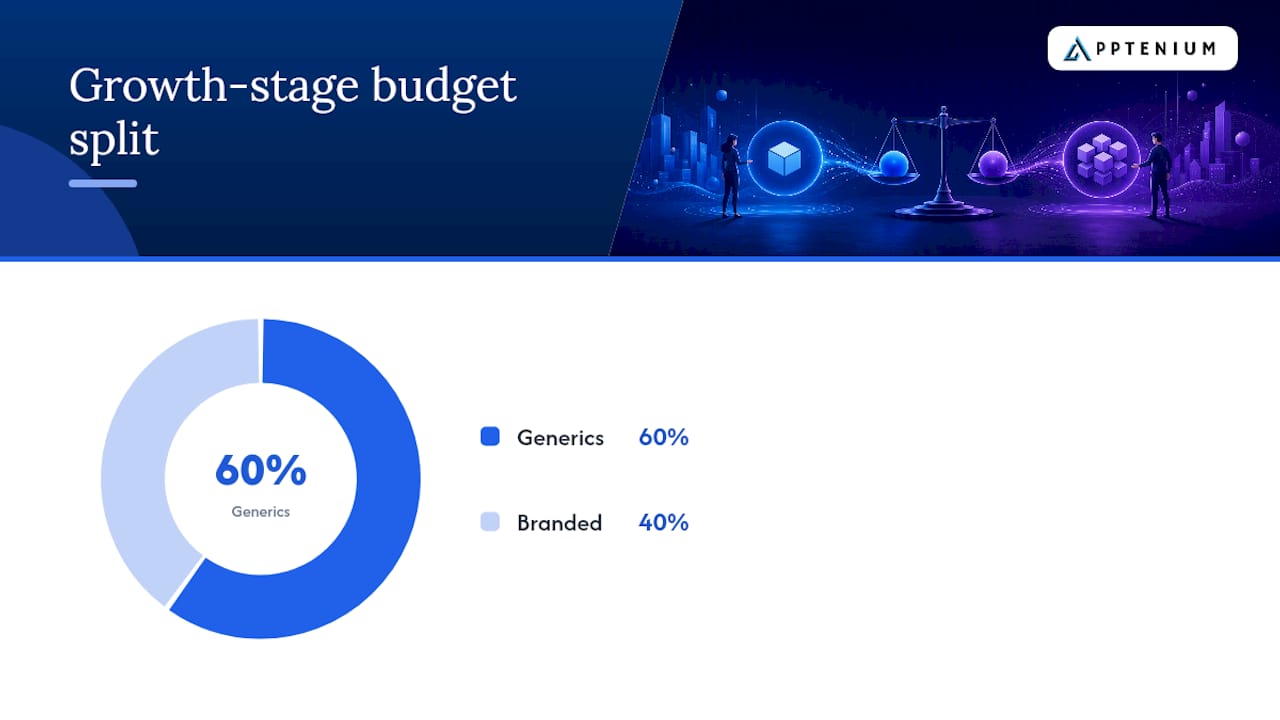
Budget splits shift by growth stage. A growth-stage company typically settles closer to 60/40 in favor of generics as brand search volume climbs. A mature brand with strong organic branded rankings can often flip that ratio, spending more on generic acquisition since branded defense costs less to maintain.
Bidding strategy needs its own logic. Value-based bidding works well for branded defense because it lets you bid higher only on the branded searches most likely to convert into revenue, not just clicks. Search intelligence and predictive signals can also tell you when to pause “lone ranger” brand bids, meaning branded ad spend that’s no longer needed because you already dominate the organic and AI-cited results for that query.
Pro Tip: Set an automated rule that flags branded CTR drops below a defined threshold. A sudden dip usually signals new competitor bidding or a change in how AI Overviews are citing your listing, both of which justify reactivating brand bids you’d previously paused.
Channel-by-Channel Tactics for SEO, Content, PPC, and ASO
Each channel needs a different playbook depending on keyword type, and conflating them is where most teams lose efficiency.
SEO: Branded pages need airtight canonicalization. When multiple pages target the same branded term, cannibalization drains crawl budget and slows indexing for the page you actually want ranked. Consolidate with canonical tags and 301 redirects rather than letting duplicate pages compete against each other.
Content: Generic queries call for how-to and comparison content mapped to a pillar-cluster structure, with internal links routing authority from supporting posts back to the pillar. Branded queries call for direct product and account pages, not blog content trying to rank for your own name.
Map each generic keyword cluster to one pillar page with three to six supporting articles.
Reserve branded landing pages for transactional intent: pricing, login, demo requests.
Cross-link sparingly between the two so search engines don’t confuse intent signals.
PPC: Branded ad copy should lean on sitelinks and asset extensions that reinforce trust and route users to specific destinations (support, pricing, app store link). Generic campaigns benefit more from responsive search ads and audience layering, since you’re persuading rather than confirming.
ASO: Metadata space is finite, and brand terms in app store keyword fields carry high difficulty because the brand owner almost always ranks first anyway. Unless you’re the brand owner, that space is usually better spent on generic category terms competitors haven’t saturated.
What KPIs and Attribution Windows Actually Tell You
Branded and generic keywords need different KPI sets, and applying one scorecard to both produces misleading conclusions. For branded terms, track impressions, CTR, and direct conversion rate, since the goal is capturing demand that already exists. For generic terms, track assisted conversions and LTV-adjusted customer acquisition cost, since the goal is building demand that converts later, often through a different channel entirely.
Attribution is where most measurement breaks down. Last-click models systematically overcredit branded terms because they sit at the end of the funnel, while generic terms that started the journey get none of the credit. That’s not a data problem, it’s a model problem. Assisted-conversion reporting and incrementality testing correct for it by showing what happens to conversions when you pause a generic campaign entirely.
A practical measurement checklist:
Build an event-level tracking setup that captures branded and generic sessions separately, not lumped into one “search” bucket.
Standardize a UTM taxonomy so campaign, keyword type, and intent stage are all identifiable in reporting.
Run cohort analysis comparing users who first touched via branded vs. generic search, tracking retention and LTV separately.
Test incrementality on at least one generic campaign per quarter by pausing it briefly and measuring the conversion drop across all channels, not just search.
Common Variants and Blind Spots to Track
A keyword list that only covers the obvious branded and generic terms misses where real leakage happens. Track brand variants systematically: common misspellings, product-line names that carry equity without the parent brand attached, and regional spelling differences if you operate across markets.
On the generic side, prioritize brand-generic compound queries, especially “[category] alternative” and “[competitor] vs [category]” searches, since these capture users actively comparing options right now.
Set up alerts for untagged social mentions, since a meaningful share of brand references never use an @ mention, meaning keyword-based monitoring catches conversations that mention-based tracking misses entirely.
Review competitor-alternative queries quarterly, since new entrants change this list faster than most teams expect.
Audit misspelling variants after any major rebrand or name change, when search behavior lags the new spelling for months.
How AI Overviews Are Changing the Branded vs Generic Calculus
The 2026 shift isn’t about choosing branded or generic anymore. It’s about calibrating how much paid defense your branded terms actually need once AI Overviews start summarizing results directly on the search page.
If your brand is well cited within an AI Overview, you may not need to bid on your own name at all. If you’re absent from that citation, paid defense becomes more urgent, not less, because AI Overview presence can reduce organic brand CTR by roughly 12 to 15% when there’s no supporting paid ad to reclaim the click.
That single data point should reshape how you budget branded PPC. Instead of running brand ads as a permanent fixture, treat them as conditional: active when AI Overview citation is weak or absent, paused when you’re clearly the cited source. Value-based bidding and predictive search intelligence both support this kind of conditional defense better than static always-on campaigns.
Pro Tip: Build a simple AIO Impact Index for your top ten branded queries, tracking whether you’re cited, how often, and how CTR moves in response. Reallocate any “lone ranger” brand spend, the budget defending queries you already dominate, into generic campaigns instead.
A Practitioner’s View on Running Balanced Branded and Generic Programs
Most keyword strategy debates I see treat branded and generic as competing priorities fighting for the same budget line. In practice, the more useful mental model is running them as two separate programs with two separate success metrics, checked against each other monthly rather than merged into one dashboard that averages out the differences.
A repeatable version of this looks something like: in the first 30 days, audit brand leakage and fix any obvious canonicalization issues. In the next 90, build out generic topic clusters and start testing incrementality on at least one campaign. By 180 days, you should have enough data to know whether your branded PPC spend is defensive necessity or “lone ranger” waste that belongs in the generic budget instead.
What surprises people most is how often the branded side turns out to need less active spend than assumed, once organic and AI-cited visibility are strong. The generic side almost never gets that luxury. It has to keep earning its placement every quarter.
How Apptenium Supports Balanced Branded and Generic Visibility
Running a balanced branded and generic program by hand means juggling keyword rank checks, competitor alerts, and AI citation monitoring across separate tools, which is exactly the fragmentation that eats a marketing team’s week. Apptenium consolidates that work into one dashboard, so you can track branded keyword rankings and generic category opportunities side by side instead of stitching together exports from three platforms.
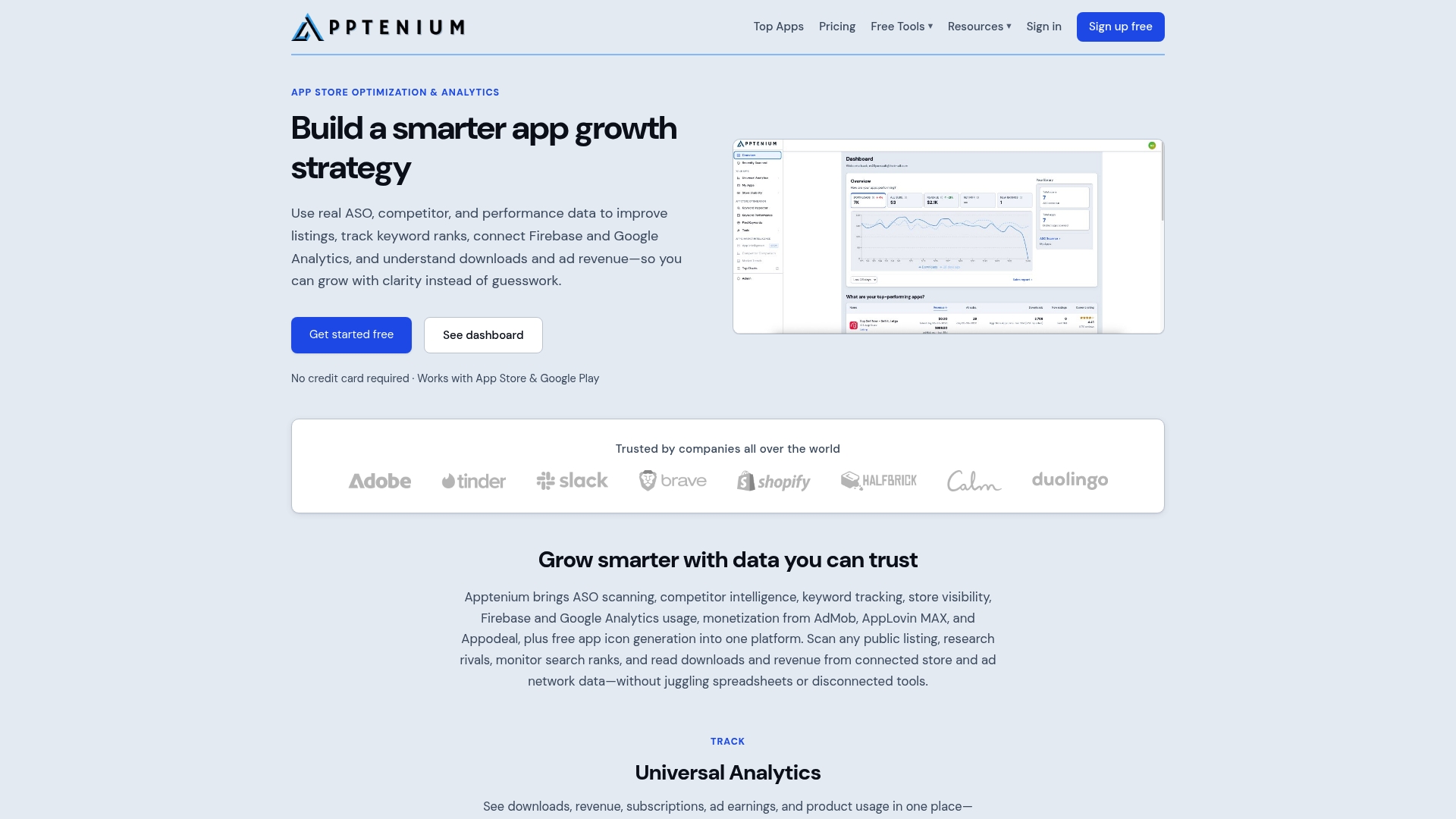
The platform’s keyword tracking flags branded search volume shifts and competitor bidding activity, while its competitor intelligence surfaces the generic category terms rivals are winning that you’re not yet targeting. Its AI-powered recommendations help prioritize which metadata changes matter most when you’re deciding how much character space to reserve for brand terms versus category keywords, the exact trade-off covered in the ASO tactics above.
A fast starting point: run your current app title and subtitle through the free Word Frequency tool to see whether you’re overloading branded terms at the expense of discoverable generic keywords, or the reverse. From there, the ASO platform built for SMBs and startups gives you ongoing tracking so this becomes a monthly check instead of a one-time audit.
Sources
Branded search and competitive PPC defense (Search Engine Land)
Brand and generic paid search: Best practices for striking a balance (Adthena)
FAQ
What Are Branded vs Non-Branded Keywords?
Branded keywords contain a company or product name, while non-branded (generic) keywords describe a category or need without naming any brand, such as “expense tracking app” versus a specific app’s name.
What Are Generic Keywords?
Generic keywords are category or problem-based search terms with no brand name attached, and they function as the main acquisition channel for reaching people unfamiliar with your product.
Should I Use Branded Keywords or Generic Keywords?
Use both: defend branded keywords because they convert at a notably higher rate, and invest in generic keywords because they’re the primary engine of new customer acquisition rather than choosing one over the other.
What Is the 3-7-27 Rule of Branding?
Definitions of this framework vary across sources, and it isn’t a standard covered by established branded-keyword research, so it’s worth treating any specific version you encounter with caution rather than as settled guidance.
What Are Branded Keywords in ASO?
In app store optimization, branded keywords are app or company name terms in metadata fields; they’re typically high-difficulty and dominated by the brand owner, so tools like Apptenium help teams decide when reserving that space is worth it versus prioritizing generic category terms.