Competitor Creative Analysis for App Ads: From One Ad to a Watchlist

Competitor Creative Analysis for App Ads: From One Ad to a Watchlist
Competitor creative analysis is the routine capture and structured assessment of rivals’ advertising assets so you can turn observed messaging, formats, and hooks into prioritized tests. Done well, it shortens your creative learning curve and cuts wasted spend on ideas the market has already tested. The first move is simple: capture one competitor campaign today, screenshot the ad and its landing page, and log it against a checklist like Forrester’s creative competency domains.
TL;DR:
- Keep a weekly watchlist of six to ten direct, substitute, and aspirational brands, prioritizing recent creative changes, sustained ads, audience overlap, and testability.
- Capture ads from Meta, Google, and TikTok libraries, save screenshots with landing page URLs, and treat snapshots as incomplete because coverage varies by region.
- Score hooks before polish, assess each creative through two to four personas, separate clarity, originality, and memorability, and account for budget and funnel stage.
- Test one creative element at a time, split budget and exposure evenly, and choose a KPI and measurement window suited to the funnel.
Table of Contents
- What Competitor Creative Analysis Covers and Why It Matters
- How to Choose Which Competitors and Campaigns to Monitor
- Where to Find Competitor Creatives Across Platforms
- A Practical Framework for Scoring Competitor Creatives
- Finding Creative Gaps and Turning Them Into Test Ideas
- From Insight to Impact: Testing, Measuring, and Scaling Winners
- How Apptenium Fits an Ongoing Monitoring Workflow
- What Years of Creative Audits Have Taught Me
- Put This Workflow on Autopilot With Apptenium
- FAQ
- Sources
What Competitor Creative Analysis Covers and Why It Matters
A single competitor ad is really a bundle of decisions: imagery or video, headline, offer, call to action, landing path, and tone. Each of those components tells you something about what a rival believes will move their audience, and each is worth recording separately rather than judging the ad as one blurry impression.
The payoff for doing this consistently is threefold. You get a benchmark for what “normal” looks like in your category, you generate test ideas faster because you are reacting to real creative rather than a blank page, and you build an evidence base instead of guessing at what might work.
Raw observation only gets you so far, though. You need to connect what you see to what it likely did in the funnel:
- Top-of-funnel creative tends to lean on click-through rate and view-through metrics, since the job is to earn attention.
- Mid-funnel creative is better judged on engagement signals like saves, shares, and comment sentiment, which hint at message resonance.
- Bottom-funnel creative should be weighed against conversion rate and the quality of the landing page it points to.
Because you rarely have access to a competitor’s actual numbers, pair this metric mapping with qualitative judgment. Forrester’s assessment tool frames creative capability across strategy, organization, technology, production, and optimization, which is a useful reminder that a weak ad might reflect a weak process, not just a weak idea. Running creatives past more than one reviewer, using a shared rubric, helps catch blind spots a single opinion would miss.
How to Choose Which Competitors and Campaigns to Monitor
Not every brand that shows up in your category deserves a spot on your watchlist. Start by sorting rivals into three tiers: direct competitors selling the same solution to the same buyer, substitute competitors solving the same problem a different way, and aspirational brands you admire but do not directly compete with yet.
- Check for recent creative refreshes. A competitor that just changed their hook or visual style is signaling a new hypothesis worth watching.
- Watch ad velocity. A brand running many creative variants at once usually has a testing budget and a process worth studying.
- Read spend signals. Ads that keep running for weeks, rather than disappearing after a few days, are a rough proxy for performance.
- Match audience overlap. Prioritize competitors targeting a buyer who looks like yours over ones chasing a different segment entirely.
- Score for impact and testability. Rank each candidate by how much you could learn from them against how easy that creative is to adapt into your own test.
Keep the list short enough to review weekly. A watchlist of six to ten accounts, revisited on a fixed cadence, beats a sprawling list nobody opens.
Where to Find Competitor Creatives Across Platforms
Most of the creative you need is public if you know where to look. Treat this as a rotation, not a one-time search.
- Meta Ad Library lets you search by advertiser name or keyword and shows active and recently stopped ads, including the creative, copy, and start date, across Facebook and Instagram.
- Google Ads Transparency Center shows advertiser-level ad history for Search, Display, and YouTube, which is useful for spotting seasonal pushes and format shifts.
- TikTok’s Creative Center and YouTube’s ad placements surface short-form video trends, while manually browsing a competitor’s channel catches organic-feeling branded content that never touches a paid library.
- LinkedIn and X require more manual tracking since neither offers a comprehensive public ad archive, so following company pages and checking “promoted” labels is the practical workaround.
- App-store listings (screenshots, preview videos, feature graphics) and press or user-acquisition landing pages round out the picture for app marketers, since store creative often previews a campaign’s core message before it appears in paid placements.
Archive everything you find, since ads disappear without warning. A simple folder structure by competitor and month, paired with a screenshot and the landing page URL, is enough.
Expect gaps: ad libraries sample rather than show everything, refresh on inconsistent schedules, and vary by region. Treat any single snapshot as a data point, not the full picture, and always respect each platform’s terms of use when capturing and storing creative.
Pro Tip: Set a recurring 20-minute block every Monday to refresh your watchlist captures. Consistency beats depth here.
A Practical Framework for Scoring Competitor Creatives
Once you have a batch of creatives captured, you need a way to judge them quickly and the same way every time. A short, priority-ranked checklist works better than a long scorecard because it forces you to answer the question that matters most before getting distracted by polish.
Run each ad through these questions, in order:
- Does it give someone a compelling reason to click? If not, nothing else on the checklist matters much.
- Is the value proposition clear within the first few seconds or the first line?
- Does the call to action align with what the landing page actually delivers?
- Is the creative distinctive enough to stand out in a crowded feed?
- Does it still feel on-brand, or has it stretched the brand’s identity too far for the sake of a hook?
The fail-first rule matters here: an ad that fails the first question rarely deserves a high score, no matter how strong its visuals or branding are. A beautiful ad nobody clicks has no second act.
One documented approach to this problem comes from the motion-creative evaluation framework, which recommends answering ranked questions through multiple personas rather than a single reviewer, since agreement across personas signals a strong creative while disagreement reveals a real trade-off worth noting. Defining two to four personas, say, a price-sensitive buyer and a brand-loyal one, and scoring each creative against what that persona cares about surfaces nuance a single pass would miss.
WPP’s research on creativity evaluation makes a related point: a single aggregate score tends to flatten dimensions like strategic alignment, cultural resonance, and memorability that each deserve their own read. Scoring creative on separate dimensions, rather than one gut-feel number, tells you which lever to pull next, originality, clarity, or memorability, instead of a vague verdict.
Finally, fold in performance context before drawing conclusions. The same motion-creative framework flags budget level, account maturity, and funnel stage as confounders that can make a weak creative look strong or a strong one look weak. A new account with a small budget will naturally show different signals than a mature one spending heavily, so judge creative relative to its own context, not against an unrelated benchmark.
Finding Creative Gaps and Turning Them Into Test Ideas
The real value in watching competitors is not copying them, it is spotting what they are all missing. Build a simple frequency heatmap of the messages, formats, and hooks you have logged across your watchlist. Patterns jump out fast: if every competitor leans on urgency-driven copy, that space is saturated and a calm, benefit-led message might cut through instead.

Negative-space analysis works the same way. Note what competitors never say, a certification they never mention, a use case they never show, and treat that silence as a candidate differentiator. Format gaps matter too: if the entire category runs long-form video but nobody is testing short, punchy cuts, that is worth a trial.
Turn each gap into a hypothesis you can actually test:
- Message swap: “Competitors lead with speed; we will lead with reliability and measure CTR.”
- Format swap: “Competitors run only static images; we will test a 15-second video against our current static control.”
- CTA reframing: “Competitors use ‘Shop Now’; we will test ‘See Pricing’ against our existing CTA.”
Prioritize these by expected reach against how cheap they are to produce. A low-cost CTA test that touches your full audience beats an expensive video shoot aimed at a narrow segment, at least until the cheap test earns its way to a bigger budget.
Pro Tip: Keep a running “gap log” alongside your watchlist so hypotheses accumulate even on weeks you do not have time to launch a test.
From Insight to Impact: Testing, Measuring, and Scaling Winners
Spotting a gap is only useful if you can turn it into a fair test and read the result correctly.
- Control your variables. Change one element at a time, message, format, or CTA, so you know what actually drove the result.
- Give variants equal budget and exposure. An uneven split makes the “winner” meaningless.
- Pick a measurement window that matches your funnel stage. A bottom-funnel CTA test can resolve in days; a brand-awareness format test needs weeks to show real signal.
- Run a simple test waterfall. Validate the concept first, then test creative variants within that concept, then test landing-page pairings for the variant that wins.
- Verify with the right KPI. CTR tells you about the hook, conversion rate tells you about the full path, and view-through tells you about brand lift, so match the KPI to what the test was actually designed to prove.
Watch for false positives caused by account stage or budget shifts rather than the creative itself. The motion-creative framework specifically calls out budget starvation and account maturity as factors that can make a test look conclusive when it is not.
Document the handoff between teams clearly: creative hands off the winning variant with its rationale, media confirms the budget and placement it ran under, and analytics logs the result against the original hypothesis. That record is what makes next quarter’s testing faster than this quarter’s.
How Apptenium Fits an Ongoing Monitoring Workflow
Running this playbook by hand works for a snapshot audit, but an ongoing watchlist needs a system behind it. Apptenium brings ASO scanning, competitor intelligence, and keyword tracking into one view of app store visibility and performance, so creative monitoring does not require stitching together separate tools.
Fragmented analytics is a common friction point for app teams, and Apptenium’s ASO tools address it by centralizing real-time insight rather than spreading it across spreadsheets. AI-powered recommendations flag listing changes likely to improve search ranking and organic installs, while integrations with Firebase, Google Analytics, and ad networks connect creative observations to actual download and revenue data. For teams tracking rivals specifically, competitor intelligence surfaces market and competitor movement that feeds directly into the watchlist process described above.
What Years of Creative Audits Have Taught Me
Three rules hold up every time I run this process: judge the hook before the polish, never trust a single creative in isolation, and always check what budget and funnel stage that creative was running under before calling it a winner or a loser. Pilot this workflow on a small watchlist before scaling it across your whole category.
— Mike
Put This Workflow on Autopilot With Apptenium
Everything in this playbook, capturing competitor creative, scoring it against a rubric, spotting gaps, and connecting results to real performance, gets faster when it lives in one place instead of six browser tabs; for best practices on creative testing and cultural-team workflows, see Get Reliable Winners with Creative Ad Testing for Cultural Teams. We built Apptenium so app marketers can run competitor intelligence alongside ASO scanning and keyword tracking, with AI recommendations that turn what you observe into a concrete next step for your own listing.
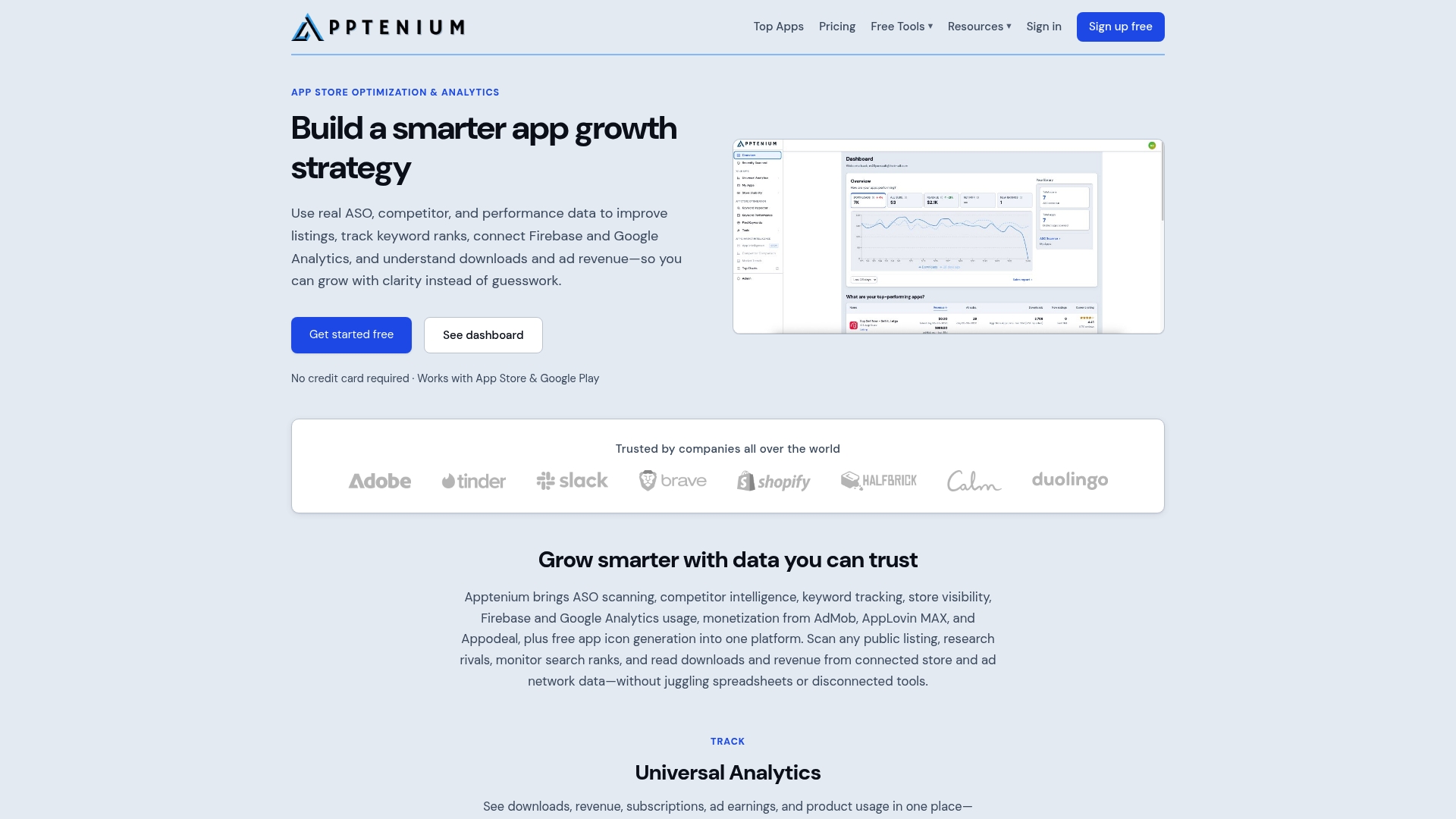
Our Free plan lets you try the core scans at no cost, and our Pro plan at $9.99 per month unlocks unlimited scans and the full competitor monitoring toolkit. Check our pricing page to see which fits your team’s current stage.
FAQ
What Are the Five Steps of a Competitive Analysis?
A practical sequence runs: define your competitor scope, capture their creative and campaign data, evaluate it against a consistent rubric, identify gaps or opportunities, and turn those gaps into tests you actually run. Each step feeds the next, so skipping the evaluation step tends to produce copycat tests rather than genuine opportunities.
What Is an Example of a Competitor Analysis?
A common example is pulling a rival’s active ads from the Meta Ad Library, logging their headline, offer, and CTA against a shared checklist, then comparing that pattern across five or six competitors to spot a message or format everyone is ignoring. The output is usually a short list of testable hypotheses rather than a single verdict.
What Is the Best Tool for Competitor Analysis?
The right tool depends on what you are analyzing: ad libraries like Meta’s and Google’s cover paid creative, while a platform like Apptenium is built specifically for app marketers who need competitor intelligence alongside ASO scanning and keyword tracking in one place. Teams evaluating ad creative capability more broadly can also reference structured frameworks like Forrester’s assessment tool.
How Much Does Competitor Analysis Cost?
Cost ranges from free, using public ad libraries and manual spreadsheets, to paid, using dedicated software or agency services. Apptenium’s Free plan offers limited scans at no cost, while the Pro plan runs $9.99 per month for unlimited scans and full competitor intelligence features.
Sources
- Creativity evaluation pod: Technical walkthrough | WPP Research
- The Ad Creative Competency Assessment Tool | Forrester
- Plugin/skills/creative-strategist/references/evaluation-framework.md