Stop ASO Keyword Cannibalization: Give Each Portfolio Term One Owner

Stop ASO Keyword Cannibalization: Give Each Portfolio Term One Owner
Yes, overlapping app-store keywords across your own apps cause cannibalization: when two or more apps in a portfolio target the same term in high-weight fields, they split ranking authority and reduce peak visibility for both. The fastest fix is to assign one app as the primary owner of each keyword and demote duplicates to lower-weight fields. Pull impressions and rank data from App Store Connect and Play Console to decide ownership objectively.
TL;DR:
- Titles carry roughly 35% of iOS weight and 40% on Android; subtitles follow at 25% and 20%, respectively, making title collisions the first audit priority.
- Export keyword impressions and ranks for a trailing 30 day window, checking each locale for shared high weight terms and apps outside the top three.
- Give each contested term to the app with the strongest impression score adjusted for rank, and move competitors down one metadata tier at a time.
- Monitor impression and rank changes for two to four weeks after updates, then rerun ownership scoring monthly under one person’s portfolio wide authority.
Table of Contents
- What keyword cannibalization looks like in app stores and how fields are weighted
- How to detect cannibalization using App Store Connect and Play Console
- Deduplication framework: computing ownership with rank-weighted impressions
- Step-by-step portfolio audit workflow and governance cadence
- Automation and tooling: which data to integrate and what automation should do
- Why we treat ASO as metadata architecture, not copywriting
- Apptenium: solving portfolio cannibalization without the spreadsheet work
- FAQ
- Sources
- Authoritative docs and practitioner posts to read next
What keyword cannibalization looks like in app stores and how fields are weighted
Not every field carries equal weight in app store search algorithms, and that matters because cannibalization is really a collision problem between your highest-weighted fields. According to practitioner field-weight analysis, app title or name carries roughly 35% weight on iOS and 40% on Android, making it the field where collisions do the most damage.
- The subtitle or short description follows at roughly 25% (iOS) and 20% (Android).
- Apple’s dedicated keyword field adds around 20% weight on iOS only.
- Long description contributes about 5% on iOS and 15% on Android.
- Developer name and locale metadata each add roughly 5% to 10%.
| Field | iOS weight | Android weight |
|---|---|---|
| Title / app name | ~35% | ~40% |
| Subtitle / short description | ~25% | ~20% |
| Keyword field | ~20% | not applicable |
| Long description | ~5% | ~15% |
| Developer name | ~5% | ~5% |
| Locale metadata | ~10% | ~10% |
Picture three related apps from the same developer, all including “budget tracker” in their titles. Instead of one app dominating the term, search authority splits three ways, and none of them lands in the top positions where conversion actually happens.
How to detect cannibalization using App Store Connect and Play Console
Detection starts with data, not guesswork. You need keyword-level impressions, current ranks, and locale breakdowns pulled consistently so patterns emerge instead of one-off snapshots.
- Export keyword impressions and ranks for every app in your portfolio over a trailing 30-day window.
- Flag any keyword that appears in a high-weight field (title, subtitle, or keyword field) for more than one app.
- Calculate each app’s share of impressions for that keyword relative to the portfolio total.
- Check whether any flagged keyword has two or more apps ranking outside the top 3 for the same term.
- A useful heuristic borrowed from traditional SEO: if a secondary listing captures a meaningful share of impressions but neither app ranks top 3, that split signals a cannibalization problem rather than healthy competition.
- Cross-locale collisions are easy to miss because they hide inside aggregate reports, so build your conflict matrix separately for each locale.
- Keywords that look fine in English often collide once you check a localized market where both apps use near-identical translated terms.
Deduplication framework: computing ownership with rank-weighted impressions
Once you have detection data, you need a consistent way to decide who keeps a keyword. The conceptual formula is straightforward: multiply impressions by an inverse rank score (where a better rank produces a higher multiplier), giving each app an ownership score per keyword. The rank-weighted impressions framework treats this score as the deciding factor rather than intuition or whichever app launched first.
- The app with the highest ownership score keeps the keyword in its top-weighted field.
- Every other app demotes that keyword by at least one field tier: title moves to subtitle, subtitle moves to the keyword field or long description, and weak performers drop it entirely.
- Demotion should be incremental and measured, not a wholesale rewrite of every losing app’s metadata in one pass.
- Watch for diminishing returns: pushing a displaced app toward much longer, more specific phrases can cut available search volume by roughly 80% to 90%, according to the same practitioner analysis, so balance specificity against the volume you are willing to sacrifice.
Pro Tip: When demoting a keyword, move it one tier at a time and measure the effect before cutting it entirely. A keyword that still performs in the subtitle might not need to disappear.
Step-by-step portfolio audit workflow and governance cadence
A one-time cleanup does not solve cannibalization because rankings shift and new keywords emerge every month. Build a recurring workflow instead.
- Export and normalize keyword, impression, and rank data for every app and every locale in your portfolio.
- Build a conflict matrix (a directed graph works well) where each edge represents a keyword shared between two apps in a high-weight tier.
- Run ownership scoring across the matrix and record which app keeps each contested keyword.
- Generate a prioritized changelog, treating title and subtitle changes as higher-impact items that need careful staging.
- Where your platform allows it, stage title or subtitle changes gradually rather than updating every app simultaneously.
- Monitor impressions and rank movement for 2 to 4 weeks before calling a change final.
- Re-run the entire scoring process monthly, keep a record of past ownership decisions, and assign one person to own portfolio-wide metadata calls.
That last step matters more than it sounds. Without a single owner, two app managers can independently “fix” the same keyword conflict in opposite directions.
Automation and tooling: which data to integrate and what automation should do
Manually rebuilding a conflict matrix every month across a large portfolio is not realistic, which is why this works best as an automated pipeline rather than a quarterly spreadsheet exercise.
- Prioritize integrations with App Store Connect and Play Console for keyword impressions and ranks, plus Firebase, Google Analytics, and your ad networks for revenue and retention context.
- Automate the normalization step: pulling raw exports into a consistent format across apps and locales is the most tedious part of the process.
- Automate ownership scoring and conflict flagging so a new collision surfaces as soon as the data shows it, not weeks later.
- Automate the output: a proposed field demotion with a generated change ticket, not just a raw alert.
Shared metadata in high-weight fields across a developer’s own apps can suppress ranking for every app involved, according to practitioner analysis of app store keyword conflicts, which is exactly the kind of pattern automated conflict detection is built to catch before it compounds.
Why we treat ASO as metadata architecture, not copywriting

We see ASO cannibalization as a governance problem first and a copywriting problem second. Treating each app’s listing as an isolated writing task misses the fact that a portfolio behaves like one connected system once two apps share a parent company.
A workable governance model assigns one person to make final ownership calls, a second role to run the monthly audit and conflict matrix, someone to implement the actual store updates, and a fourth function to track impressions and rank movement after each change. Smaller teams can combine these roles, but someone has to hold each responsibility, or decisions drift back to guesswork within a quarter.
— Mike
Apptenium: solving portfolio cannibalization without the spreadsheet work
We built our platform around exactly this workflow. Apptenium pulls keyword impressions and ranks directly from App Store Connect and Play Console, so you are not stitching together exports by hand every month.
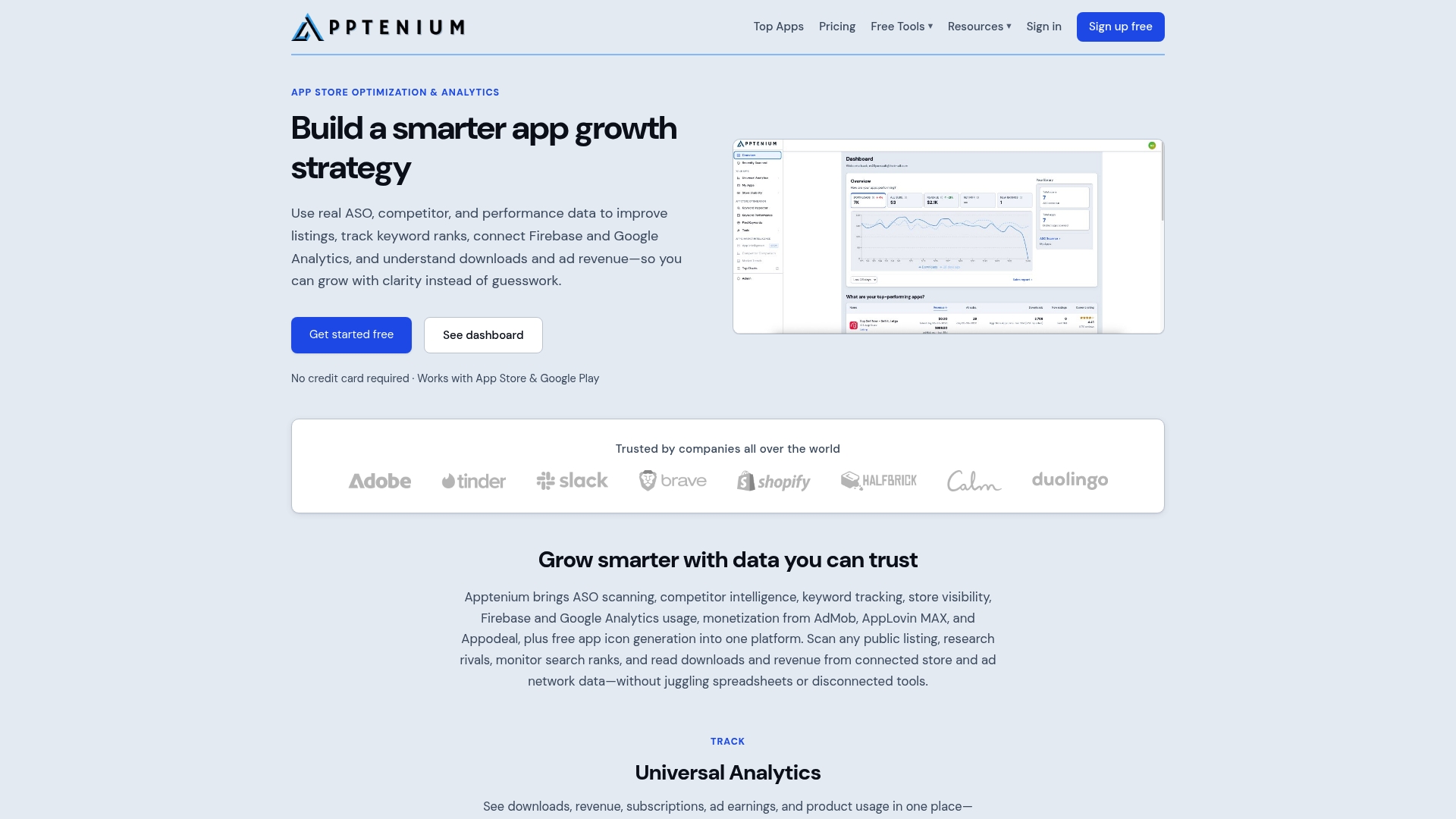
- Our ASO scanning and keyword tracking surface high-weight collisions across every app in your portfolio automatically.
- AI-powered recommendations suggest which app should keep a contested keyword and how to demote the others, following the same rank-weighted logic covered above.
- Competitor intelligence shows how shared terms perform against rival apps in the same category, not just within your own portfolio.
If your portfolio has more than one app competing for the same search terms, running a scan is the fastest way to see where authority is currently split. Check our pricing page for the Free plan or the Pro plan at $9.99 per month, or explore the competitor intelligence tools to see shared keyword performance across your category.
FAQ
Does keyword overlap between my own apps hurt rankings?
Yes, when two or more of your apps place the same keyword in high-weight fields like the title or subtitle, ranking authority for that term splits between them. Assigning one app as the clear owner and demoting the keyword in your other apps’ listings resolves most of this.
What is the 80/20 rule in SEO?
The 80/20 rule generally refers to the idea that a small share of keywords or pages drives most of your traffic or conversions, so prioritizing your highest-performing terms tends to produce better returns than spreading effort evenly. In ASO terms, this means focusing ownership decisions on the keywords generating the most impressions rather than chasing every possible variant.
What are some free tools for app store keyword research?
Free options include basic word-frequency analyzers and listing scanners that surface which terms already appear in your metadata. Our free tools include a scanner and word-frequency checker useful for an initial audit before deeper keyword tracking.
What does cannibalization mean in SEO and ASO?
Cannibalization happens when multiple pages or, in ASO, multiple apps compete for the same keyword and split ranking signals instead of one asset capturing full authority for that term. The fix in both contexts is the same: pick one owner for each keyword and reduce or remove the competing usage elsewhere.
How do I check if my own apps are competing for the same keywords?
Export keyword impressions and ranks for each app from App Store Connect or Play Console over a trailing 30-day window, then flag any term that appears in a high-weight field for more than one app. If two apps show meaningful impressions but neither ranks in the top 3 for that term, you likely have a cannibalization problem worth correcting.
Sources
- App Store Keyword Cannibalization: How Your Own Apps Compete Against Each Other and the Metadata Architecture That Fixes It — MVP Factory
- Platform version information - App information - Reference - App Store Connect - Help - Apple Developer
- Best practices for your store listing - Play Console Help
- Create custom store listings to target specific user segments - Play Console Help
Authoritative docs and practitioner posts to read next
For teams that want to go deeper into the data and policy side of this issue, these are worth bookmarking:
- App Store Keyword Cannibalization: How Your Own Apps Compete Against Each Other and the Metadata Architecture That Fixes It
- Platform version information - App Store Connect - Apple Developer
- Best practices for your store listing - Play Console Help
- Create custom store listings to target specific user segments - Play Console Help
- Free AI Audit: GEO First Playbook to Win SaaS AI Visibility