Six Stage Agency ASO Workflow for Mobile Marketers With Shared Data
Six Stage Agency ASO Workflow for Mobile Marketers With Shared Data
An agency ASO workflow is an iterative, measurable loop: audit, prioritize, implement, test, monitor, report, repeat. It runs on shared data and clear ownership, and it delivers rising visibility and better conversion only when both sides commit to it. Most agencies fit into your team as an extension, a gap specialist, or a full-service partner depending on your internal capability. Start by requesting an intake audit and a workflow diagram before signing anything.
TL;DR:
- A shared, standardized workflow provides visibility at every stage of ASO, preventing ownership confusion, siloed data, and untested ad hoc changes.
- The appropriate agency engagement model depends on internal capacity, with full-service suited for startups and tool-driven or niche roles for mature teams with existing processes.
- Clear roles, responsibilities, approval SLAs, and documented decision logs are crucial to maintaining accountability and preventing miscommunication.
- Reliable data sharing through scoped access to tools and dashboards is essential for defensible reporting and requires formal agreements; full admin access is often unnecessary.
- Regular KPI tracking, with weekly operational and monthly outcome reviews, ensures actions are tied to measurable results and avoids mistaking activity for genuine progress.
Table of Contents
- What Is an Agency ASO Workflow and Why Does It Matter?
- Which Agency Engagement Model Fits Your Team?
- What Does the End-to-End ASO Agency Workflow Look Like?
- Who Owns What? Roles, Approvals, and RACI
- What Tools and Data Access Does an Agency Engagement Need?
- Which KPIs Should You Track, and How Often?
- How Do Agencies Scale Across Apps and Hand Off to Internal Teams?
- How Apptenium Supports the Agency ASO Workflow
- A Practical Onboarding Checklist for Your First 30 Days
- Try Apptenium Against Your Own Agency Requirements
- Sources
- FAQ
What Is an Agency ASO Workflow and Why Does It Matter?
App store optimization is not a one-time project. It’s a cross-functional discipline that touches your keyword strategy, your creative team, your product analytics, and your release calendar all at once, which is exactly why so many agency relationships stall out. A workflow gives that chaos a shape: a repeatable sequence of steps with defined owners, so wins compound instead of evaporating every time someone changes a title tag without telling anyone.
Without a defined process, three failure modes show up almost every time. Ownership goes fuzzy, so nobody can say who approved a metadata change that tanked conversion. Data lives in silos, with the agency staring at one rank tracker while your product team stares at Firebase, and neither side sees the full picture. And changes get made ad hoc, outside any test structure, which means you can’t tell whether a install lift came from a keyword swap, a seasonal spike, or a paid campaign your growth team launched the same week.
A shared workflow fixes this by forcing visibility into every stage of the process. When both sides work from the same audit template, the same experiment log, and the same reporting cadence, you get:
- Faster learning cycles, because hypotheses get logged and tested instead of debated in Slack threads
- Replicable experiments, so a winning icon test in one market can be re-run in another with a documented method
- Clean handoffs, since a new agency team member (or an internal hire) can read the workflow history instead of re-learning tribal knowledge
- Defensible reporting, because every ranking change traces back to a specific, dated action
Phiture’s research on agency-client partnerships found that clear ownership, shared data, and a defined path to independence are the features that consistently separate engagements that deliver from ones that quietly fail. That’s not a soft cultural preference. It’s an operational requirement, and it’s the backbone of every section that follows.
Which Agency Engagement Model Fits Your Team?
Not every app needs the same kind of help, and the model you pick should match the capability gap you actually have, not the one a sales deck assumes you have. Four setups cover almost every real-world engagement.
- Full-service replacement. The agency owns ASO end to end, from keyword research through creative testing and reporting. This fits teams with no internal ASO hire and limited bandwidth to manage one, but it requires the tightest governance because you’re trusting an outside team with your entire store presence.
- Agency-as-extension. The agency works inside your existing process, sitting in your sprint planning and sharing your tools, rather than running a separate track. As of mid-2026, the strongest partnerships operate this way, with shared access to tools and joint planning that makes knowledge transfer possible from day one.
- Gap specialist. You keep ASO in house but bring in an agency for a specific hole, localization into a new market, or App Intents and conversational discovery work, without handing over the whole function.
- Tool-driven model. You license a platform and run the workflow yourself, using the agency (if any) in a consulting capacity rather than an execution one. This suits teams with ASO literacy but no dedicated headcount.
Full-service fits early-stage apps with zero internal ASO capacity. Agency-as-extension fits mid-size teams that have a marketer but need specialist depth. Gap specialist and tool-driven models fit teams that already run a mature process and need either a narrow skill or better tooling, not a replacement.
Whichever model you choose, put governance in the contract, not a verbal agreement. Require a written SLA for response times on approvals, explicit data access terms (read access at minimum, ideally shared dashboards), and a fixed reporting cadence, weekly at minimum during active testing.
Pro Tip: Ask any prospective agency to show you a sample audit and a sample weekly report before you sign. If they can’t produce real examples, they don’t have a repeatable workflow, they have a sales pitch.
What Does the End-to-End ASO Agency Workflow Look Like?
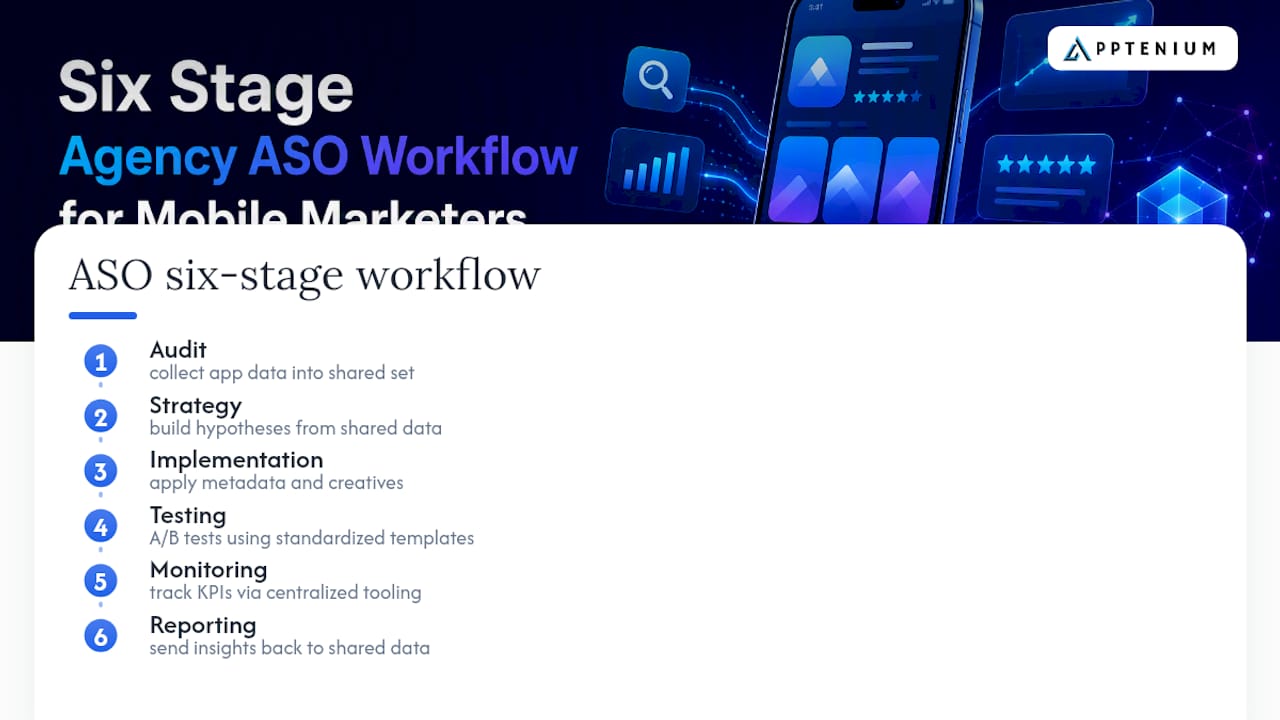
A working ASO cycle has six stages, and skipping any one of them is usually where engagements quietly break down. ASOMobile’s framework for agencies describes this same audit, strategy, implementation, monitoring, reporting loop, and notes it scales from a single app to a full portfolio only when centralized tooling and standardized templates exist underneath it.
Audit: know what you’re starting with
An audit is only as good as its inputs. A real one pulls current metadata (titles, subtitles, descriptions, keyword fields), historical and current keyword ranks, all live creative assets, analytics exports from your existing tools, and the full review corpus, not just the last thirty days. The output should be a written competitive gap analysis, a ranked list of quick wins, and a baseline scorecard you can compare against three months later.
Strategy: build clusters, not keyword lists
Modern ASO strategy groups keywords into semantic clusters organized around user intent, typically three to five themes per app, rather than optimizing single terms in isolation. This matters more in 2026 than it did a few years ago, as conversational discovery surfaces and App Intents reward apps that own a whole intent theme instead of a scattered keyword list. Before committing metadata changes around a new cluster, validate the anchor term with a small, low-budget Apple Search Ads test. It’s cheap insurance against a metadata rewrite built on a keyword nobody actually searches.
Implementation: the unglamorous middle
This is where metadata updates get uploaded, creative assets go live, and localization gets executed, ideally against a documented standard operating procedure so the fifth market update doesn’t reinvent the process the first one used. Every change needs a logged hypothesis: what you changed, what you expected, and the date. Skip this and your monitoring stage becomes guesswork.
Testing: give experiments room to breathe
Store-level testing, whether Google Play’s listing experiments or third-party platforms running icon, screenshot, and preview tests, needs a defined minimum duration and a rough sense of the sample size required for a readable result. Cutting a test short because early numbers look good, or bad, is one of the most common ways agencies burn traffic without learning anything.
Monitoring: catch the anomaly, not just the trend
Ongoing tracking through rank monitoring tools and conversion dashboards needs alerting built in, not just a weekly glance at a spreadsheet. A sudden rank drop on a core term deserves a same-day check, not a mention three weeks later in a monthly report.
Reporting: connect actions to outcomes
Weekly reports should be operational: what shipped, what’s running, what needs approval. Monthly reports should connect specific actions to specific outcomes, this metadata change correlated with this rank movement, not a general “visibility is trending up” summary that can’t be traced back to any decision.
A practical first-90-days plan breaks this cadence into concrete phases, days 0 to 7 for the audit and access setup, days 8 to 30 for the first round of metadata and creative changes, days 31 to 60 for the first test cycle, and days 61 to 90 for the first full reporting loop tied back to baseline numbers. Ask any agency you’re evaluating to show you their version of this timeline before kickoff.
The core steps themselves, keyword research, metadata updates, creative optimization, localization, review management, and A/B testing, are not proprietary to any single agency. What separates a good workflow from a mediocre one is whether those steps are sequenced, logged, and tied to a shared dataset both sides can see.
Who Owns What? Roles, Approvals, and RACI
Ownership drift kills more agency relationships than bad strategy does. Someone assumes the agency will handle App Store Connect access; the agency assumes you’re handling releases; three weeks pass and nobody uploaded the new screenshots. A written RACI (Responsible, Accountable, Consulted, Informed) chart, reviewed at kickoff, closes that gap before it opens.
Every functional area, keywords, creative, analytics, and app releases, needs exactly one accountable owner. Not a team, not “whoever’s free,” one named person.
| Area | Responsible | Accountable | Consulted | Informed |
|---|---|---|---|---|
| Keyword strategy | Agency ASO lead | Client marketing lead | Product team | Executive stakeholder |
| Creative testing | Agency creative lead | Client marketing lead | Design/brand team | Executive stakeholder |
| Analytics & reporting | Agency analyst | Client marketing lead | Data/BI team | Executive stakeholder |
| App releases & store access | Client dev/release manager | Client product lead | Agency ASO lead | Agency account manager |
Approval gates need SLAs attached to them, not vague goodwill. A metadata change should get sign-off within a fixed window, 48 hours is a common standard, and a creative test should get a go or no-go answer within a similarly defined window. Without that, agencies either wait indefinitely or move without approval, and both outcomes damage trust.
Decision logging matters as much as the RACI itself. Every experiment, hypothesis, and metadata version should live somewhere both sides can see it, with dates and rationale attached. Team-size dependent structures, weekly ASO syncs, bi-weekly review response checks, and monthly audits, give this cadence a practical shape rather than leaving it to whenever someone remembers to update a doc.
What Tools and Data Access Does an Agency Engagement Need?
The workflow above only functions if both sides can see the same numbers at the same time. A minimum viable toolset for an agency ASO engagement includes a rank tracker covering your priority markets, a store-level A/B testing platform, a review management tool, analytics integration through Firebase or Google Analytics, and a shared place to log experiments and hypotheses.
Data sharing generally falls into one of a few patterns:
- Direct platform access, where the agency gets a login to your existing analytics and store consoles
- Read-only tokens or scoped API keys, which limit what the agency can change while still giving full visibility
- A single shared dashboard that pulls from multiple sources into one view, so nobody’s reconciling numbers between two different tools mid-meeting
Scoped access matters for more than convenience. Sensitive data, revenue figures, user-level analytics, unreleased creative, needs contractual boundaries and an audit log of who touched what and when. This isn’t paranoia; it’s the same due diligence you’d apply to any vendor with backend access to your product.
Pro Tip: If a prospective agency asks for full admin access to your App Store Connect or Google Play Console before you’ve even seen a sample audit, slow down. A scoped, read-first access request is the standard practice, not an inconvenience they’re tolerating.
Which KPIs Should You Track, and How Often?
The right KPI set separates agency work you can defend in a budget meeting from agency work you’re taking on faith. Track visibility (keyword rank movement across your core clusters), impressions, organic install volume, store-page conversion rate, experiment win rate, and review sentiment. Each measures a different part of the funnel, and reporting on install volume alone hides whether conversion or discovery is the actual lever moving.
Cadence should match the decision each metric supports:
- Weekly: operational checks, rank shifts, active test status, anomaly flags
- Monthly: experiment summaries tying specific changes to specific outcomes
- Quarterly: strategy reviews assessing whether the current keyword clusters and market priorities still hold
Attribution discipline matters here more than most teams admit. An install spike during an active paid campaign, or right after a product update that changed onboarding, is not automatically an ASO win. A defensible reporting process isolates organic-channel movement and flags any overlapping product or paid activity in the same reporting window, so nobody’s crediting ASO for a lift a Facebook campaign actually drove.
The ASO checklist steps, keyword research through A/B testing, only prove their value when the KPIs above show a traceable line from action to outcome. A workflow without this measurement layer is just activity, not evidence.
How Do Agencies Scale Across Apps and Hand Off to Internal Teams?
An agency managing one app is straightforward. An agency managing a portfolio, or preparing to hand the whole function back to you, needs a documented playbook or the knowledge walks out the door with whoever leaves.
Knowledge transfer starts with documentation that outlives any single person: written runbooks for recurring tasks, a hypothesis backlog showing what’s been tested and what’s queued, and decision logs explaining why past changes were made. Most successful agency engagements build toward internal independence deliberately, treating documentation as a deliverable rather than an afterthought.
Portfolio-scale work needs its own standards:
- A centralized keyword repository shared across every app in the portfolio, not five separate spreadsheets
- Per-locale research standards, since translation alone rarely captures local search intent, a locale needs its own intent clusters, not a translated version of the home-market list
- Standardized audit and reporting templates, so a new app entering the portfolio can be onboarded in days, not weeks
Deciding when to insource comes down to three signals: whether you now have the internal capacity to run the workflow, whether the ROI still favors an outside specialist versus a hire, and whether cross-channel integration (ASO decisions increasingly touch paid UA and product) needs someone embedded full time rather than consulted periodically.
How Apptenium Supports the Agency ASO Workflow
Every stage of the workflow above depends on shared, real-time data, and that’s the specific gap Apptenium was built to close. Instead of an agency staring at one tool and your team staring at another, both sides work from the same ASO scanning and keyword tracking dataset from day one.
- Audit speed: the ASO scanner pulls current metadata, keyword ranks, and competitor positioning in one pass, cutting the manual data-gathering that usually eats the first week of an audit.
- Centralized keyword repository: keyword clusters and rank history live in one dashboard both the agency and your internal team can access, solving the portfolio-scale problem of scattered spreadsheets.
- Experiment logging: AI-generated listing recommendations get tracked against actual rank and conversion movement, giving both sides the dated, traceable action-to-outcome link that defensible reporting requires.
- Integrated analytics: Firebase and Google Analytics data flow into the same view as keyword and rank data, so attribution conversations happen against one dataset instead of three.
For teams evaluating whether to bring in an agency, run tools yourself, or blend both, seeing how Apptenium fits smaller teams and startups is a useful way to gauge whether your gap is a tooling problem, a headcount problem, or both.
A Practical Onboarding Checklist for Your First 30 Days
The workflow theory is easy. The first month with a new agency is where it actually gets tested, and most friction I’ve seen traced back to teams skipping the boring setup steps because they wanted to see results faster.
A tight 30-day sequence: week one is kickoff and scoped data access, no exceptions on the scoping. Week two is the first audit, delivered as a written document, not a call. Weeks three and four launch your first metadata or creative test, logged with a hypothesis before it goes live.
The most common mistake is skipping the RACI conversation because it feels like paperwork. It isn’t. It’s the thing that prevents a metadata change from shipping without anyone noticing until rankings drop. The second most common mistake is under scoping data access so tightly the agency can’t diagnose problems, which just pushes the friction to week three instead of removing it.
Renegotiate scope the moment the engagement outgrows its original model, usually when a gap specialist relationship starts touching areas nobody defined at kickoff.
— Mike
Try Apptenium Against Your Own Agency Requirements
Apptenium gives you the same shared-dashboard, audit-ready dataset that a well-run agency partnership depends on, without the setup lag or the retainer commitment most agencies require before you’ve even seen a sample report.
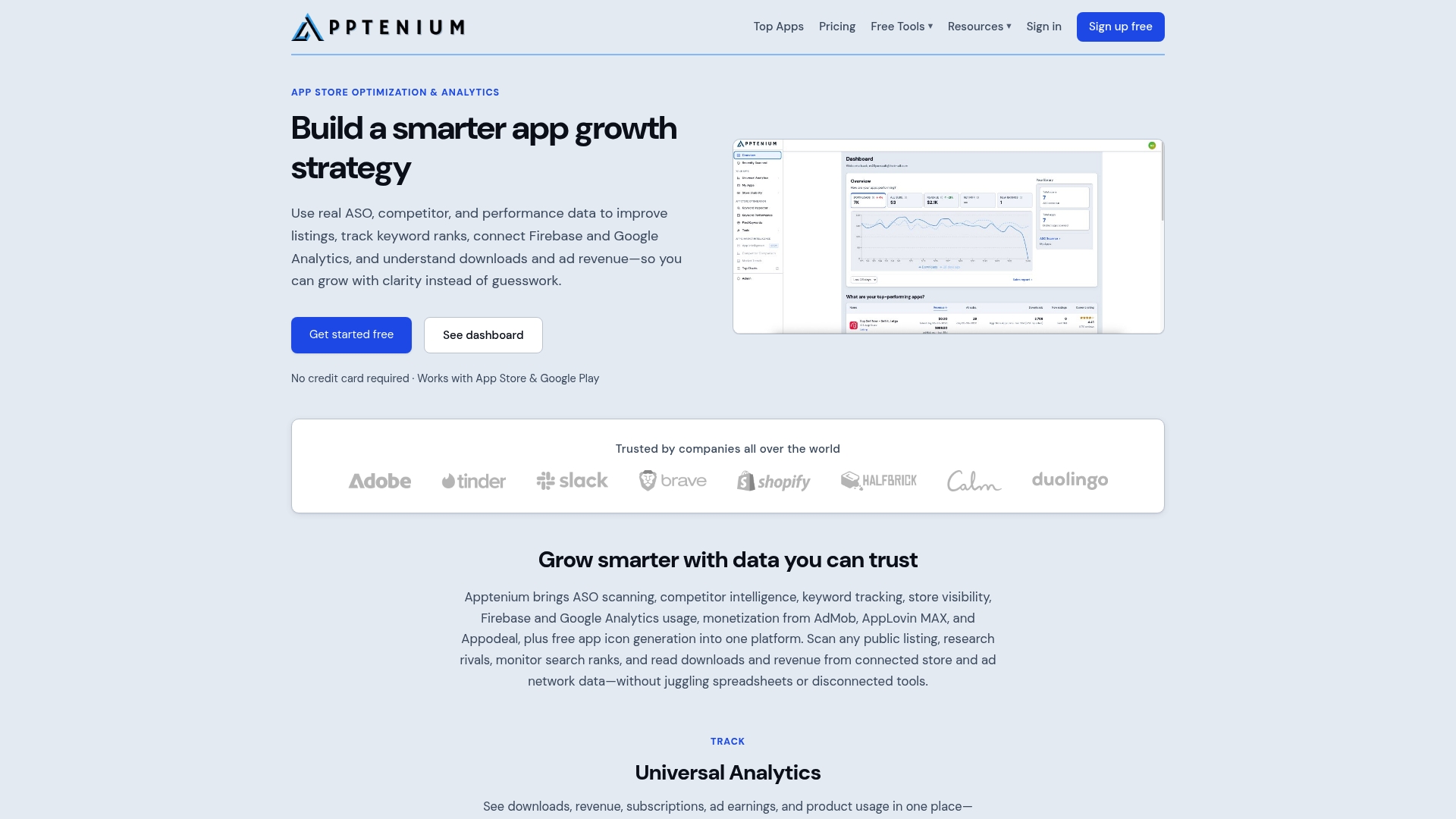
Before you sign anything with an outside team, or renew one, run three quick tests inside Apptenium: pull a full audit on your current listing, import your Firebase or Google Analytics data to see it sit alongside keyword ranks, and build one semantic keyword cluster the way this article describes. Compare what you get against whatever your agency delivered in its last audit. If the platform surfaces gaps faster than your last report did, you’ve found a real answer to whether your tooling gap is bigger than your headcount gap.
Start with the free ASO plan to run the audit and cluster exercises with no commitment, or check the feature breakdown if you want to see the full integration list before you begin.
Sources
The workflow structure in this piece pulls from a handful of frameworks worth reading directly. Phiture’s breakdown of agency-client partnership models covers the ownership and independence criteria in more depth than any single article can. Business of Apps on ASO localization explains why per-locale keyword research beats translation. ThatDevPro’s ranking-signals audit framework lays out a full first-90-days plan with day-by-day tasks. Semrush’s ASO checklist is a solid reference for the tactical steps underneath any agency workflow.
- The power of localization in ASO | Business of Apps
- How an ASO agency fits alongside your internal growth team | Phiture
- App Store Optimization (ASO) 2026: Ranking signals + audit | ThatDevPro
- App Store Optimization (ASO) checklist & keywords | Semrush
FAQ
What Is an Agency ASO Workflow?
It’s a repeatable, measurable process, audit, strategy, implementation, testing, monitoring, reporting, that an agency and an internal team run together with shared data and defined ownership at each stage.
Which Agency Engagement Model Should I Choose?
Pick full-service if you have no internal ASO capacity, agency-as-extension if you have a marketer but need specialist depth, and a gap specialist or tool-driven model if your process is already mature and you need a narrow skill or better software.
How Often Should Agency ASO Work Be Reported?
Weekly for operational status, monthly for experiment summaries tied to outcomes, and quarterly for strategy reviews that reassess keyword clusters and market priorities.
What Data Access Should I Give an ASO Agency?
Start with scoped, read-only access to analytics and store consoles rather than full admin rights, and formalize it with a written contract and audit log.
Can a Tool Like Apptenium Replace an Agency?
Apptenium replaces the fragmented-tooling problem, scanning, keyword tracking, and analytics in one dashboard, but many teams still pair it with agency strategy work, particularly during the audit and cluster-building phases.