Decide Your App Name in a Week: App Naming Strategy for Developers
Decide Your App Name in a Week: App Naming Strategy for Developers
Pick a short brand name plus one descriptive keyword, then run four availability gates today: store search, domain, social handles, and a quick trademark scan. If your top candidate clears all four in under an hour, secure it now. If it doesn’t, the mechanical process below gets you to a locked name inside a week, without the guesswork.
TL;DR:
- Conduct quick checks on store, domain, social handles, and trademark before investing heavily in a name, prioritizing low-cost validation steps.
- Favor short, easy-to-spell names that focus on outcomes and appeal to voice search, avoiding overly clever or misspelled options.
- Use data-driven tools to surface exact and phonetic collisions and assess keyword demand, ensuring the name has genuine market potential.
- Test names through bar, sleep, and voice assessments to confirm discoverability, memorability, and pronunciation in noisy environments.
- Avoid international linguistic and cultural pitfalls by performing basic native-speaker checks in target markets before international rollout.
Table of Contents
- Quick Checklist: The Four Gates of Name Sanity
- Naming Principles: What Makes a Name Memorable and Ownable
- ASO Mechanics: Store Character Limits and Metadata Strategy
- Availability and Legal Checks: The Order to Run Them
- A Repeatable Naming Process You Can Finish in a Week
- Testing and Validation: Bar Test, Sleep Test, Voice Tests
- Validate Faster: Using ASO Scans and Market Intelligence
- Cultural and Linguistic Pitfalls Across Markets
- Legal Risks Beyond Trademark: Copyright and Domain Disputes
- Aligning Your App Name With Audience and Brand Positioning
- SEO Implications of App Naming and Keyword Strategy
- Trends and Innovations Shaping App Names Today
- Naming as a Tactical Product Decision, Not a Creative Ritual
- Run a Free ASO Scan Before You Lock In a Name
- Sources
- FAQ
Quick Checklist: The Four Gates of Name Sanity
Before you fall in love with a name, run it through four filters. Any failure here should send the name back to the shortlist, no exceptions.
- Store collision: search the exact phrase on the App Store and Google Play. An exact match in your category is a hard stop.
- Phonetic near-matches: check for similar-sounding names across categories, not just yours. A phonetic cousin of a major brand causes voice-search confusion and can invite a trademark dispute later.
- Domain and handles: a .com is preferable, but .app or .io works fine if the brand name itself is clean and consistent across platforms.
- Voice-search sanity: say the name out loud in a noisy room. If a smart assistant mangles it, your users will hit the same wall.
- Trademark check: run a fast search on your national trademark registry before you commit budget to a launch.
This checklist follows the same gate order that practitioner guides recommend: cheapest and fastest checks first, expensive legal review last.
Naming Principles: What Makes a Name Memorable and Ownable
Short names win. One to three syllables is the sweet spot for recall and for voice search, where every extra syllable is a chance for a smart assistant to mishear you. GNOME’s own interface guidelines for application naming point in the same direction: short, domain-related names read better on a home screen and get typed correctly more often.
Spellability matters more than cleverness. A creative misspelling (“Fotografee” instead of “Photography”) might feel distinctive in a brainstorm, but it breaks findability the moment a real person tries to search for it from memory.
There’s a real trade-off between distinctive and descriptive naming. A fully invented name (“Slack,” “Venmo”) builds a stronger long-term brand but takes longer to rank for anything. A descriptive name ranks faster out of the gate but caps how ownable it ever becomes. For most new apps, brand plus one descriptive keyword splits that difference.
- Favor outcomes over features: “CalmSpace” beats “MeditationTimerApp.”
- Test recall before testing preference; a name people remember beats one they merely like.
- Keep the invented or brandable portion permanent, and treat the descriptor as the part you’re allowed to change later.
Pro Tip: Write your top three candidates in a plain text message to a friend with zero context. If they ask “what does that even do?” before “what is that?”, you’ve leaned too far into brandable and not enough into descriptive.
ASO Mechanics: Store Character Limits and Metadata Strategy
Both major stores cap the app title at 30 characters. That limit is identical whether you’re on the App Store or Google Play, but what happens after the title differs sharply between platforms.
| Field | Apple App Store | Google Play |
|---|---|---|
| Title | 30 characters | 30 characters |
| Secondary field | Subtitle: 30 characters | Short description: 80 characters |
| Visibility | Appears directly under title | Appears above the fold, more prominent |
Apple’s subtitle is a tight, secondary headline. Google’s short description gives you nearly triple the room, which changes how aggressively you can layer in keywords without stuffing.
Sequencing matters too. A brand-new app with zero recognized name should generally lead with its primary keyword in the title to catch category search volume, then shift to brand-first once branded searches start showing up in your analytics. An established brand does the opposite: lead with the name, let the keyword live in the subtitle.
- Don’t stuff keywords into the title itself; that reads as spam to both the algorithm and the user.
- Use the subtitle or keyword field to carry secondary terms, not the title.
- Every separator character costs you: a colon plus a space is shorter than a spaced dash, and inside a 30 character budget, that difference is real.
Availability and Legal Checks: The Order to Run Them
Run these checks cheapest to most expensive, in this exact order, so you never spend money before you’ve confirmed a name is even usable.
- Store search first. Search both the exact phrase and its phonetic variants on the App Store and Google Play. This costs nothing and takes five minutes.
- Domain check second. Once the name survives store search, check domain availability. A .com is ideal; a clean .app or .io is an acceptable fallback if the core name is strong.
- Social handle check third. Confirm the name (or a close, consistent variant) is available across the platforms where you’ll actually market the app.
- Trademark search fourth. Only after the name clears the first three gates do you run a national trademark registry search. This is the most time-consuming check, so save it for names that have already earned the effort.
Watch for dangerous collisions specifically: a phonetic cousin of a major, well-funded brand is a bigger risk than a similarly spelled name from a small, inactive app. If a domain is taken but parked and unused, it’s often worth a modest purchase offer before you pivot. If a name collides with an active trademark holder in your exact category, that’s the moment to loop in a lawyer rather than gamble on a rename six months post-launch.
A Repeatable Naming Process You Can Finish in a Week
Naming doesn’t need a month of debate. A mechanical, repeatable process removes the emotional attachment that stalls most teams.
- Generate volume. Produce 50 candidate names using combinatorics (prefix plus suffix lists) and AI brainstorming tools. Quantity beats quality at this stage; you’re not allowed to fall in love with anything yet.
- Cut mechanically to 8. Apply hard rules: no more than three syllables, no creative misspellings, no words that are hard to spell after hearing them once.
- Cut to 3. Run the remaining eight through the four availability gates from the earlier checklist. Keep only the two or three survivors.
- Secure the winner same day. The moment you pick, buy the domain, claim the social handles, and reserve the app store listing before the sun sets on that decision.
Pro Tip: Reserve your top two survivors’ domains simultaneously, even before final selection. A $12 domain hold is cheap insurance against losing your second choice while you deliberate over the first.
Testing and Validation: Bar Test, Sleep Test, Voice Tests
Two low-cost, high-signal tests beat casual polling every time. Friends and family tend to be encouraging rather than honest, which makes their feedback close to useless for findability.
- The bar test: tell three strangers your app name once, in conversation. Five minutes later, ask them to repeat it back and spell it. If they can’t, your name has a discoverability problem, not a taste problem.
- The sleep test: live with the name for 48 hours. Use it in real sentences: “I built [Name] this weekend.” If it still feels natural on day two, it likely holds up.
- The voice test: ask a smart assistant to open or search for the name out loud, including in a noisy environment. This has become less optional over time, since voice-first parsing is now a real discovery and accessibility requirement, not a novelty.
Once you have quantitative ASO signals, like actual keyword volume and impression data, trust those over any remaining qualitative feedback. A name that tests fine with three strangers but generates zero search volume for its category keyword still needs a subtitle fix.
Validate Faster: Using ASO Scans and Market Intelligence
Manually running all four availability gates by hand works, but it’s slow. Treating naming as a data problem rather than a taste problem is where an ASO scan earns its keep.
Running a scan through a tool like Apptenium’s ASO scanner surfaces exact and near-name collisions across categories in seconds, along with category noise you’d otherwise miss by eyeballing search results. Keyword volume data tells you whether to front-load a term in the title or leave it for the subtitle, replacing guesswork with an actual demand number. Icon and name preview tools also matter here: a name that looks clean in a spreadsheet can crowd or truncate awkwardly next to an icon on a real home screen, which is worth checking with something like Apptenium’s icon generator before you lock anything in. Once a winner emerges, reserve the domain and every social handle that same day.
Cultural and Linguistic Pitfalls Across Markets
A name that sounds sharp in English can land badly, or just confusingly, somewhere else. This matters more the moment you plan any international rollout, even an unofficial one where users in other countries discover your app organically.
Sound is the first risk. A brandable, invented name might accidentally mimic a real word with an unfortunate or vulgar meaning in another language. This is a known failure mode in global branding history, and it’s exactly why larger companies run linguistic screening before finalizing a name, not after.
Spelling conventions are the second risk. A name that reads naturally to an American ear might use letter combinations that look foreign or unpronounceable to a reader in another script or language family, which quietly kills word-of-mouth referrals in that market.
Symbolism is the third, subtler risk. Colors, numbers, and even certain animals carry different associations across cultures. A name or icon built around the number four, for instance, carries unlucky associations in parts of East Asia, similar to how the number thirteen is treated in parts of the West.
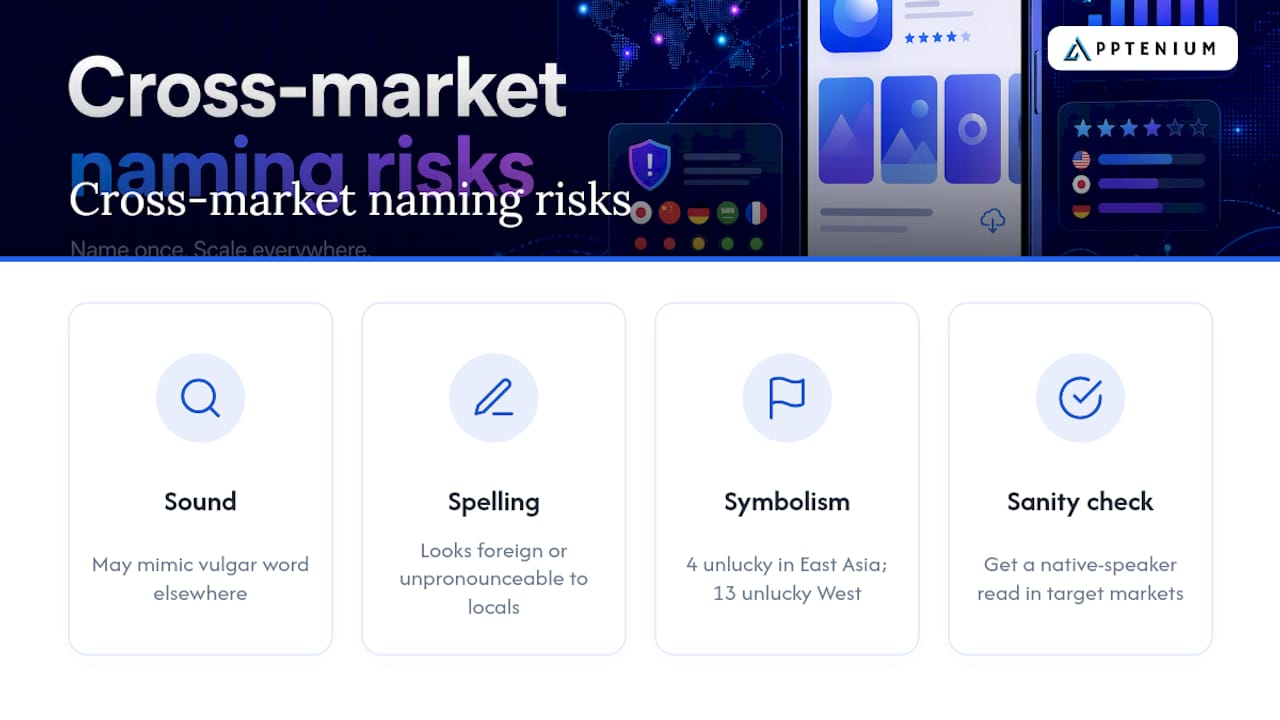
None of this means you need a linguist on staff before shipping a first version. It means running a basic check, a native-speaker sanity read in any market where you expect meaningful download volume, before that market becomes a meaningful share of your user base. It’s a cheap insurance policy against a name that quietly caps your growth in a region you haven’t even launched a marketing campaign in yet.
Legal Risks Beyond Trademark: Copyright and Domain Disputes
Trademark is the risk everyone thinks about. Two others deserve equal attention, because they can force a rename just as fast, and sometimes with less warning.
Copyright disputes usually don’t come from the name itself; they come from what surrounds it. An icon, a tagline, or a slogan lifted too closely from an existing brand’s creative assets can trigger a claim even when the app name itself is entirely original. Keep your icon design, tagline, and app name evaluated as a bundle, not as separate decisions made by different people on different days.
Domain disputes are the second risk, and they show up in two forms. The first is straightforward: someone else already owns the exact domain you want, and you either negotiate a purchase or pick a different extension. The second is thornier: cybersquatting, where someone registers a domain that closely resembles your brand once you start gaining traction, hoping to sell it back to you at a markup or redirect traffic to something unrelated. If your app grows quickly, registering the most obvious domain variants (plurals, common misspellings, alternate extensions) early is far cheaper than fighting a squatter later.
The order from the availability checklist still applies here: cheap checks first, legal escalation last. A quick domain search and a national registry lookup catch most problems before they cost you anything beyond time. Save an attorney consultation for cases where a name has already cleared every mechanical gate and still collides with an active, defended trademark in your exact category.
Aligning Your App Name With Audience and Brand Positioning
A name that tests well in isolation can still be wrong for your specific audience. The gap usually shows up between what sounds clever to the founding team and what actually resonates with the people who’ll download the app.
Think about who searches for your category and how they talk about their problem. A meditation app aimed at busy parents needs a name that signals calm and brevity, not a name built around technical mindfulness terminology that only appeals to people who already meditate daily. A B2B expense-tracking app aimed at finance teams can afford a more clinical, descriptive name than a consumer budgeting app aimed at first-time earners, because the two audiences search and decide differently.
Positioning should drive tone before it drives specific words. If your broader brand promise is speed and simplicity, a name with three syllables and a hard consonant sound reinforces that faster than a soft, four-syllable, vowel-heavy name ever will. If your positioning is trust and authority, a slightly more formal, descriptive name often outperforms something playful or invented, even if the playful option tested better in a casual poll.
The audience alignment test is simple: read your shortlist to someone who matches your actual target user, not to a coworker or a friend in an unrelated industry. Their instinctive reaction, positive, confused, or indifferent, tells you more about fit than any amount of internal debate.
SEO Implications of App Naming and Keyword Strategy
App naming and app store SEO are the same discipline wearing different names. The title field is the single highest-weighted piece of metadata in most store ranking algorithms, which means every naming decision is also a keyword decision whether you treat it that way or not.
The practical pattern that ASO practitioner guides converge on is brand plus one descriptive keyword for apps without existing recognition. That single keyword in the title does real work: it’s the difference between ranking for a category term on day one versus waiting months for branded search volume to build naturally.
Once brand recognition exists, the calculation flips. A recognized brand searched by name doesn’t need to spend its scarce 30 characters proving what it does; it can lead with the name and push keywords into the subtitle or short description field instead, where there’s more room and less competition for attention. This is also where the platform gap matters again: Google’s 80 character short description gives meaningfully more room to layer secondary keywords than Apple’s 30 character subtitle does, so a title and metadata strategy that works well on one store may need adjusting on the other.
The mistake to avoid is treating the title as a keyword dumping ground. A title crammed with three or four search terms separated by dashes might look thorough, but it reads as spam to users and often gets flagged or deprioritized by store review processes. One well-chosen keyword, placed once, beats three mediocre ones stacked together.
Trends and Innovations Shaping App Names Today
Naming conventions shift alongside how people search and talk. A few patterns are worth watching as you build your shortlist.
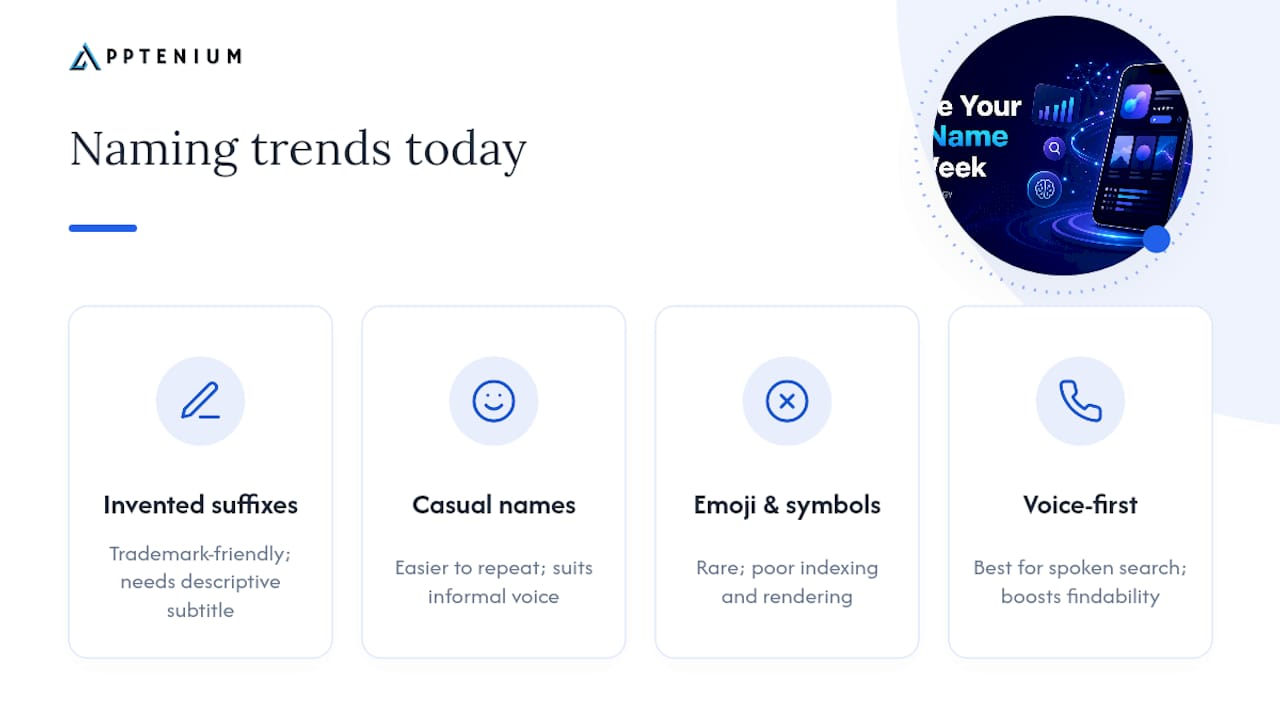
Invented, brandable suffixes keep spreading: “.ify,” “.ly,” and single-syllable made-up tails attached to a real word (“Spotify,” “Duolingo”) remain popular because they’re easy to trademark and rarely collide with existing dictionary words. The trade-off hasn’t changed: these names take longer to become self-explanatory, so they work best when paired with a strong subtitle that does the descriptive work the name itself skips.
Casual, conversational naming has grown too, names that read more like a phrase a friend would say than a corporate product label. This mirrors a broader shift toward informal brand voice across consumer apps generally, and it tends to test well in the bar test described earlier, because conversational names are inherently easier to repeat back correctly.
Emoji and symbol use inside the actual app name field remains rare and risky. Store search algorithms don’t always index emoji characters reliably, and a symbol that renders as intended on one device can appear as a blank box on another. Reserve emoji for marketing screenshots and social presence, not the title field itself, until store-level emoji indexing becomes more consistent.
Voice-first naming is the trend with the most staying power. As more discovery happens through spoken queries to a phone or smart speaker, names that survive being said out loud in a noisy room have a structural advantage over names that only look good typed in a search bar. That’s less a fad and more a permanent shift in how findability gets measured.
Naming as a Tactical Product Decision, Not a Creative Ritual
Naming deserves real process, but it doesn’t deserve months. The mechanical approach outlined here, generate wide, cut fast, gate hard, works precisely because it treats naming as a tactical decision with reversible stakes rather than a permanent creative statement.
Early renames aren’t fatal. They’re annoying, and they cost some SEO equity, but a name changed at 500 downloads is a rounding error compared to a name that quietly caps growth for two years because nobody wanted to revisit it. Prioritize discoverability and clean ownership over a name that merely feels clever in a meeting.
— Mike
Run a Free ASO Scan Before You Lock In a Name
Apptenium turns the availability and validation steps above into a single scan instead of five separate manual checks across different tools. Running a scan surfaces exact and phonetic collisions, shows real keyword demand for the terms you’re considering, and gives AI-generated suggestions for title and subtitle edits that map directly onto the framework above.
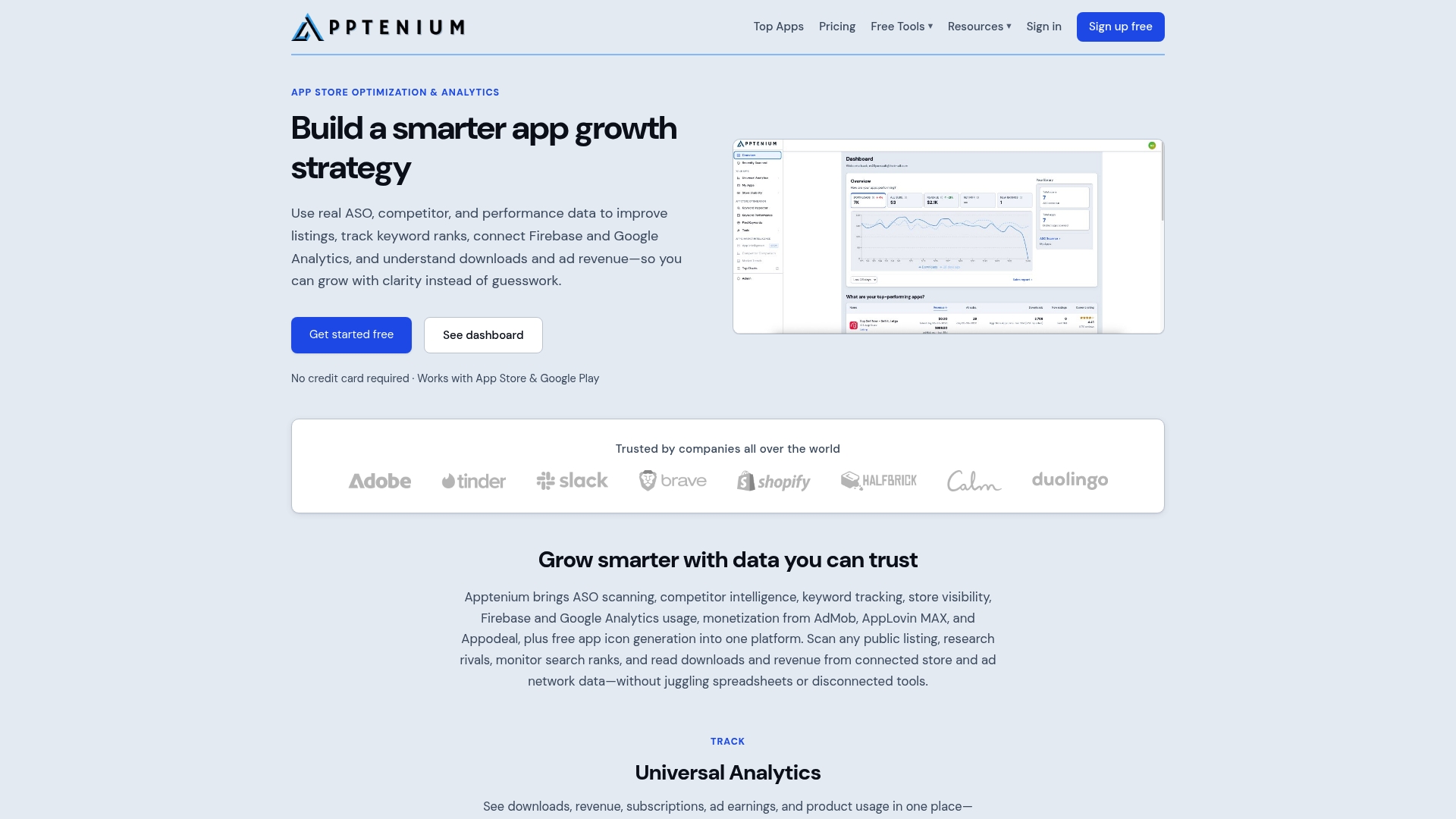
Instead of guessing whether your shortlist has a hidden collision or an untapped keyword opportunity, you get the answer from actual store data. The free ASO scanner covers a limited number of scans per month at no cost, enough to test your top two or three candidates before you commit to buying domains and reserving handles. If you’re managing multiple apps or want unlimited scans and the full set of AI recommendations, the Pro plan runs $9.99 per month. Run your shortlist through a scan today, before you spend money on a domain for a name that’s already crowded in your category.
Sources
A few sources are worth bookmarking as you finalize a shortlist:
- How to Name an App (Without Losing a Month to It) - DEV Community
- App Naming - GNOME Human Interface Guidelines
FAQ
What Are Some Cool Naming Conventions for Apps?
Brand plus one descriptive keyword is the most practical convention for new apps, alongside invented suffixes like “.ify” or “.ly” for apps aiming at a distinct, ownable brand identity. Conversational, phrase-like names are also gaining ground because they tend to pass the bar test more reliably than formal or technical-sounding names.
How Do I Create a Good App Name?
Generate a large batch of candidates, cut them down using mechanical rules like syllable count and spellability, then run the survivors through four gates: store search, domain availability, social handles, and a trademark check. A name that clears all four and passes the bar test and sleep test is ready to secure.
How Do I Name My App to Avoid Collisions?
Search for the exact phrase and its phonetic near-matches across both the App Store and Google Play, not just within your own category, since phonetic collisions with major brands create both voice-search confusion and trademark risk. A tool like Apptenium’s ASO scanner can run this check automatically and flag category noise a manual search might miss.
What Are Good App Names?
Good app names are short (one to three syllables), easy to spell exactly as heard, and built around an outcome or feeling rather than a specific feature. The strongest names also survive being said out loud in a noisy room, since voice-search parsing is now a real discovery requirement rather than a nice-to-have.
How Much Does Apptenium Cost?
Apptenium offers a free plan with a limited number of scans per month and a Pro plan at $9.99 per month for unlimited scans and full AI recommendations, detailed on the pricing page.