Audit First ASO Checklist for App Teams: Test Custom Pages

Audit First ASO Checklist for App Teams: Test Custom Pages
An effective ASO checklist organizes discovery, conversion, product quality, and measurement into one repeatable process rather than a scattered list of tips. Before you touch a keyword or a screenshot, verify the live store listing on both platforms and capture baseline ranks, impressions, product-page views, and conversion rates. Two mechanics matter most going in: Apple’s custom product pages and Google Play’s custom store listings, both of which govern how much of this checklist you can actually test in 2026.
TL;DR:
- Verifying the live store listing before testing any changes is crucial to avoid baseline errors that skew results.
- Segmenting keywords into intent buckets and mapping them to appropriate metadata fields improves relevance and conversion.
- Successful ASO requires focusing on impact times confidence divided by effort when scoring fixes and hypotheses.
- Localization and custom store listings should be used strategically for different markets or campaigns, not combined unnecessarily.
- Regularly monitoring technical quality signals like crash and ANR rates prevents ranking drops caused by quality issues.
Table of Contents
- How to Use This ASO Checklist and Prioritize What You Find
- Keyword Research and Discovery: Setting Your Baselines
- Metadata Field Checklist: What Actually Gets Checked
- Visual Assets Checklist: Icon, Screenshots, and Video
- Localization and Custom Store Listings by Platform
- Running ASO Experiments Without Wasting a Release Cycle
- Technical Quality and Reviews: The Signals Metadata Can’t Fix
- Measurement and Turning Findings Into a Backlog
- App Category and Competitor Analysis
- Conversion Rate Optimization Techniques Specific to ASO
- App Store Algorithm Updates and Their Impact on ASO
- Backlinks and External Traffic Influence on App Ranking
- User Engagement and Retention Strategies Related to ASO
- Practitioner Perspective: The Mistakes That Undo a Good Checklist
- Apptenium: Run This Checklist Without Juggling Five Tools
- Sources
- FAQ
How to Use This ASO Checklist and Prioritize What You Find
Run the audit in a fixed order: verify the live listing, then discovery (keywords), then creatives, then experiments, then measurement, and then backlog. Skipping the first step is the most common mistake in ASO. Teams test new screenshots against a listing that’s misconfigured in App Store Connect or Google Play Console, then wonder why conversion didn’t move. Your creative was never the variable, your baseline was broken.
For every item you check, record one of three outcomes: pass, fail, or unknown. Unknowns are instrumentation gaps, not neutral results. If you don’t know your product-page view to install conversion rate by country, that’s a fail on measurement, not a shrug.
Once you have a list of fixes, score each one using impact times confidence divided by effort. This keeps you from spending a sprint on a low-impact icon tweak while a broken keyword field sits untouched.
- Score every finding, don’t just list it
- Pick one hypothesis per release, not five
- Treat “unknown” as a measurement bug, not a pass
This scoring model is close to what the 40-point ASO audit framework recommends: verify, score, prioritize, then act on one variable at a time.
Keyword Research and Discovery: Setting Your Baselines
You can’t optimize what you haven’t measured. Before changing a single metadata field, record where you already stand.
- Capture baseline rank and impressions for every priority keyword, broken out by store, country, and language. A keyword ranking #4 in the US App Store might rank #40 in the UK Play Store for the same app.
- Segment keywords into intent buckets. Branded terms (your app name and variants), category terms (broad descriptors like “budgeting app”), problem terms (“how to track spending”), and feature terms (“recurring bill reminders”) each convert differently and belong in different metadata fields.
- Map each keyword to a field based on impression volume and how well it matches search intent. High-volume category terms usually belong in the title or app name; long-tail problem terms fit better in the App Store keyword field or the Play full description.
Skipping the segmentation step is why so many teams stuff their app name with category terms and wonder why conversion drops. A searcher typing a problem term wants a promise, not a label.
Metadata Field Checklist: What Actually Gets Checked
Metadata is the part of ASO that behaves most like traditional SEO, and it’s also where the platform rules diverge the most.
On the App Store:
- App name: 30 characters, front load your strongest keyword or brand term
- Subtitle: 30 characters, reserve for a second keyword cluster or the core benefit
- Keyword field: 100 bytes total, no spaces after commas, no repeating words already in the name or subtitle
- Promotional text: not indexed, but visible above the fold, use it for time-sensitive offers
- Avoid prohibited practices: no misleading claims about awards, rankings, or pricing
On Google Play:
- Title: keep it readable, don’t cram keywords past the point of clarity
- Short description: your highest-leverage 80 characters for both ranking and tap-through
- Full description: repeat priority keywords naturally, but Play policy explicitly bans deceptive or spammy metadata, including repetitive keyword stacking
- Run a quick compliance pass on both stores before submitting: does anything imply a certification, ranking, or guarantee you can’t back up?
Visual Assets Checklist: Icon, Screenshots, and Video
Your icon and first few screenshots do more conversion work than any paragraph of description text, because most searchers never scroll past them.
- Icon: shrink it to the size it appears in search results and check legibility at that scale. Source your artwork at 1024×1024 for the App Store, and avoid badges or banners that imply an award or ranking you don’t hold.
- Screenshots: Apple allows up to 10 screenshots per device size, but only the first one to three actually show up in search results when there’s no preview video running. Sequence them as promise, then proof, then differentiator. Keep captions large enough to read on a phone screen at a glance.
- Preview video: open with real product footage in the first two seconds, since most viewers watch muted. Localize the video for markets where the metadata language differs, otherwise you risk a message mismatch between what the video shows and what the text promises.
Pro Tip: Screenshot order is the single highest-leverage, lowest-effort test most teams never run. Before touching copy, try reordering your existing screenshots and measure the shift in product-page conversion alone.
Localization and Custom Store Listings by Platform
Localization and custom listings solve different problems, and mixing them up wastes engineering time.
Apple lets you build up to 70 custom product pages per app, each with its own screenshots, video, and text, tied to specific ad campaigns or App Store Search Ads keywords. They need App Review approval before they go live, so build them into your release calendar rather than launching them the same week as an ad campaign.
Google Play’s custom store listings work differently: they let you tailor title, icon, descriptions, and graphics per country or language, while shared fields like your contact details and privacy policy stay constant across every version.
- Localize an asset when the market speaks a different language or has different cultural expectations
- Build a custom page or listing when you’re targeting a specific campaign, feature, or acquisition channel
- Tie every custom page back to a campaign so you can measure its lift separately from your default listing
Running ASO Experiments Without Wasting a Release Cycle
A good experiment starts with a hypothesis, not a hunch. Write down the primary metric, the minimum runtime, the target audience segment, and the guardrail metrics that must not decline before you launch anything.
- Define the test. State what you’re changing, what metric it should move, and what the floor is for a metric like crash rate or one-day retention that must hold steady.
- Choose the right tool. Apple’s Product Page Optimization tests variants of your primary listing, while custom product pages serve a different purpose entirely: targeted landing pages for specific campaigns. Treatments in a PPO test default to copies of your original page, and any icon used in a treatment must already exist in your app binary before the test can launch.
- Read the result honestly. A statistically clear lift with stable guardrails means roll out. A flat result means iterate on a sharper hypothesis. A guardrail breach, even with a conversion lift, means rollback.
Statistic to watch: teams that swap in a new icon mid-test without adding it to the binary first are a documented, recurring cause of failed PPO tests — an avoidable error that costs an entire test cycle.
Technical Quality and Reviews: The Signals Metadata Can’t Fix
No amount of clever copy survives a crash loop. Google tracks user-perceived crash rate and ANR rate on a rolling 28-day window, and apps that exceed the bad-behavior thresholds can see reduced visibility on Play, independent of how strong your keywords are.
- Assign an owner to watch crash and ANR trends weekly, not quarterly
- Fix the crash groups affecting the largest number of users first, not the ones easiest to reproduce
- Reply to reviews that mention specific bugs; it improves both conversion and your signal to the platform that you’re active
- Add crash rate, ANR rate, and rating trend as guardrails in every experiment, so a conversion win never masks a quality regression
Pro Tip: If your rating trend is dropping while your keyword ranks hold steady, don’t touch metadata yet. Fix the underlying product issue first. Chasing a rank number while ignoring a quality slide just grows a cohort of unhappy users faster.
Measurement and Turning Findings Into a Backlog
An audit without a backlog is just a document nobody reads. Report five metrics separately, never blended: visibility, product-page views, conversion, activation, and retention, alongside revenue.
- Visibility tells you if you’re being found
- Product-page views and conversion tell you if the listing is doing its job once found
- Activation and retention tell you if the product delivers on what the listing promised
Score every finding with the same impact-confidence-effort model from your initial audit, then write a short decision record for each: the hypothesis, the evidence behind it, an owner, the expected impact, and how you’ll measure it. Run this full audit before major launches, before big feature releases, before localization pushes, and any time rank or conversion moves without an obvious cause.
App Category and Competitor Analysis
Your category placement shapes which “similar apps” surface next to you and which chart you compete on, so get it right before you optimize anything else. A finance app miscategorized as “Utilities” competes against calculator apps for visibility instead of budgeting apps, which usually means worse relevance and weaker conversion.
Pull the top 10 to 15 apps in your actual category and audit their listings the same way you’re auditing your own: title structure, keyword patterns in the subtitle or short description, screenshot sequencing, and rating volume. You’re not copying their copy. You’re finding the gap.
Look specifically for keywords your competitors rank for that you don’t, and for search terms with real volume that nobody in your category has claimed yet. Those unclaimed terms are often the fastest path to a ranking win, because you’re not fighting an incumbent for the same slot.
Watch rating count and velocity too. An app with 50,000 ratings at 4.7 stars has a trust signal you can’t out-copywrite. If your category leader has that kind of volume, your near-term win usually comes from a keyword gap or a screenshot sequence they haven’t tested, not from trying to out-rank them on a branded term they’ve owned for years.
Revisit this analysis quarterly at minimum. Categories shift, new entrants show up, and a competitor’s redesign can reset the visual bar for the entire category overnight.

Conversion Rate Optimization Techniques Specific to ASO
CRO for app stores isn’t the same discipline as web CRO, because you’re optimizing a page you can’t fully control the layout of and a decision the user makes in seconds, often on a small screen with sound off.
Start with the first screenshot. It carries more conversion weight than any other single asset, since it’s often the only one a searcher sees before deciding to tap. Lead with the core promise of your app stated as a benefit, not a feature list.
Sequence the rest of your gallery to build a case: promise in the first shot, proof (a screen showing the app actually doing the thing) in the second and third, then a differentiator that separates you from the app right next to you in search results.
Your short description or subtitle should answer the question a searcher is implicitly asking: “why this one instead of the ten others in this list?” Vague adjectives don’t answer that. A specific benefit tied to a specific use case does.
Test one variable per cycle. Changing your icon, your first screenshot, and your subtitle in the same release means you’ll never know which change moved the number. Use Apple’s Product Page Optimization or a Google Play store listing experiment to isolate the variable and measure it against your guardrails.
Review length also matters more than most teams assume: a description padded with keyword repetition reads as spam to both the algorithm and the searcher. Write for the person reading it first, then check that your priority terms appear naturally.

App Store Algorithm Updates and Their Impact on ASO
Apple and Google update their ranking systems continuously, and neither publishes a full changelog. What’s changed over the past several cycles is the weight both platforms place on behavioral and quality signals alongside keyword relevance.
Ranking today reflects a blend of textual relevance (your metadata), behavioral signals (tap-through and conversion rate from search results), and quality signals (retention, crash rate, ratings). A listing with perfect keyword placement but poor conversion will lose ground to a less optimized listing that converts better, because the algorithm treats real user behavior as a stronger signal than metadata alone.
This is why a static, “set it and forget it” listing decays over time even without any changes to it. Competitors update their creatives, user behavior patterns shift, and a listing that ranked well six months ago can quietly slide if nobody’s watching.
The practical response isn’t chasing every rumored algorithm shift. It’s running the audit cadence from the measurement section on a fixed schedule, so you catch a ranking or conversion drop within weeks instead of discovering it a quarter later when a stakeholder asks why downloads are down.
Backlinks and External Traffic Influence on App Ranking
Backlinks don’t function in app store algorithms the way they do in web search, but external traffic still shapes your ranking indirectly through the volume and quality of installs it drives.
When a review site, a press mention, or a social post sends a burst of traffic to your listing, the resulting installs, conversion rate, and early retention from that cohort feed into the same behavioral signals the store algorithm already weighs. A spike of low-quality installs from a low-intent source (a giveaway, a bot-heavy ad network) can actually hurt you if those users churn immediately and drag down your retention numbers.
Prioritize external traffic sources that send users who convert and stick around, not just users who tap install. A tech blog review that explains exactly what your app solves tends to send higher-intent traffic than a broad paid campaign with vague targeting.
Track where your installs originate using your attribution setup, and segment retention by source. If one channel consistently sends users who churn in the first session, that channel is quietly working against your store ranking even while it inflates your install count.
User Engagement and Retention Strategies Related to ASO
Retention isn’t a separate discipline from ASO anymore. It’s an input the algorithm reads. Both platforms increasingly treat early retention and session behavior as evidence of listing accuracy: if users install and immediately churn, that’s a signal your listing promised something the product doesn’t deliver.
The fix starts before the install, not after it. Audit whether your screenshots, video, and description set accurate expectations. An app that oversells a feature to win the tap will lose the retention battle that follows, and that loss shows up in your ranking within weeks.
Onboarding matters just as much as the listing that got the user there. A confusing first session drives the kind of one-day churn that platforms read as a quality problem, even when the underlying product is solid. Map your onboarding flow against the specific promise your top-performing screenshot makes, and fix any gap between the two.
Push notification strategy and re-engagement campaigns extend the life of an install, and that extended engagement feeds back into the retention metrics that support your ranking over time. Treat engagement work as part of your ASO checklist, not a separate marketing function running in parallel with no connection to it.
Practitioner Perspective: The Mistakes That Undo a Good Checklist
The single most expensive mistake is testing against a broken baseline: verify the live listing before you touch anything else, or every result that follows is noise. The second is running three changes at once and calling whichever metric moved “the winner.” Test one hypothesis per cycle. The third is shipping an English preview video into a localized German listing and wondering why conversion lags, when the message never matched the metadata in the first place.
— Mike
Apptenium: Run This Checklist Without Juggling Five Tools
Most of this checklist requires pulling data from your App Store Connect dashboard, your Play Console, an analytics tool, and a spreadsheet to tie it all together. An ASO platform unifies ASO scanning, keyword tracking, competitor intelligence, and AI-generated listing recommendations into one place, connecting those with performance data from analytics tools to avoid manual stitching of install and conversion data.
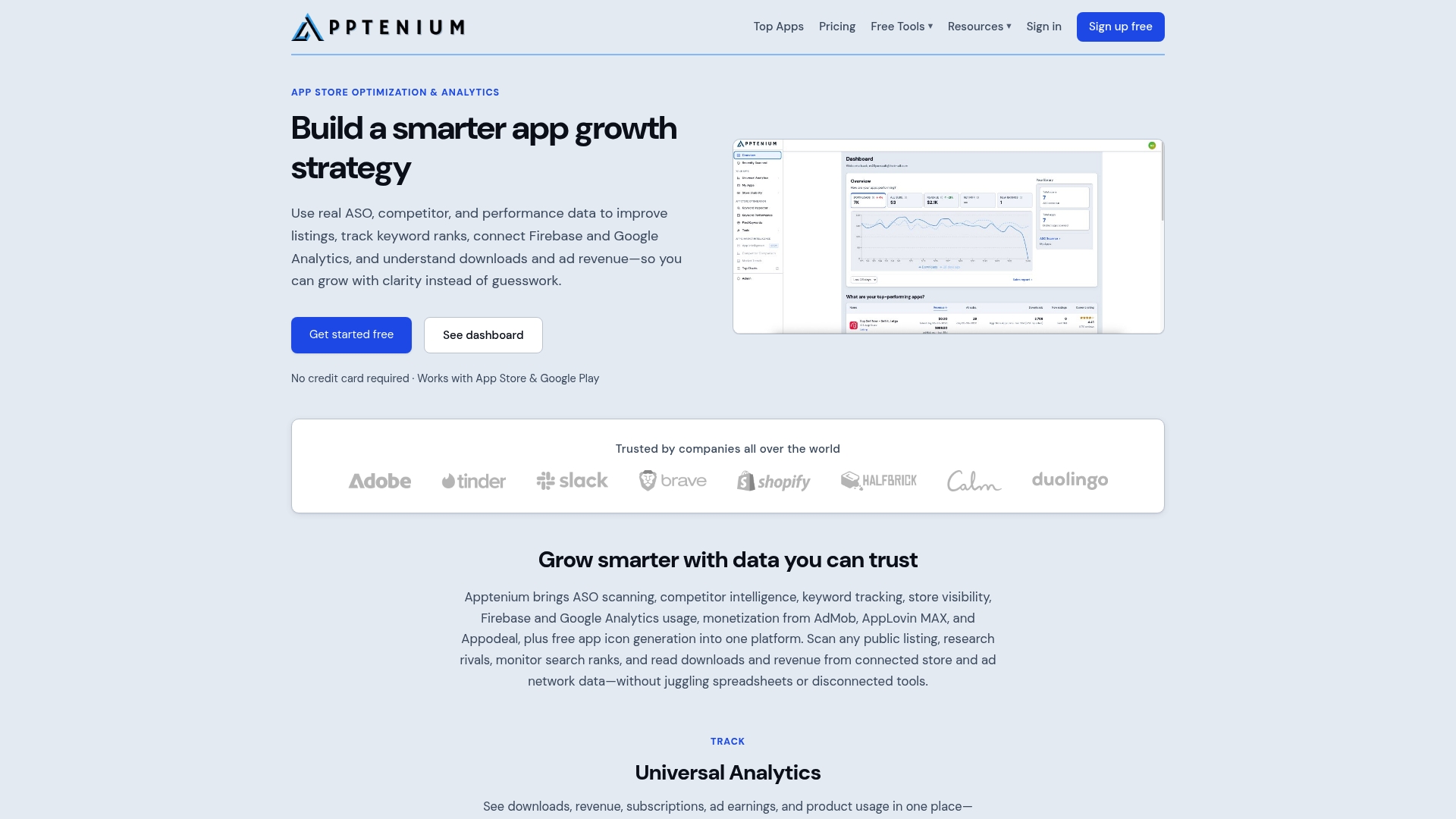
If you want to see where your current listing stands against the checklist above, run a free ASO scan and it will flag metadata, keyword, and creative gaps automatically. From there, the features page walks through how the AI recommendations and integrations work in practice. When you’re ready to move past the limited free scans, the Pro plan runs $9.99 a month and unlocks unlimited scanning and the full recommendation set, no long sales process required.
Sources
Apple’s own product page and custom product page guidance covers screenshot limits, custom product page caps, and PPO testing rules referenced throughout this checklist. Google’s custom store listings documentation explains how to tailor listings per country and set up store listing experiments. For the technical-quality section, Google’s Android vitals guidance details the crash and ANR thresholds that affect Play visibility, while Apple’s test treatment configuration guide covers the icon and approval rules experiments depend on. For a ready-made scoring template, the 40-point ASO audit checklist offers a practical structure to adapt.
- Product page and custom product page guidance - Apple Developer
FAQ
What Does ASO Stand For?
ASO stands for App Store Optimization, the practice of improving an app’s visibility and conversion rate within app store search and browse results. It covers keyword strategy, metadata, visual assets, ratings, and technical quality signals across both the Apple App Store and Google Play.
What Is an ASO Checklist?
An ASO checklist is a structured, repeatable list of audit steps covering keyword discovery, metadata fields, visual assets, localization, experiments, technical quality, and measurement. A reliable version starts by verifying the live store listing, then works through each area with pass, fail, or unknown scoring so nothing gets missed before a launch.
What Is an ASO Tool?
An ASO tool is software that tracks keyword rankings, scans listing metadata for gaps, monitors competitors, and often generates recommendations for improving conversion. Apptenium combines ASO scanning, keyword tracking, and competitor intelligence with AI-powered suggestions and Firebase and Google Analytics integrations, so ranking data and revenue data sit in one dashboard instead of several.
How Is ASO Different From SEO?
ASO optimizes an app’s visibility inside app store search results and browse surfaces like Apple’s App Store or Google Play, while SEO optimizes a website’s visibility in web search engines like Google. The mechanics overlap on keyword research and metadata, but ASO adds store-specific elements SEO doesn’t touch, like app icons, screenshots, preview videos, and quality signals such as crash rate and ANR that can directly affect store visibility.