Start With Impression Share: Unified App Store Keyword Growth Tracking

Start With Impression Share: Unified App Store Keyword Growth Tracking
Keyword growth tracking means watching keyword rank, impression share, store listing clicks, and the installs those clicks produce, then tying all four together instead of chasing any one number in isolation. The metric to start with is impression share paired with listing clicks, since that pair tells you whether more people are actually seeing and tapping your app. Connect your store consoles today and set up a weekly keyword dashboard before you touch anything else.
TL;DR:
- Tracking impression share and store listing clicks together provides a clear view of actual visibility and user interest in specific keywords.
- Combining rank, impression share, clicks, and installs over at least two weeks helps differentiate genuine growth from short-term or manipulated spikes.
- Using multiple data sources like Apple Search Ads, Google Play Console, Firebase, and third-party trackers ensures comprehensive insights into keyword performance and attribution.
- Automating data collection and trend analysis with a unified platform like Apptenium reduces manual effort and helps prioritize keyword optimization strategies effectively.
- Validating growth through experiments and detecting suspicious activity such as fake installs or review spikes prevent overestimating true app success.
Table of Contents
- Key metrics to track for ASO keyword growth
- Where to get reliable keyword and attribution data
- A repeatable tracking workflow and dashboard to measure keyword growth
- Interpreting growth: attribution, causation, and common pitfalls
- Validate growth with experiments and fraud detection
- How Apptenium implements and accelerates this workflow
- Practical prioritization and team setup advice
- Try Apptenium to automate your keyword growth tracking
- FAQ
- Sources
Key metrics to track for ASO keyword growth
Every keyword metric answers a different question, and mixing them up is how teams waste months optimizing the wrong thing.
Rank tells you your position for a given term, but it only matters in context. Apple Search Ads reports rank on a 1 to 5 scale (or “greater than 5”) alongside Search Popularity and Impression Share, while Google Play Console exposes a comparable search-term dimension inside its acquisition reports. Rank without volume is meaningless: a top-3 position on a term nobody searches does nothing for installs.
Impression share shows you how much of the available search volume you’re actually capturing. It acts as a headroom indicator, if your impression share sits at 20% on a high-popularity term, there’s real room to grow before you’ve saturated that keyword’s ceiling.
Store listing clicks and the click-through rate that follows are the verification layer. A keyword can rank well and generate impressions, but if searchers aren’t clicking through, the term isn’t converting attention into interest.
Keyword-attributed installs close the loop, though attribution here is directional rather than exact, since app stores don’t expose a perfect one-to-one map between a single search and a single install.
- Rank tells you position; impression share tells you how much visibility you’ve captured.
- Listing clicks and CTR confirm whether that visibility translates into interest.
- Keyword-attributed installs confirm whether interest translates into growth.
- Retention and reviews confirm whether that growth sticks.
Apple Search Ads scores keyword opportunity on a 1 to 5 Search Popularity scale, giving teams a consistent way to rank which terms deserve attention first.
Where to get reliable keyword and attribution data
No single console gives you the full picture, so your workflow needs to pull from several sources and understand what each one actually measures.
- Apple Search Ads supplies Search Popularity, Impression Share, and Rank at the keyword level, plus keyword-level reports through its API covering impressions, taps, and install rates.
- App Store Connect Analytics adds acquisition source data, showing how much of your traffic arrives through App Store search versus other channels.
- Google Play Console goes further on the Android side: its acquisition reporting breaks down visits and conversions by search term, store listing, and country, and its listing performance tools now center on unique clicks as the primary intent signal.
- Third-party rank trackers add historical trend lines and competitor visibility that the first-party consoles don’t expose, though they estimate rather than measure install volume directly.
- Firebase and Google Analytics connect store-level traffic to in-app behavior, letting you follow a keyword-driven install through to retention, not just the moment of download.
Treat the consoles as your source of truth for what happened in-store, and treat Firebase or GA as the layer that tells you whether that traffic was worth acquiring.
A repeatable tracking workflow and dashboard to measure keyword growth
Keyword growth tracking only works if it’s repeatable, which means defining scope, cadence, and baselines before you open a single report.
- Pick your keyword set by market and language, separating exact-match terms you’re actively bidding on from broad-match discovery terms you’re testing.
- Set a capture cadence, weekly for most apps, daily during launches or major listing changes.
- Establish a baseline for rank, impression share, clicks, and installs per keyword before you make any changes, so growth has a reference point.
- Name and tag keywords consistently across tools (brand, category, competitor, long-tail) so trend lines stay comparable over time.
- Build dashboard KPIs as trend lines rather than single snapshots: rank, impression share, listing clicks, installs per keyword, conversion rate, and retention by cohort.
- Automate the pull using the Apple Search Ads API, Play Console exports, and a connector into Firebase or GA so you’re not copying numbers by hand every week.
- Set alert thresholds, for example a 15-point impression share jump or a rank move from outside top 10 to top 5, so meaningful shifts surface without you scanning every row.
Pro Tip: Build your dashboard around trend lines, not single-week snapshots, since one good week on a volatile keyword rarely means a durable gain.
Interpreting growth: attribution, causation, and common pitfalls
A rank increase by itself tells you almost nothing about whether your app is actually growing.
- Pair rank with clicks and installs before celebrating a jump, since rank can move for reasons unrelated to your listing quality.
- Watch for paid spillover: research on ad shutoffs and store rankings shows that paid spend can temporarily lift organic rank, which then produces a short-term bump in organic installs that fades once the campaign stops.
- Account for seasonality and featuring, both of which can move rank and impressions without reflecting any change you made.
- Expect reporting delays, since store consoles don’t update in real time and a one or two day lag can look like a false dip or spike.
- Triangulate before acting: a durable gain shows up across impressions, clicks, installs, and retention together, not in just one metric.
The same research notes that moving from a top-5 rank to top-10 costs far more visibility than a similar numeric slide further down the chart, so weight rank changes near the top more heavily than equivalent moves lower down. When a keyword shows gains across all four signals for two or more consecutive weeks, it’s worth doubling down. When only rank moves, wait before reallocating effort.
Validate growth with experiments and fraud detection
The only way to know a listing change actually caused growth, rather than coinciding with it, is to test it directly.
- Run a store listing experiment, testing one variable (icon, screenshot set, or short description) against your current listing using Google Play’s experiment tooling or an equivalent approach on the App Store.
- Use holdout testing around paid campaigns, pausing ads in one region while keeping them live in a comparable one, to isolate how much organic lift is real versus ad-driven.
- Watch for manipulation signals: sudden review spikes, unusual install-to-review timing, and device or account clustering all suggest non-organic activity rather than genuine growth.
- Apply behavioral detection logic, since academic work on ASO deception in Google Play has identified detectable device and timing patterns that distinguish ASO-provider-controlled devices from real users.
- Feed every result back into your dashboard, updating your decision rules each time an experiment confirms or disproves a hypothesis.
Pro Tip: Treat a spike in installs with no matching spike in impressions or clicks as a red flag worth investigating before you report it as a win.
How Apptenium implements and accelerates this workflow
We built our platform to run this entire workflow from one place instead of five browser tabs. The platform combines ASO scanning, keyword tracking, and competitor intelligence with AI-powered recommendations that turn raw metrics into specific listing edits.
- The platform pulls keyword and performance data alongside integrations with Firebase and Google Analytics, so rank and click data sit next to installs, revenue, and retention.
- The AI recommendations prioritize which keyword or listing edit to make first, based on the gap between current and achievable performance.
- Dashboards update automatically, removing the manual exports most teams rely on today.
Start on our Free plan or check Pro pricing to see how the workflow runs in practice.
Practical prioritization and team setup advice

Focus first on keywords already generating impressions and clicks. A term with zero visibility isn’t worth your time no matter how relevant it feels.
Most small teams can run this cadence with one person reviewing the dashboard weekly and a short monthly sync to reprioritize keywords. Bring in paid support, like Apple Search Ads campaigns, when you want to accelerate validation on a promising term, then measure lift by comparing organic rank and installs before and during the campaign.
— Mike
Try Apptenium to automate your keyword growth tracking
Running this workflow by hand across multiple consoles takes hours every week. We built Apptenium to unify that data, apply AI recommendations to your listing, and connect directly to Firebase and Google Analytics so your keyword dashboard updates itself.
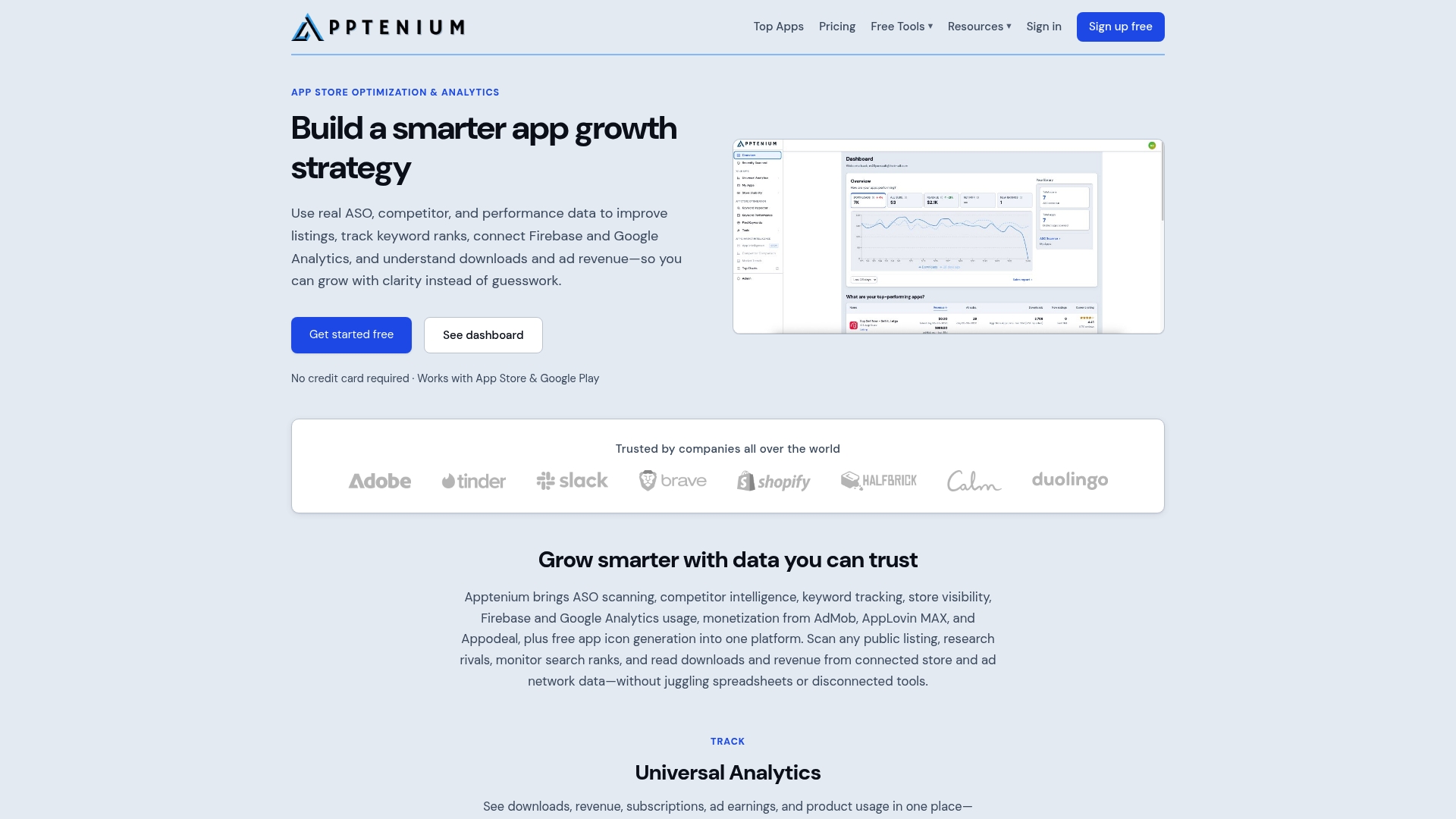
- One dashboard instead of five disconnected reports.
- AI-generated listing edits based on your actual keyword gaps.
- Direct integrations with Firebase, Google Analytics, and ad networks.
Start free or compare our Free and Pro plans to see which fits your team.
FAQ
What counts as keyword growth tracking in app stores?
Keyword growth tracking means monitoring rank, impression share, store listing clicks, and the installs tied to each keyword over time rather than checking position alone. Combining these signals shows whether a keyword is genuinely driving more visibility and installs, not just shifting position.
Which metric should I check first each week?
Start with impression share paired with store listing clicks, since this pair verifies whether visibility is actually converting into interest. Apple Search Ads reports impression share at the keyword level, and Google Play’s acquisition reports do the same for Android.
How do I tell if a keyword gain is real or temporary?
Check whether impressions, clicks, installs, and retention moved together over at least two weeks, since research shows paid spend can temporarily lift organic rank before fading once a campaign ends. A gain confirmed by a store listing experiment carries more weight than a rank jump alone.
Can Apptenium track keyword growth automatically?
The platform tracks keywords, scans listings, and connects to Firebase and Google Analytics so rank, click, and install data update in one dashboard. Pricing for the Free and Pro plans is available on our pricing page.
What’s the best way to detect fake installs or reviews?
Watch for unusual install-to-review timing and device or account clustering, patterns that academic research on Google Play has used to separate ASO-provider devices from genuine users. A sudden spike in installs with no matching rise in impressions or clicks is worth investigating before you count it as growth.
Sources
- Review recommendations - Help - Apple Ads
- Acquisition reporting | Google Play Console
- Store listing experiments | Google Play Console
- Advertising spillovers in mobile apps: Evidence from ad shutoffs and store rankings
- RacketStore: Measurements of ASO deception in Google Play via mobile and app usage