App Descriptions That Convert for Developers: 4–6 Verb Led Bullets

App Descriptions That Convert for Developers: 4–6 Verb Led Bullets
A converting app description opens with one line naming the user and the primary benefit, then backs it up with four to six verb-led feature bullets before it asks for the install. On the App Store, that hook does the conversion work because the description itself isn’t indexed for search. On Google Play, the short description and full description are both indexed, so the same hook has to carry natural keywords too. Rewrite your first 170 to 255 characters first. Everything else follows from that one edit.
TL;DR:
- The app’s short description on Google Play and the first three lines on the App Store are crucial for conversion, requiring a clear hook and benefits.
- Ensure all store fields are correctly filled and optimized, with the app’s metadata, keywords, and promotional text tailored to each platform’s indexing and conversion needs.
- Write the App Store description for persuasion without search constraints, and adapt it for Google Play by integrating natural keywords and maintaining readability.
- Use a structured description format that quickly explains who the app is for, what it does, why it matters, and what sets it apart, to mirror how users decide to download.
- Regularly test and measure changes in impressions, installs, and retention to optimize app descriptions through A/B experiments and avoid common copy mistakes that lower conversion or risk policy rejection.
Table of Contents
- How Do You Write an App Description Step by Step?
- Should You Write Different Copy for Each App Store?
- What Is the Best Structure for an App Description?
- How Do You Test an App Description for Conversion?
- What App Description Mistakes Hurt Installs the Most?
- How Can ASO Tools Speed Up Description Writing?
- An Editor’s Take on Writing App Descriptions
- Try Apptenium’s Free ASO Scanner
- Sources
- FAQ
How Do You Write an App Description Step by Step?
Before you touch a single word of prose, confirm every field is filled and sized correctly. A polished hook buried under a half-empty metadata set still underperforms, because each store weighs different fields for discovery.
Run through this at the editor before you write anything:
- Title (30 characters on App Store, 50 on Google Play): includes your brand name and, ideally, one core keyword.
- Subtitle (App Store only, 30 characters): a second keyword slot, separate from the title.
- Short description (Google Play, 80 characters): this is indexed and often the only copy a searcher sees before tapping through.
- Full description (4,000 characters on both platforms): on Google Play it’s indexed; on the App Store it isn’t.
- Promotional text (App Store only, 170 characters): editable anytime, no app resubmission needed.
- Keywords field (App Store only, 100 characters, comma separated, invisible to users).
Apple indexes the title, subtitle, and keywords field for search. It does not index the description itself, which is why Apple’s own product page guidance frames that field as a conversion tool, not a discovery tool. Google Play works differently: both the short description and full description count toward search ranking, so keyword placement inside the prose actually matters there.
Once every field is populated correctly, make three edits before anything else: rewrite the hook to name the user and the benefit, draft four to six bullets that each lead with a verb, and set your short description or promo text to carry any time-sensitive detail, like a seasonal feature or limited offer.

Should You Write Different Copy for Each App Store?
Yes, and the reason comes down to what each platform actually reads. Treating both stores the same way wastes the field that matters most on each.

App Store: write for the human, not the algorithm
Apple gives you 4,000 characters for the description, but only the first three lines show above the “more” fold, roughly 170 to 255 characters depending on device. Since that visible slice does the majority of conversion work, everything after it is really for the reader who’s already leaning toward downloading. Because the description isn’t indexed for search, you’re free to write it purely for persuasion. That’s also where the 170 character promotional text field earns its keep: Apple lets you update promo text without submitting a new app version, which makes it the right spot for a holiday sale, a new feature drop, or a “now available in Spanish” note.
Google Play: balance keywords with readability
Google Play splits the job differently. The 80 character short description is indexed and often doubles as the snippet searchers see in results, so it needs a real keyword, not just a tagline. The full 4,000 character description is also indexed, which means natural keyword variation inside the prose genuinely helps rank. However, Google’s own policy explicitly bans keyword stuffing and misleading claims. Write sentences a person would actually say; work the keyword in the way you’d mention it to a friend, not the way you’d cram it into a meta tag.
Both platforms also restrict what you can say. Avoid unverifiable superlatives (“the world’s best”), ranking claims you can’t source, pricing or discount language buried in the main description, and testimonials you can’t attribute to a real, verifiable customer. Apple and Google both reserve the right to reject or pull listings that make claims they can’t confirm, so keep pricing promos in the promo text or short description where updates are faster and the policy risk is lower.
Pro Tip: Draft the App Store version first. Once the hook and bullets read well for a human, adapt that same copy for Google Play by folding in two or three natural keyword variants and tightening the short description around your top search term.
What Is the Best Structure for an App Description?
The strongest descriptions follow a sequence that mirrors how a person actually decides to download something: they need to know what it is, why it matters to them, what it does, when they’d use it, why this one and not a competitor’s, whether anyone else trusts it, and what it costs.
- Hook — one sentence naming the user and the core benefit.
- Value expansion — two to three sentences on the problem solved and the outcome delivered.
- Feature to benefit bullets — four to six lines, each starting with a verb, each naming a result rather than a spec.
- Use cases — a short line or two on who uses it and when.
- Differentiation — what makes this app distinct from the obvious alternative.
- Social proof — a verifiable rating, download count, or press mention, if you have one.
- Pricing or CTA — a closing line on cost model or the next step.
For a simple utility app, a compact version of that structure running 350 to 800 characters covers everything a reader needs. For something with more moving parts, like a fintech or health app juggling several use cases, an extended version running 1,000 to 2,500 characters gives each section room to breathe without turning into a wall of text.
Here’s the difference in practice. Before: “Our app helps you manage your tasks with many powerful features and a beautiful design.” After: “Plan your week in under two minutes. Built for freelancers juggling multiple clients, this app turns scattered to-dos into a single daily schedule.” The second version names the user, states the benefit, and implies the outcome. The first says nothing a reader can act on.
Practitioner swipe files of high-converting landing pages show the same pattern outside app stores: headline states the outcome, subhead names the audience, bullets carry the proof. The structure travels well because attention spans don’t change by channel.
How Do You Test an App Description for Conversion?
Rewriting copy is only half the job. Without measurement, you’re guessing whether the new hook actually moved installs or just happened to launch during a good week.
Track four numbers before and after any change: impressions (how often your listing appeared in search or browse), installs, install conversion rate (installs divided by product page views), and a short retention snapshot at day one and day seven to confirm the new copy isn’t attracting the wrong users. On Google Play, also watch keyword rank movement inside Play Console, since a short description change can shift both conversion and discovery at once.
Both platforms support structured experiments:
- App Store product page experiments let you test different screenshots, icons, or preview text against a control, split by treatment group.
- Google Play store listing experiments work similarly, letting you A/B a short description, icon, or feature graphic.
- Good starting hypotheses: “naming the target user in the hook increases install conversion,” “reordering bullets to lead with the top pain point improves conversion from organic search,” or “adding a proof line increases conversion without hurting impressions.”
Run each variant for at least 7 to 14 days depending on your traffic volume before calling a winner. Low-traffic apps need the longer end of that window just to collect enough installs per variant for the result to mean anything. Once a test concludes, pull the winning variant’s conversion data into Firebase or your Play Console dashboard and treat it as your new baseline before you queue the next test.
What App Description Mistakes Hurt Installs the Most?
Two categories of mistake do damage: the kind that gets your listing flagged, and the kind that just quietly loses readers.
Policy risks that can get a listing rejected or pulled:
- Unverifiable awards or “#1 app” ranking claims with no source.
- Promotional pricing or discount language inside the main description instead of the promo text or short description field.
- Testimonials or quotes you can’t attribute to a real, checkable source, which Google’s own guidance flags directly.
Copy problems that quietly kill conversion:
- Leading with a feature dump instead of the hook, so the benefit shows up in line eight instead of line one.
- Adjective stacks like “powerful, intuitive, seamless experience” that name no outcome a reader can picture.
- Vague superlatives (“the best way to manage your life”) instead of a specific, concrete result.
If your current listing has any of these, here’s a fix that takes under 30 minutes: move any pricing or promo language out of the main description into the promo text field, rewrite the first sentence to name the user and the benefit, cut every adjective that isn’t attached to a specific outcome, and reorder your bullets so the strongest one leads.
How Can ASO Tools Speed Up Description Writing?
A scanner that audits your live listing against competitor keywords and current field usage will surface gaps a manual read-through misses, like a missing keyword in your short description or a subtitle that duplicates your title instead of adding a second term.
- Run a scan first to find which fields are underused before you rewrite anything.
- Treat AI-generated phrasing as a starting draft, not a final line. Feed it your rewritten hook and let it suggest bullet variations, but rewrite anything that reads generic.
- Prioritize edits by potential impact. Weighing search traffic estimates against your current rank gap for a term gives a better return on editing time than chasing the highest raw search volume.
- Connect scanner findings to Play Console and Firebase data so you know whether an edit actually moved installs, not just impressions.
Apptenium’s free ASO scanner preview runs this exact audit without a credit card and pairs it with analytics integrations for measuring what happens next.
An Editor’s Take on Writing App Descriptions
Most developers over-edit the paragraph nobody reads and under-edit the first line everybody sees. Fix that ratio before anything else. Prioritize the hook, measure what changes when you touch it, and resist the urge to cram in every keyword you can think of. Clarity converts; density doesn’t. I’ve spent years watching app teams chase ASO tactics while ignoring the fifteen words that actually decide whether someone taps “install.”
— Mike
Try Apptenium’s Free ASO Scanner
This platform offers a scanner-first workflow as described in this article, without stitching together three separate tools to get there. One scan surfaces metadata gaps, provides AI-generated suggestions for hooks and bullets, tracks keywords against competitors, and pulls in Firebase and Google Analytics data to help see whether a rewrite actually moved installs.
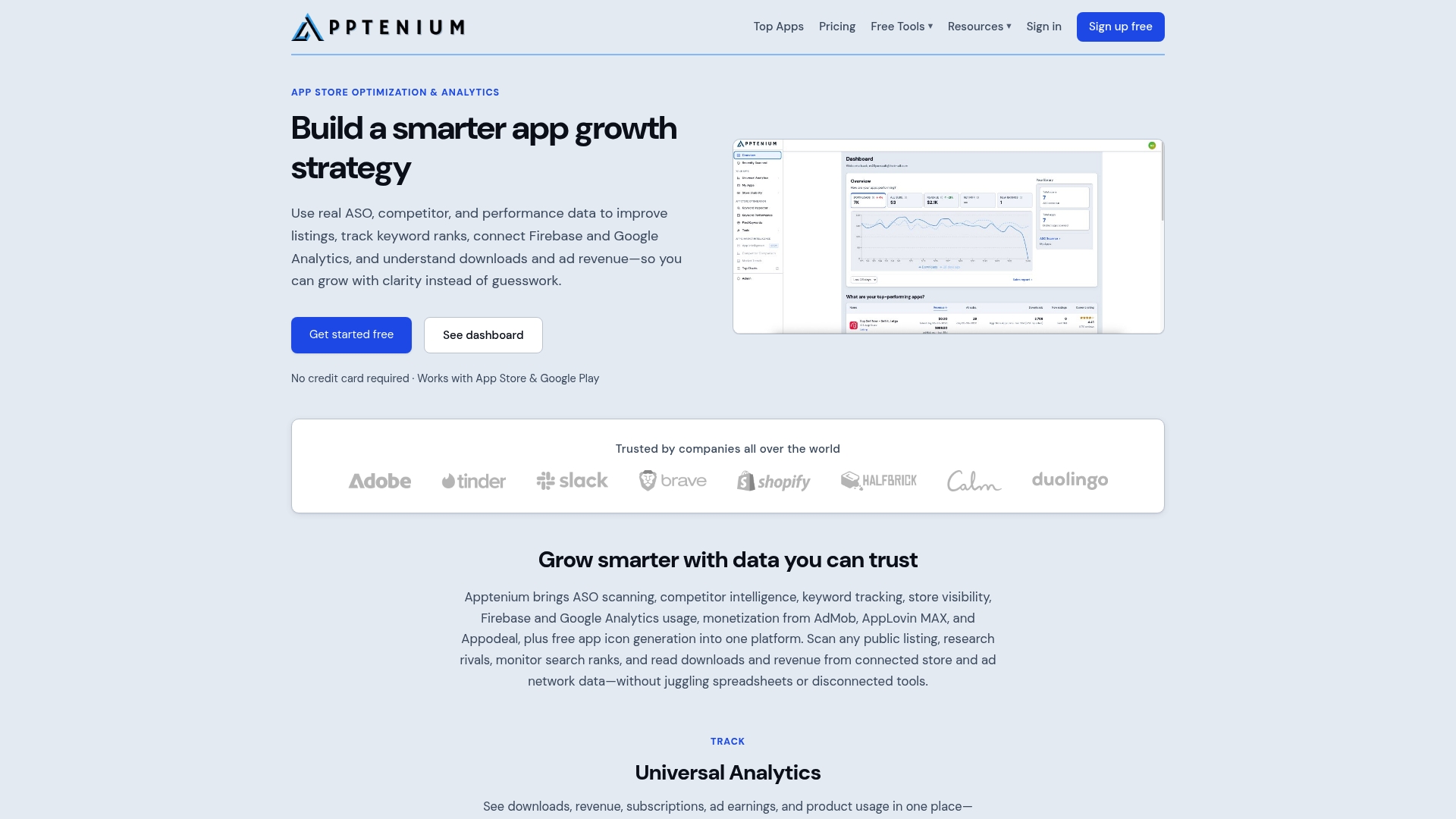
Compared to piecing together a keyword tool, a competitor tracker, and a separate analytics dashboard, this platform keeps the scan, the recommendation, and the performance check in one place, so you spend your time rewriting copy instead of reconciling spreadsheets. Run the free ASO scanner preview on your current listing, no credit card required, and see which fields need the edits this article covers. If you’re comparing tools for a small team or startup budget, the ASO tool comparison for SMBs breaks down where Apptenium fits against the alternatives.
Sources
For anything beyond this guide, go straight to the platforms and the practitioners who track their updates closely.
- Creating Your Product Page - App Store
- Best practices for your store listing - Play Console Help
- App Store Description: The 4,000-Character Guide (2026) — LaunchShots
FAQ
What is an app description?
An app description is the marketing copy on your store listing that tells a potential user what the app does, who it’s for, and why they should install it. It sits alongside your title, screenshots, and reviews as one of the main conversion elements on the page.
How do you describe an app in a way that converts?
Open with one sentence naming the user and the main benefit, then follow with four to six verb-led bullets that each state a concrete outcome instead of a raw feature. On the App Store, that opening line matters most because only the first 170 to 255 characters show before the “more” tap.
How do I start writing an app description if I’ve never done it before?
Start with the App Store version, since the description there is purely persuasive with no indexing pressure. Write the hook first, list your three strongest features as benefit statements, then adapt that same copy for Google Play by adding natural keyword variants to the short and full descriptions.
Can you give examples of app types that need different description approaches?
A utility app like a to-do list or calculator usually works best with a compact 350 to 800 character description built around one clear use case. A multi-feature app like a fitness tracker, budgeting tool, language learning app, or telehealth platform benefits from the extended 1,000 to 2,500 character structure, since it needs to cover several use cases and differentiators. Games, social apps, and productivity suites each shift emphasis slightly, games toward mood and visuals, social apps toward community proof, productivity tools toward time saved, but the hook first, bullets second structure holds across all of them.