Turn Rank Into Installs: App Keyword Tracking for Developers

Turn Rank Into Installs: App Keyword Tracking for Developers
App keyword tracking means monitoring where your app ranks for specific search terms across stores and locales, then connecting those rank movements to impressions and installs. If you haven’t started, your next move is simple: baseline 10 to 20 target phrases across your priority stores and locales, then begin snapshots, daily for your top keywords, weekly for the rest. Both Apple and Google Play publish guidance on how search surfaces work, and tools like Apptenium exist to run this workflow without stitching together spreadsheets.
TL;DR:
- Tracking search impressions and install conversion rates is crucial, as visibility alone does not guarantee downloads.
- Prioritize long-tail, locally relevant keywords and measure their performance over time rather than relying solely on difficulty estimates.
- Target high-volume markets with higher tracking frequency and integrate impression data with analytics platforms for accurate attribution.
- Run metadata tests only after establishing baselines, allowing enough time to account for indexing lag and seasonal demand shifts.
- Use dedicated ASO tools like Apptenium to automate workflow, monitor keyword trends, and connect rank changes to actual revenue and retention metrics.
Table of Contents
- What app keyword tracking is and why it matters for ASO
- Which metrics to track in your keyword performance dashboard
- Choosing and prioritizing your keyword basket
- Setting up tracking: snapshots, automation, and integrations
- Localization and custom listings change your tracking priorities
- Cadence, experiments, and reading rank movement correctly
- How Apptenium runs this workflow end to end
- Priorities differ by team size
- Try Apptenium for your own ASO tracking
- FAQ
- Sources
What app keyword tracking is and why it matters for ASO
Keyword rank tells you where your app shows up for a given search term. Impressions tell you how many people saw your listing after that search. Install conversion rate tells you how many of those viewers actually installed. Discoverability depends on the first two; conversion depends on everything else, your icon, screenshots, and reviews.
The two major stores handle keyword surfaces differently:
- iOS uses a dedicated 100-character keywords field plus title and subtitle, invisible to users but readable by Apple’s search index.
- Google Play has no hidden keyword field; it derives relevance from your long description and other visible metadata.
- Both stores let you target specific audiences through custom product pages and custom store listings.
Behavioral signals, downloads, ratings, and review velocity amplify or mute whatever you do with metadata. A perfectly optimized title will not rescue an app with a weak rating trend.
Which metrics to track in your keyword performance dashboard
A keyword tracking setup only earns its keep when you watch the right combination of numbers, not just rank position.
- Per-keyword rank by store, country, and locale, tracked as a trend, not a single snapshot.
- Search impressions, installs from search, and install conversion rate for each tracked phrase.
- Rating and review velocity, since both stores weigh behavioral signals in ranking.
- Retention signals, which increasingly factor into how stores judge app quality over time.
One keyword moving from rank 30 to the top 10 can matter less than a smaller rank gain on a high-impression phrase, because conversion on that phrase determines whether the visibility turns into installs. Difficulty and traffic estimates you see in most tools are proxies, built from rating averages, rating counts, and competitor strength, so treat them as relative signals rather than fixed truths. Watch the deltas week over week instead of fixating on an absolute difficulty score, and always pair a rank change with its conversion data before deciding it means anything.
Choosing and prioritizing your keyword basket
Picking keywords is less about brainstorming and more about running a repeatable filter.
- List 10 to 20 phrases that reflect real user intent, favoring 2 to 4 word search phrases over single words.
- Score each phrase by difficulty against opportunity, and weight local market intent rather than assuming a global list works everywhere.
- Group phrases by intent, for example “budget tracker” versus “expense splitting,” and assign each group to a custom product page or listing experiment.
- Localize by intent, not by direct translation, since different markets search for the same feature in different words.
Practitioner guidance on tracking search phrases consistently favors multi-word phrases over single keywords because they map more closely to how people actually search.
Pro Tip: Start with long-tail phrases you can realistically rank for in the first month, then reinvest the traffic data into sharpening your higher-competition targets.
Setting up tracking: snapshots, automation, and integrations

A minimum viable tracking setup needs five things: your keyword list, app IDs for each store, your target locales, a snapshot cadence, and a place to store history so you can see trends instead of isolated data points.
From there, decide what your tooling needs to deliver, such as features offered by an Amazon Seller Keyword Tool & Rank Tracker for comprehensive tracking.
- Rank history and deltas over time, not just a current position.
- Impression and conversion data tied to specific keywords where the store allows it.
- Alerting when a tracked phrase moves sharply in either direction.
- Exportable data so you can line up a metadata change against the resulting rank and conversion shift.
Self-hosted options, like the open-source trackers documented on GitHub, give indie developers a low-cost, transparent starting point, often built on the iTunes Search API. A SaaS platform trades some of that manual control for integrations with Firebase and Google Analytics, which matter once you want to attribute installs from search to actual revenue or retention, not just download counts.
Localization and custom listings change your tracking priorities
Custom product pages on iOS and custom store listings on Google Play let you target specific keyword intent segments with tailored screenshots, descriptions, and even pricing, rather than showing every searcher the same default page.
- Localize copy around how each market actually searches, not a literal translation of your primary language.
- Give priority markets higher tracking cadence and a larger keyword basket, since they carry more of your install volume.
- Connect store impression data from Play Console or App Store Analytics to Firebase or Google Analytics so you can see which market and keyword combination actually produces installs, not just views.
Per-market tracking turns a single global keyword list into several smaller, sharper ones.
Cadence, experiments, and reading rank movement correctly
Track your highest-priority keywords daily and everything else weekly: frequent enough to catch real shifts, infrequent enough to avoid chasing noise.
- Baseline your current ranks and conversion rate before making any change.
- Change one metadata element at a time, ideally with a control market left untouched.
- Measure both rank and conversion together before deciding the change worked.
Indexing lag, seasonal demand, store algorithm updates, and review spikes all create movement that has nothing to do with your last metadata edit. Baselining before you test is what separates a real signal from background noise.
Pro Tip: Give any metadata experiment at least a full index cycle, often several days, before you read the results.
How Apptenium runs this workflow end to end
Running this process by hand across two stores, several locales, and multiple analytics tools gets tedious fast. A typical ASO platform walks through it in order:
- Scan your current listing metadata to flag weak or missing keyword opportunities.
- Select 10 to 20 target phrases based on the scan and your own market knowledge.
- Run snapshots across stores and locales on a schedule you set.
- Pull in Firebase and Google Analytics data so rank changes connect to actual installs and revenue, not just visibility.
- Iterate on metadata and creative based on what the combined data shows.
Recommendations may surface alongside each scan, pointing at specific copy and keyword fixes rather than leaving you to interpret raw numbers alone.
Priorities differ by team size
If you’re a small team, resist the urge to track 50 keywords. Pick a tight basket, run fast snapshots, and test one or two creative changes at a time, you’ll learn faster with less noise. Larger teams with dedicated ASO resources can afford to scale per-market tracking, build richer attribution models, and automate experiments across many locales at once. Either way, the next step is the same: baseline, snapshot, and measure before you change anything else.
— Mike
Try Apptenium for your own ASO tracking
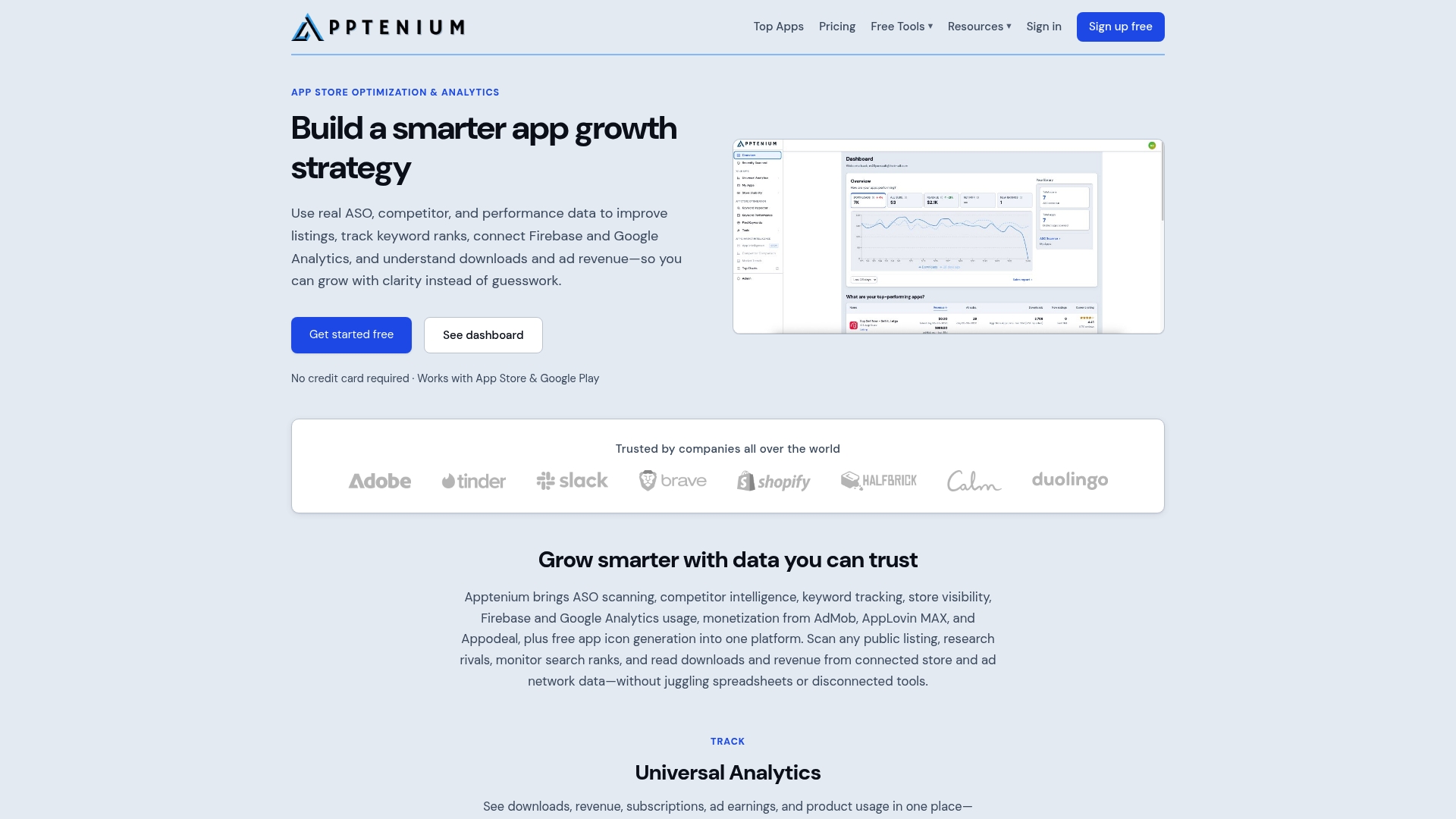
We built Apptenium to bring ASO scanning, keyword tracking, competitor intelligence, and Firebase and Google Analytics integrations into one place, so you aren’t jumping between five tabs to answer one question about your rankings.
- Start free with limited monthly scans, no commitment required.
- Upgrade to a paid plan for unlimited scans and premium features.
Check Apptenium’s pricing and pick the plan that matches where your app is today.
FAQ
What are the best keyword tracking tools?
The right tool depends on your budget and technical comfort: self-hosted options like the open-source aso-tracker project suit developers who want transparency and control, while SaaS platforms like Apptenium add integrations with Firebase and Google Analytics for revenue attribution. Look for rank history, deltas over time, and exportable data regardless of which route you choose.
How to check what apps are tracking you?
This question usually refers to app privacy tracking, not ASO keyword tracking, and both iOS and Android let you review which apps request tracking permissions in your device’s privacy settings. Check your phone’s app permissions menu under privacy or tracking to see which apps have requested access and revoke it if needed.
How to choose App Store keywords?
Start with 10 to 20 phrases of 2 to 4 words that reflect real user intent, then prioritize them by weighing difficulty against opportunity in your target markets. Apple’s own guidance recommends assigning specific keywords to custom product pages rather than relying on one generic set for every audience.
How to make an app request tracking?
On iOS, implementing the App Tracking Transparency framework triggers the system permission prompt that asks users to allow or deny tracking before you collect any cross-app data. This is a developer-side implementation task governed by Apple’s App Store review guidelines, separate from the keyword tracking workflows covered in this guide.