Does a Keyword Stuffing Penalty Apply to App Store Listings?
Does a Keyword Stuffing Penalty Apply to App Store Listings?
Yes. Both Apple and Google penalize keyword stuffing in app metadata, and the consequences run from a same-day metadata rejection to slow ranking suppression that quietly buries your listing. If you’ve packed your title, subtitle, or keywords field with repeated terms, competitor names, or promotional superlatives, it’s best to pause and review your listing carefully.
- Pause any planned metadata update that leans on aggressive keyword lists.
- Pull up your current listing in App Store Connect or Google Play Console and read it the way a reviewer would.
- Run a quick scan with a tool like Apptenium’s ASO scanner to catch flagged patterns before you resubmit anything.
Key Takeaways
App stores penalize keyword stuffing through a mix of instant metadata rejections and slower, harder-to-spot ranking suppression driven by poor conversion.
| Point | Details |
|---|---|
| Penalties are real on both stores | Apple and Google both reject or suppress listings with stuffed, repetitive, or deceptive metadata. |
| Rejection often needs no new build | Most metadata rejections clear by editing the flagged field and resubmitting the same binary. |
| Ranking suppression is silent | A listing that reads like a keyword list can lose visibility through poor conversion, with no rejection notice at all. |
| Audit per locale, not once | Check title, subtitle, keywords field, and description separately in every market you support. |
| Apptenium flags triggers before submission | Its ASO scanner checks metadata against known spam patterns and ties fixes to Firebase and Google Analytics conversion data. |
Table of Contents
- What Triggers a Keyword Stuffing Penalty on iOS and Android?
- How Does a Keyword Stuffing Penalty Actually Show Up?
- How Do You Audit Your App Listing for Stuffing Risk?
- What’s the Fastest Way to Fix and Appeal a Keyword Stuffing Penalty?
- How Do You Prevent a Keyword Stuffing Penalty Before It Happens?
- What the Enforcement Data Actually Tells You
- How Apptenium Helps You Stay Ahead of a Keyword Stuffing Penalty
- Where to Check Official App Store Policy
- Sources
- FAQ
What Triggers a Keyword Stuffing Penalty on iOS and Android?
Both stores flag the same basic behavior: metadata written for algorithms instead of people. Apple’s own guidance on App Store search lists the usual suspects, and they show up in rejection notes constantly:
- Titles or subtitles using all capital letters to grab attention.
- Emoji clusters or special characters used excessively for visual effect.
- Competitor app names or platform trademarks included in your keywords to improve ranking.
- Promotional superlatives such as “#1 app” or “best free app ever” that Apple considers unverifiable claims.
- The same keyword repeated across title, subtitle, and keywords field until it feels like a list, not a sentence.
iOS specifics: you get exactly 100 characters in the keywords field, and Apple explicitly warns that promotional text in that field does nothing for ranking. Duplicating a word already in your title wastes space Apple has indexed elsewhere, and trademarked or competitor terms can trigger a flag even if the rest of your listing is clean.
Android specifics: Google Play indexes your visible long description, so keyword lists hidden at the bottom of it are not actually hidden from enforcement. Google Play’s metadata guidelines call out repetitive or irrelevant keywords, deceptive claims, and inflated single-word repeats as policy violations, not gray areas.
Pro Tip: Read your title and subtitle out loud. If it doesn’t sound like something a person would say to describe the app, a reviewer will probably flag it too.
How Does a Keyword Stuffing Penalty Actually Show Up?
Enforcement rarely looks the same twice, but it tends to follow one of four patterns.
- Metadata rejection. This is the most common outcome and the easiest to fix, since it usually only requires editing the flagged field and resubmitting, not a new binary.
- Listing removal or account suspension. Repeated or severe violations escalate here. Google Play’s enforcement documentation notes that prior versions of an app can be removed and that suspensions can block future publishing entirely.
- Ranking suppression. No rejection notice arrives at all. Instead, a listing crammed with keywords converts poorly, and lower install rates from impressions quietly push the app down search results over time.
- Automated pre-filter, then human review. Obvious violations like all-caps titles or emoji spam often get caught and rejected automatically before anyone reads the listing; nuanced cases go to a person, which is part of why enforcement can feel inconsistent from one submission to the next, as developers have documented on Stack Overflow.
How Do You Audit Your App Listing for Stuffing Risk?
Run this checklist per locale, not just once for your primary market.
- Pull every metadata field. Title, subtitle or short description, the iOS keywords field, and the Android long description all need a separate pass.
- Scan for banned elements. Look specifically for competitor names, unauthorized trademarks, and any word repeated five or more times across the listing.
- Check your conversion signals. A sudden drop in impressions-to-install ratio, or a falling click-through rate with no obvious cause, often means your listing is reading as spammy to algorithms even if no rejection ever landed.
- Read the actual console message. Before changing a single word, open the Resolution Center note or Play Console policy citation and identify exactly which field and which rule triggered it.
Pro Tip: Don’t rewrite your whole listing after one flag. Fix the cited field first, resubmit, and confirm clearance before touching anything else. Overcorrecting often creates a second, unrelated issue.
What’s the Fastest Way to Fix and Appeal a Keyword Stuffing Penalty?
Most metadata rejections don’t require a new build. The remediation path that clears fastest is narrow: read the citation, edit only that field, resubmit the same binary, and monitor the console until it clears.
- Identify the exact element named in the Resolution Center or Play Console message. Don’t guess.
- Edit only the flagged field. Touching unrelated metadata slows review and adds risk.
- Resubmit, since most metadata fixes don’t need a new binary upload.
- If the flag seems wrong, appeal with specifics: screenshots of the prior listing, a short change log, and a plain explanation of what you fixed.
Timelines vary by severity. A single flagged keyword field in a first-time metadata rejection often clears within a normal review cycle. Account-level actions, like a suspension tied to repeated violations, take longer and demand more documentation to reverse. One long-running developer thread on Android keyword spam rejections shows how the same app can get flagged inconsistently across updates, which is exactly why a clear paper trail matters when you appeal.
How Do You Prevent a Keyword Stuffing Penalty Before It Happens?
Prevention is mostly a matter of discipline in four places.
iOS checklist:
- Title at 30 characters or fewer.
- Subtitle at 30 characters or fewer.
- Keywords field at 100 characters or fewer, comma-separated, no duplicate words from your title, no competitor or brand names.
- No special characters unless they’re part of your actual brand name.
Android checklist:
- Treat your short description (80 characters) as high-value real estate, not filler.
- In the long description, use your top keywords naturally two or three times. Don’t build a visible keyword list at the bottom.
- Avoid hidden text tricks entirely. Google Play’s crawlers index the full visible description.
Because Android indexes your visible description and iOS hides its keywords field from users entirely, the same word can behave very differently depending on the store — a phrase that’s safe to repeat once in an Android description could be redundant clutter in an iOS title.
Localization matters here too. Translate the intent of your keyword strategy per locale, not the literal words. What converts in English rarely converts the same way translated word-for-word into German or Japanese.

Pro Tip: A/B test a readable, benefit-led title against a keyword-heavy one. Track installs per impression, not just raw keyword rank. The version that reads like a sentence usually wins on conversion even when it “loses” on paper keyword count.
What the Enforcement Data Actually Tells You
Most developers treat keyword stuffing as a binary risk: either you get flagged or you don’t. That framing misses the more expensive version of the problem. A listing can pass every automated check and still underperform because it reads like a list instead of a pitch. Algorithms on both stores weight post-click engagement, so a title stuffed with search terms that never converts a browser into an installer gets buried anyway, no rejection notice required.

The conventional advice, “just avoid the banned words,” treats this as a compliance checkbox. It’s really a conversion problem wearing a policy costume. The developers who recover fastest from a flag aren’t the ones who memorize Apple’s and Google’s rulebooks. They’re the ones who treat every keyword field as a place to earn a click from a real person first, and pass the automated filters as a byproduct of writing that way.
If you take one thing from the research: fix the cited field, then check your install conversion, not just your rejection status. A cleared listing that still converts poorly hasn’t actually solved anything.
How Apptenium Helps You Stay Ahead of a Keyword Stuffing Penalty
Catching a spam trigger before you submit costs you five minutes. Catching it after a rejection or a suspension costs you days, and sometimes installs you never get back. Apptenium’s ASO scanner checks your title, subtitle, keywords field, and description against the exact patterns that trigger enforcement, all-caps, competitor names, repeated keyword blocks, and flags them before you resubmit anything.
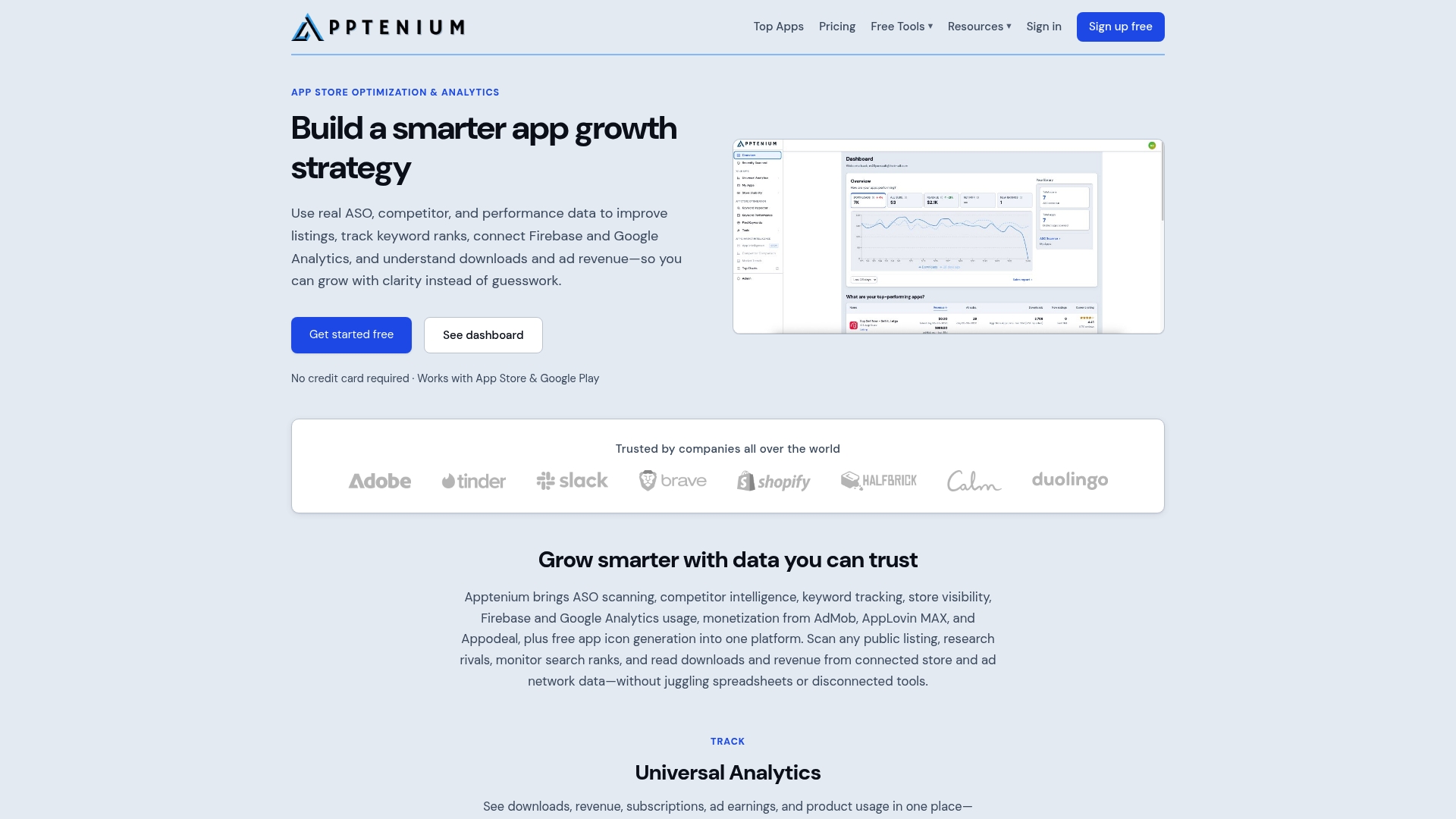
What makes the difference for teams managing more than one listing is what happens after the fix. Apptenium ties your metadata changes to Firebase and Google Analytics data, so you can see whether a rewritten description actually improved your conversion-to-install rate, not just whether it cleared review. That’s the gap most audits miss: passing the filter and improving performance are two different outcomes.
If you’re managing listings across multiple markets or apps, start with a free preview scan on your current metadata, or compare your setup against other ASO tools built for smaller teams before you commit to a workflow.
Where to Check Official App Store Policy
Before you edit a flagged field, read the source policy directly rather than relying on secondhand summaries.
- App Store search guidance covers Apple’s keyword and metadata restrictions.
- Creating your product page explains the 100-character keywords field and custom product pages.
- Google Play metadata guidelines list prohibited tactics and real violation examples.
- Enforcement actions and appeals details how Google Play combines automated and human review.
Sources
- App Store search - App Store - Apple Developer
- Creating Your Product Page - App Store - Apple Developer
- Metadata guidelines - Google Play Console Help
- Enforcement actions and appeals - Google Play Console Help
FAQ
What counts as keyword stuffing in an app store listing?
Repeating the same word across your title, subtitle, and keywords field, using competitor names, or padding descriptions with unnatural keyword lists all count as keyword stuffing under Apple and Google policy.
Can keyword stuffing get my app removed from the store?
Yes, repeated or severe violations can lead to listing removal or account suspension, not just a metadata rejection, according to Google Play’s enforcement policy.
Do I need to submit a new app build to fix a metadata rejection?
Usually not. Most metadata rejections only require editing the cited field in App Store Connect or Play Console and resubmitting the same binary.
How long does a keyword stuffing penalty last?
A single metadata rejection often clears within a normal review cycle once fixed. Account-level suspensions tied to repeated violations take longer and require more documentation to appeal.
How can I check my app listing for keyword stuffing before submitting?
Run your title, subtitle, keywords field, and description through a scanner like Apptenium’s ASO scanner, which flags common spam triggers before you submit.