App Marketers: Portfolio Keyword Tracking with 2–4 Word Phrases Weekly

App Marketers: Portfolio Keyword Tracking with 2–4 Word Phrases Weekly
Portfolio keyword tracking means monitoring how every app in your lineup ranks for the same set of search phrases across app stores and locales, then connecting those ranks to real store metrics. The recommended approach: track 2 to 4 word phrases per app and locale, snapshot ranks weekly, and tie every rank change to impressions, product page views, conversion rate, and installs so you know which moves actually matter.
TL;DR:
- Tracking 2 to 4 word phrases per app and locale weekly helps identify meaningful rank changes linked to store metrics like installs and conversions.
- Diverse metrics such as unique impressions, product page views, and conversion rates are essential for accurately assessing keyword performance.
- Prioritizing high-value, high-traffic keywords close to page one yields better results than evenly distributing efforts across all apps or keywords.
- Pairing metadata coverage with live rank snapshots reveals listing issues causing ranking or conversion drops, especially in large portfolios.
- Using automation and integrating data from platforms like Firebase or ad networks enhances tracking accuracy and prevents duplicated spend on highly ranked phrases.
Table of Contents
- Portfolio fundamentals: what to track and why
- Key metrics and signals for portfolio keyword tracking
- How we track and report on a portfolio week to week
- Organizing keywords across apps, markets, and locales
- Scaling with automation and integrations
- Common challenges and troubleshooting in portfolio keyword tracking
- Examples of effective portfolio keyword tracking strategies
- Tools comparison for portfolio keyword tracking
- What experience with multi-app tracking actually teaches you
- Try Apptenium for your app portfolio
- FAQ
- Sources
Portfolio fundamentals: what to track and why
Before you track anything across a portfolio, you need to agree on what the numbers mean. Apple and Google define acquisition metrics slightly differently, and mixing them up leads to false conclusions when you compare apps across stores.
On the App Store, Apple’s metric definitions describe conversion rate as total downloads and pre-orders divided by unique device impressions, with installations and product page views tracked as separate acquisition metrics. On Google Play, the Play Console acquisition guidance centers on visitors, click-through rate, and search-term data, with unique clicks treated as a core listing performance signal, a topic covered in detail on Save Your App — Find out why your app isn’t growing.
Here is why phrase-level tracking matters more than single keywords: real searchers type phrases, not isolated words, and a 2 to 4 word phrase usually signals clearer intent than a one-word query ever could. Matching your tracking to that behavior gives you cleaner signal.
The funnel below is the backbone of portfolio tracking:
- Impressions show how often your listing appeared for a searched phrase.
- Product page views show how many of those impressions led to a visit.
- Conversion rate shows how many visits became downloads.
- Installs confirm the phrase is producing actual users, not just visibility.
Every rank you track should map to this chain. A phrase that ranks well but never converts is a metadata problem, not a ranking win.
Key metrics and signals for portfolio keyword tracking
Once the funnel is clear, the next step is deciding what to measure per keyword and per app. A handful of metrics and derived signals carry most of the weight.
- Unique impressions per keyword: tells you how visible a phrase actually is, separate from total impressions that can double count repeat views.
- Product page views: your clearest read on whether the listing itself is compelling once a searcher clicks through.
- Conversion rate: the ratio that ties keyword visibility to real downloads, as App Store Connect defines it.
- Unique clicks on Google Play: Play Console’s conversion analysis treats unique install, open, and pre-register clicks as the core listing signal, so weight those over raw traffic.
Opportunity scoring, which weighs a keyword’s estimated value against the difficulty of ranking for it, is a common way ASO teams prioritize terms when direct search-volume data is not available. Because official volume data is limited on both stores, this kind of relative scoring tends to be more reliable than chasing absolute numbers.
Two more derived signals round out a portfolio view: ranking velocity, which flags phrases moving up or down faster than normal, and the gap between metadata coverage and live rank, since coverage tools show what you can rank for while live tracking confirms whether you actually do. For high-traffic apps, prioritize phrases close to page-one thresholds. For low-traffic apps, prioritize phrases with the clearest intent match, since they will not have the volume to recover from a mismatched click.
How we track and report on a portfolio week to week
A portfolio only stays under control with a repeatable cadence. Here is the rhythm that scales across many apps without burning a team out:
- Daily: run lightweight rank checks on your highest-revenue apps only, scanning for sudden drops.
- Weekly: take a full snapshot across every app, market, and tracked phrase, and store it as a baseline for comparison.
- Weekly: compute week-over-week deltas against the prior snapshot to catch ranking velocity before it becomes a trend.
- Monthly: review the full portfolio against goals, retire stale keywords, and reprioritize based on opportunity scores.
Keep snapshot history rather than overwriting it. A single week’s drop can be noise, but a pattern across four snapshots is a signal worth acting on.
Set alert rules so a meaningful rank change (say, falling out of the top 10 for a converting phrase) routes to the ASO owner, while broader trend summaries go to product or growth teams in a weekly digest.
Pro Tip: Snapshot every tracked keyword at the same time of day across your portfolio so week-over-week deltas reflect real movement, not time-of-day noise.
Organizing keywords across apps, markets, and locales
A portfolio without a naming structure turns into a spreadsheet nobody trusts. A simple taxonomy keeps things navigable as the number of apps grows: app, then product area within that app, then search intent, then locale.
- App: the top-level bucket, matching your store listing identity.
- Product area: the feature or use case a keyword cluster maps to, such as “budgeting” or “habit tracking.”
- Intent: whether the searcher is comparing options, looking for a specific feature, or ready to download.
- Locale: the market and language combination, since the same intent often needs different phrasing per region.
Localize by intent rather than by literal translation. A phrase that converts well in one market can fail elsewhere if the direct translation does not match how people actually search there, a pattern documented in self-hosted ASO tracker projects that build localization logic around intent rather than word-for-word translation.
Keep two separate lists per app: a canonical list of keywords you actively optimize metadata around, and an experiment list reserved for product page optimization tests, so a short-term test never contaminates your core tracking data.
Scaling with automation and integrations
Tracking ranks in isolation only gets you halfway. The real value comes from connecting keyword performance to what happens after the install, which means wiring your tracking into the platforms that already hold that data.
- Firebase and Google Analytics: connect install events and in-app conversions back to the keyword and locale that drove them.
- Ad networks: cross-reference organic keyword performance against paid campaigns targeting the same terms, so you are not duplicating spend on phrases you already rank for.
- API-driven snapshots: schedule exports on a fixed cadence instead of pulling data manually across dozens of apps.
We built a platform around this exact gap: all ASO tools unified in one place with AI recommendations, integrating monetization and ad performance data alongside listing work and keyword tracking, so teams avoid tool sprawl and complexity. Copy-ready fixes come out of every scan, with integrations to the major ad and analytics platforms already wired in.
Pro Tip: Attach UTM parameters to any paid campaigns targeting your tracked keywords so your acquisition reports separate organic rank gains from paid lift.
Common challenges and troubleshooting in portfolio keyword tracking
The most common failure mode in portfolio tracking is treating every app the same way. A ten-app portfolio with wildly different revenue per app needs different tracking depth per app, not a uniform checklist.
A second recurring issue is rank data that looks fine while conversion quietly drops. If a phrase holds its position but product page views or conversion rate slip, the problem usually sits in the listing itself, screenshots, icon, or description, not in the ranking algorithm. Pulling the App Store Connect acquisition reports alongside your rank history usually isolates whether the drop is a visibility problem or a listing problem.
Locale mismatches cause a third class of trouble. A keyword that was translated rather than localized for intent can rank well and still convert poorly, because the phrase does not match how people in that market actually search.
Finally, teams managing many apps often let snapshot history lapse, deleting old data to save storage and losing the ability to spot slow, multi-month declines. Retaining history, even in a lightweight compressed form, is worth the storage cost the first time it catches a six-week slide you would have otherwise missed.
The fix for most of these issues is the same: pair metadata coverage analysis (what you could rank for) with live rank snapshots (what you do rank for), since the gap between the two usually points straight at the problem.

Examples of effective portfolio keyword tracking strategies
A travel app portfolio with apps across five markets gets more value from clustering keywords by intent, booking, browsing, deal-hunting, than from tracking every literal phrase variation. Tracking “cheap flights [city]” as one intent cluster per locale, rather than a dozen near-duplicate phrases, keeps the dataset readable and the deltas meaningful.
A fintech portfolio with one flagship app and several regional spinoffs often benefits from a shared canonical keyword list at the parent level, with each regional app layering on local intent phrases. This avoids duplicating tracking work while still catching market-specific opportunities.
For a utility app competing on a narrow set of high-intent phrases, weekly snapshots paired with tight alert thresholds (any drop of more than three positions) catch problems fast, since a single phrase might drive a large share of installs.
Across these patterns, the common thread is matching tracking depth to where the revenue actually sits in the portfolio, not spreading equal attention across every app and every keyword.
Tools comparison for portfolio keyword tracking
Teams managing a portfolio generally choose between three approaches: self-hosted tracking scripts, single-purpose ASO point tools, and unified platforms that combine tracking with listing and performance data.

Self-hosted options, like the patterns shown in the open-source aso-tracker project, offer full control over snapshot logic and are a reasonable fit for a developer comfortable maintaining infrastructure for one or two apps. They demand ongoing engineering time that grows with portfolio size.
Single-purpose keyword trackers handle rank snapshots well but usually require a separate tool for metadata scanning and another for monetization data, which recreates the fragmented-analytics problem portfolio teams are trying to escape in the first place.
Unified platforms fold keyword tracking, metadata scanning, and performance reporting into one view. That matters most once a portfolio crosses a handful of apps, since the time saved not reconciling exports from three tools compounds every week. We built a platform as this kind of option, pairing keyword tracking with AI-powered listing recommendations and integrated monetization data, specifically for teams past the point where a single spreadsheet or script can keep up.
What experience with multi-app tracking actually teaches you
Tracking depth and portfolio breadth trade off against each other. You cannot give fifteen apps the same granular attention as two, so the real skill is deciding which apps and which keywords earn that depth.
My heuristic: prioritize keywords that drive conversions in your highest-revenue territories first, then expand coverage outward. Smaller teams should budget tracking effort the same way they budget ad spend, concentrated, not evenly spread.
— Mike
Try Apptenium for your app portfolio
We built a platform around the exact workflow this guide describes: keyword tracking, metadata scanning, competitor intelligence, and performance reporting in one place, with AI-powered recommendations that turn a rank drop into a copy-ready fix instead of a mystery. Analytics and ad network data can connect directly, so a conversion dip shows up next to the keyword that caused it rather than in a separate export.
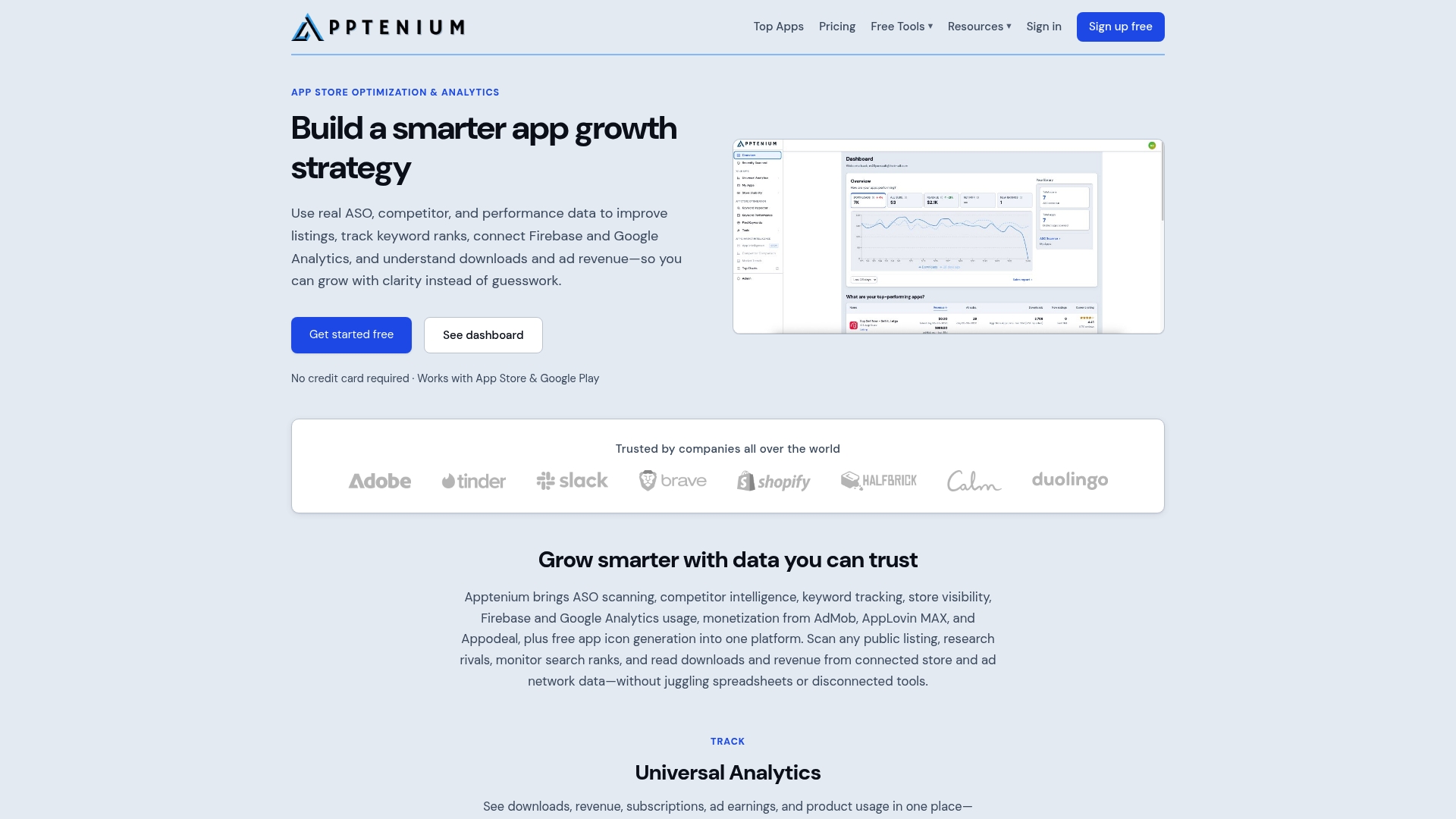
The Free plan covers a limited number of scans a month, enough to test the workflow on your core apps, and the Pro plan at $9.99 per month unlocks unlimited scans for teams tracking a full portfolio. Check Apptenium pricing to see which tier fits your current app count.
FAQ
How many keywords should I track per app?
There is no fixed number that works for every app. A practical approach is to track your full canonical list plus a smaller experiment list reserved for product page optimization tests.
How often should I snapshot keyword rankings?
Weekly full snapshots across your portfolio catch most meaningful changes without generating noise, while daily lightweight checks on your highest-revenue apps flag sudden drops faster. Monthly reviews then use that snapshot history to guide bigger strategy decisions.
What’s the difference between metadata coverage and live rank tracking?
Metadata coverage analysis shows which terms your listing could plausibly rank for based on your current text and keywords, while live rank tracking confirms whether you actually rank for those terms right now. Pairing both closes the gap between what should work and what is actually happening in search results.
Should I translate keywords or localize them for each market?
Localize by intent rather than translating literally, since a direct translation often does not match how people in that market actually search. Projects like the open-source aso-tracker build their localization logic around matching intent per locale rather than word-for-word translation.
Can Apptenium track keywords across my entire app portfolio?
Yes, keyword tracking across multiple apps and locales is one of the core tools in Apptenium, alongside metadata scanning and competitor intelligence in the same platform. Pricing and scan limits for the Free and Pro plans are listed on the Apptenium pricing page.