4 Steps to Verify AI Keyword Suggestions with Google & Apptenium

4 Steps to Verify AI Keyword Suggestions with Google & Apptenium
AI keyword suggestions are automatically generated lists of seed and long-tail search phrases, produced from your input plus a model’s trained knowledge and sometimes grounded with live metrics, built to speed up discovery and idea expansion. Use them when you need volume of ideas fast, then confirm every promising phrase with real search data before you build content or optimize a listing around it. The quickest next step: feed a seed term into an AI generator, then drop the strongest candidates into Google Keyword Planner.
TL;DR:
- AI keyword tools excel at quickly expanding seed phrases but often suggest outdated or inaccurate terms without real-time validation.
- Using retrieval-augmented generation methods grounds suggestions in current search data, reducing the risk of pursuing irrelevant keywords.
- Validating AI-generated keywords in Keyword Planner helps filter out terms with no actual search demand, making your list more actionable.
- Tailor keyword prompts specifically to your channel and content type to improve the relevance and usefulness of suggestions.
- For app store optimization, always cross-reference AI suggestions with real performance data to prioritize terms that drive downloads and revenue.
Table of Contents
- What AI keyword suggestions are and why they matter now
- How AI tools actually generate keyword ideas
- Generate, validate, cluster: a workflow you can follow today
- Prompt examples and tuning tips for sharper suggestions
- Picking the right keywords by channel
- Applying AI keyword suggestions to App Store Optimization
- Put this workflow on autopilot with Apptenium
- FAQ
- Sources
What AI keyword suggestions are and why they matter now
An AI keyword tool takes a seed phrase, a URL, or a short brief as input and returns a list of related terms, questions, and phrase variations as output. Some tools stop there. Others layer in real search data, pulling from APIs or live search engine results to add volume estimates, competition scores, or trend direction to the raw list.
The appeal is speed. A marketer who used to brainstorm thirty variations manually can now generate hundreds in seconds, across multiple angles: informational questions, comparison terms, transactional phrases, even channel-specific variants for video or app store listings. That scale is genuinely useful for idea expansion.
The limitation shows up just as fast. A model trained on general text can suggest a phrase that sounds plausible but gets zero monthly searches, or one that peaked two years ago and has since disappeared from real query data. AI keyword tools work best as a discovery layer, not a targeting layer.
Where this fits in a research stack:
- AI generation expands your seed list and surfaces angles you would not have brainstormed alone.
- Metric-backed tools like Keyword Planner confirm which of those ideas real people are actually searching for.
- Clustering and prioritization turn validated terms into a content or ASO plan you can execute against.
How AI tools actually generate keyword ideas
Most AI keyword generators lean on a mix of four techniques, and knowing which one a tool uses tells you a lot about where it will fail.
Seed expansion is the simplest: the model takes your input phrase and generates grammatically and semantically related variations, drawing on patterns learned during training. Embeddings and semantic similarity go a step further, mapping words and phrases into a mathematical space where related concepts sit close together, which is how a tool suggests “app store visibility” when you type “ASO ranking.” Autocomplete scraping pulls real suggestions directly from search engines or app stores as users type, which grounds the output in actual query behavior rather than model guesswork. Retrieval-augmented generation, or RAG, combines a language model with a live data source, letting the tool check its suggestions against current search results or indexed pages before responding.
The difference between purely generative output and RAG-grounded output matters more than most marketers realize. A tool that only generates from training data can confidently suggest a keyword that no longer reflects how people search, because its knowledge has a cutoff date. A RAG-based tool checks against live data first, which cuts down on that drift considerably.
Google’s own guidance on optimizing for generative AI features recommends grounding responses in retrieval rather than chasing AI-specific shortcuts, and points to structural clarity as what actually helps content get used as grounding material.
Pro Tip: Ask any AI keyword tool whether its suggestions are generated, retrieved, or both. A vendor that cannot answer clearly is probably running pure generation with no grounding.
Google’s own documentation on generative AI content warns that unchecked AI output can contain inaccuracies and recommends manual review before publishing. Treat every AI-suggested keyword as a hypothesis, not a fact, until you have checked it against real data.
- Generative-only tools: fast, broad, prone to outdated or invented phrases.
- Autocomplete-based tools: grounded in real queries, narrower in scope.
- RAG-based tools: combine breadth with live grounding, generally the most reliable for current trends.
Generate, validate, cluster: a workflow you can follow today
A repeatable process beats a one-off brainstorming session, especially when you are producing keyword lists every month for multiple content pieces or app updates.
- Prepare your seeds and context. Gather your core product terms, your top-performing existing pages or listings, and a clear sense of your audience’s vocabulary before you open any AI tool.
- Run controlled generation. Use a tuned prompt that specifies audience, channel, and intent rather than a bare keyword, and cap the output at a manageable number so you are not drowning in noise.
- Validate against real data. Pull your shortlist into Keyword Planner, where you can check average monthly searches, competition level, and top-of-page bid ranges, then filter out anything with no measurable demand.
- Cluster and prioritize. Group validated keywords by search intent and opportunity size, then build a content brief or listing update around each cluster rather than chasing single terms.
Keyword Planner’s “Discover new keywords” feature lets you filter by category, platform, and date range, which helps you catch seasonal spikes or platform-specific demand that a generic AI suggestion would miss. The same documentation notes that forecasts refresh frequently and some very low-volume keywords will not surface at all, so a term’s absence from Keyword Planner is not always a dead end.
Your deliverable checklist at the end of this process should include a prioritized keyword list grouped by cluster, a short content brief or listing-update note per cluster, and a tracking ID or tag so you can measure performance once you act on the list.
Pro Tip: Run the same seed through your AI tool twice, a week apart, and compare the outputs. Significant drift between runs usually signals a generation-only tool with no grounding.
Prompt examples and tuning tips for sharper suggestions
The quality of an AI keyword suggestion depends heavily on how specific your prompt is. A bare keyword gets you a bare list. Context gets you something usable.

For a blog post, try: “Generate 15 long-tail, question-based keywords for a beginner audience researching [topic], grouped by informational versus comparison intent.” For a product page: “Suggest 10 transactional keyword variations for [product category], written the way a buyer close to purchase would search.” For a video: “List 12 keyword and title variations for a YouTube tutorial on [topic], including phrases likely to appear in autocomplete.” For an app store listing: “Suggest 10 short-tail and long-tail keywords for an app in the [category] category, optimized for a title and subtitle under character limits.”
A few tuning habits improve output quality across all of these:
- Ask the tool to label each suggestion with intent (informational, navigational, transactional) rather than returning a flat list.
- Request question-format variants separately from phrase-format variants, since they often serve different content types.
- Set a hard cap on the number of results so you get a curated shortlist instead of a sprawling dump.
- Never ask the model for exact search volumes. It will produce a confident-sounding number with no real data behind it.
The most common mistake is a prompt so broad it could apply to any business: “give me keywords for marketing” returns generic noise. The second most common mistake is skipping context entirely, which strips the model of the audience and channel signals it needs to narrow its output. Test a few prompt variations, run the results through Keyword Planner, and keep whichever prompt structure produces the highest validation rate.
Picking the right keywords by channel
The same seed term produces different useful outputs depending on where you plan to publish, because discoverability and conversion carry different weight on each platform.
- YouTube: prioritize topic clusters and transcript-friendly phrases, since titles and descriptions benefit from terms viewers actually say out loud when searching.
- Blog and web content: lean toward question-based keywords and FAQ-style phrasing, which align with how structural clarity helps generative AI features ground their answers in your page.
- App Store and ASO: focus on short, high-relevance terms for the title and subtitle fields, plus localized variants for each market you target, since app store search weighs exact-match terms heavily within tight character limits.
The guiding question for any channel is whether you are optimizing for discovery or for conversion. A YouTube title chasing broad discoverability looks different from an app store subtitle built to convert a searcher who already knows roughly what they want. Map each keyword cluster to the stage of intent it serves before you commit it to a title, description, or content brief.
Applying AI keyword suggestions to App Store Optimization
In our own ASO work, we treat AI-generated keyword lists as a starting point, never a final answer. We pair generation with scanning and competitor data so every suggestion gets checked against what is actually driving visibility and installs for similar apps, not just what sounds plausible.
Search volume alone misleads in app stores more than it does on the web. A keyword with decent interest that never translates into installs gets deprioritized in favor of one that moves downloads and revenue, even at a lower raw search estimate. We track visibility, download trends, and revenue together so a keyword decision reflects actual performance, not a single metric in isolation.
Localization adds another layer: the same product term can perform very differently across markets, so we treat each localized listing as its own keyword experiment with its own measurement cycle.
— Mike
Put this workflow on autopilot with Apptenium
![CTA image placeholder]
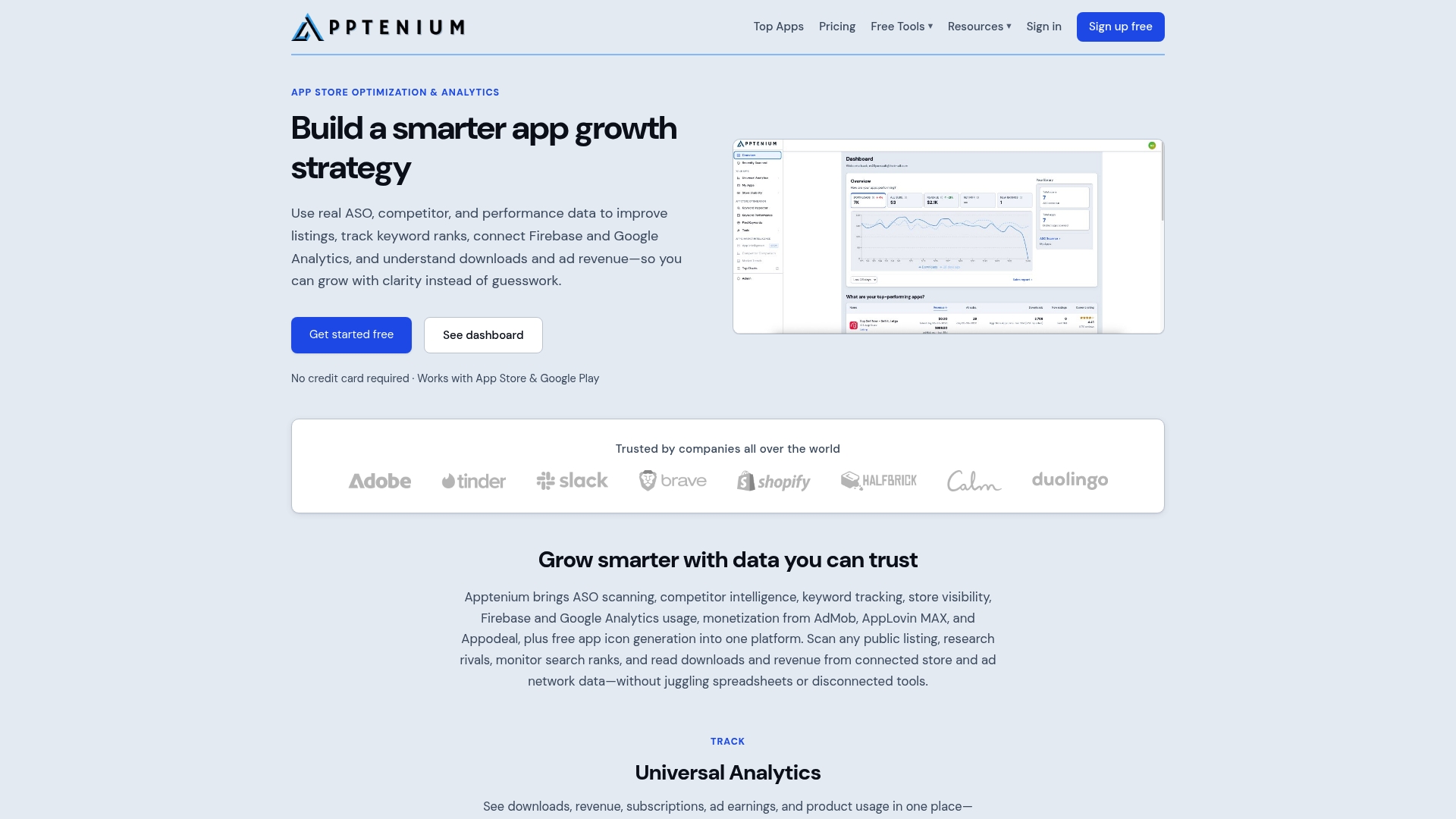
Running to generate, validate, and cluster workflow by hand works, but it takes time every single month. Our ASO platform folds that process into one place: scanning your app listing, surfacing AI-powered keyword and copy recommendations, tracking competitors, and pulling in performance data so keyword decisions are grounded in installs and revenue, not guesses.
This fits app developers and marketers who need keyword and listing decisions backed by actual performance signals instead of a spreadsheet full of disconnected tools. Start on our Free plan or check Pro pricing at $9.99 per month to see your current listing’s keyword opportunities in minutes.
FAQ
What are the trending keywords right now?
Trending keywords shift by industry, platform, and season, so there is no fixed list that stays accurate for long. The reliable approach is to generate candidate terms with an AI tool, then check current demand and trend direction in Keyword Planner before acting on any of them.
Which AI is best for keyword suggestions?
No single AI tool is best for every use case, because generative-only tools, autocomplete-based tools, and RAG-grounded tools each have different strengths and failure points. Choose based on whether you need broad idea generation, real-time search grounding, or channel-specific suggestions, and always validate the output against actual search or app store data.
What are keywords in AI-driven search tools?
In this context, keywords are the search phrases an AI tool generates by analyzing your seed input alongside patterns from training data, autocomplete signals, or live retrieval. They represent candidate terms for content or listing optimization, not confirmed search behavior until checked against real metrics.
What are the best keywords to use for content or app listings?
The best keywords are the ones validated by real search volume and clear intent match for your specific audience and channel, not simply the ones with the highest raw search estimate. For app listings, prioritize terms that correlate with downloads and revenue over terms that only show high interest, since performance signals matter more than visibility alone when deciding what to target.