ASO: Competitor Tracking Checklist for Weekly Scans, Triage, Analytics

ASO: Competitor Tracking Checklist for Weekly Scans, Triage, Analytics
Track rivals weekly across keyword ranks, metadata, creatives, ratings and reviews, update cadence, and estimated downloads and revenue, then act immediately on anything that signals a live test or a sentiment shift. Daily checks catch rating drops and featured placement changes before they compound. Our platform supports this workflow with scans, alerts, and AI recommendations, so you don’t need to combine multiple tools manually.
TL;DR:
- Focus on monitoring ranking shifts, metadata changes, and creative swaps that signal testing or ranking impacts in target territories.
- Automate weekly scans and alerts for metadata or creative changes, reserving manual review for review sentiment and thematic analysis.
- Prioritize high-impact signals like full metadata rewrites paired with rank lifts, and confirm changes over multiple days before acting.
- Track competitor release notes and advertising activities, especially new features and seasonal marketing campaigns that influence ranking and downloads.
- Use estimated download ranges for directional insights and connect store data with analytics tools to determine if rank movements affect actual installs or revenue.
Table of Contents
- The ASO Competitor Tracking Checklist: What to Monitor
- How Often to Check: Cadence, Automation, and Triage
- Turning Monitoring Data Into Prioritized ASO Actions
- What to Automate, What to Keep Manual, and How to Connect the Data
- Tracking Competitor Feature Updates and New Functionality
- Watching Competitor Marketing Campaigns and Advertising Strategies
- Monitoring Competitor Pricing Changes and Promotional Offers
- Social Media Presence and Engagement Metrics of Competitors
- How Industry Trends Shape Competitor Moves
- Mapping Competitor User Acquisition Channels and Strategies
- What I’d Watch Out for When You Start This
- Automate This Checklist With Apptenium
- FAQ
- Sources
The ASO Competitor Tracking Checklist: What to Monitor
Before you open a spreadsheet or a monitoring dashboard, decide what actually belongs on the list. A competitor tracking checklist that tries to capture everything becomes noise. The one below focuses on signals that move rankings, conversion, and retention, the three outcomes that actually matter for your app’s visibility.
Start with keyword ranks. For each rival, log the territory, the keyword, the current position, and the delta since your last scan. Long-tail keywords deserve the same attention as your top terms because they often reveal where a competitor is quietly picking up volume with less competition.
Next, track metadata diffs. Watch the app name or title, the subtitle, and the short and long description for every rival. Record the old text, the new text, and the timestamp of the change. A title tweak that coincides with a rank lift is one of the clearest signals you can get, and it is invisible unless you are capturing snapshots regularly.
Creative assets need the same discipline. Monitor icon variants, the first three screenshots (the ones that drive most conversion decisions), and any preview video changes. When a competitor swaps a screenshot set and then reverts part of it a week later, that is usually a sign of an active test, worth flagging even before you know the result.
Ratings and reviews round out the qualitative side. Track the average rating, the rating count, the weekly delta, and review sentiment or polarity. Watch for recurring complaint themes like crashes, subscription confusion, or onboarding friction. Review text features such as polarity, subjectivity, and length combine with rating metrics to shape downloads, and the effect varies by app category, so a rating pattern that matters for a game may not matter the same way for a productivity app.
Update cadence tells you how aggressively a rival is iterating. Log the version number, the release date, and whether the release notes mention a prominent feature or a bug fix. Estimated downloads and revenue should be recorded as ranges, never as fixed numbers, and used mainly to weight how closely you monitor a given rival. Finally, note any category or featured placements, since an editorial feature often precedes a ranking jump that has nothing to do with the rival’s own ASO work.
- Keyword ranks: territory, keyword, position, and delta per scan.
- Metadata diffs: title, subtitle, short and long description, with old text, new text, and timestamp.
- Creative changes: icon, first three screenshots, and preview video, flagged as suspected tests.
- Ratings and reviews: average rating, count, weekly delta, and sentiment themes.
- Update cadence: version, release date, and notable release note content.
- Estimated performance: downloads and revenue as ranges, used to prioritize attention.
- Placements: category or editorial features worth a closer look.
A simple tracking sheet, or a tool that automates it, needs a consistent row structure so nothing falls through the cracks.
Pro Tip: Snapshot creatives weekly, not monthly. Most A/B tests run for one to three weeks, and a monthly cadence will miss the test entirely.
How Often to Check: Cadence, Automation, and Triage
A checklist only works if it runs on a schedule you can actually sustain. Split your monitoring into three tiers.
- Daily: rating drops, a spike in one-star reviews, or a sudden featured placement change. These need same-day attention because they can signal a broken update or a store-level event.
- Weekly: keyword rank shifts, metadata diffs, creative swaps, and estimated performance changes. This is the backbone cadence for most of the checklist.
- Monthly: trend analysis that combines store-level data with Firebase or Google Analytics signals, where you look for patterns rather than single events.
Automate what you can using top SEO competitor analysis tools. Schedule recurring scans, set diff alerts for metadata and creative changes, and auto-export weekly summaries so you are not manually comparing screenshots every Monday. Keep the qualitative work, reading review text for tone and recurring complaints, as a manual step, since sentiment nuance still needs a human read.
Triage findings with a simple rule set. A high-priority signal combines a large change (a full title rewrite, a 0.3-star rating drop) with meaningful estimated impact (a top-10 competitor in your category). A medium signal might be a single screenshot swap with no rank movement yet. Low-priority signals go on a watchlist and get revisited at the next weekly check rather than triggering immediate action.
Pro Tip: If a competitor’s rank jumps the same week they change metadata, wait for a second week of confirmation before you copy the move. Store ranking algorithms absorb changes with some lag, and a one-week jump can reverse.
Turning Monitoring Data Into Prioritized ASO Actions
Not every flagged change deserves a response. Build a lightweight decision matrix: score the signal’s magnitude (how big the change is) against its business impact (how much the rival’s performance could shift). A metadata swap paired with a rank lift in a territory you target is worth a mirror test on your own listing. A negative review spike mentioning crashes is worth prioritizing a bug fix and referencing it directly in your next release notes.
Review sentiment and polarity are useful beyond diagnosis. Apple’s review summaries, generated with large language models and refreshed at least weekly, give you a fast read on dominant themes without reading every review line by line. Use that signal to shape how you word your own release notes and how you respond to low-star reviews about technical failures.
- Score magnitude (small, moderate, large) against estimated impact to set priority.
- A metadata change plus a rank lift in a target territory warrants a mirrored test.
- A review spike about crashes should move straight into your next bug-fix cycle.
- Require multi-day confirmation before committing to a wide-scale metadata change based on a single data point.
Research shows explicit ranking criteria substantially change model-generated recommendations, which means the qualitative factors behind a rival’s rank, not just the visible metadata, often sit outside what a keyword tool alone will show you.
What to Automate, What to Keep Manual, and How to Connect the Data
Rank tracking, metadata diffing, and creative snapshotting are mechanical tasks that automation handles better than a person checking manually. Alerting on those diffs should be automatic too. Reading review text for tone and recurring complaint patterns is the one piece worth keeping manual, since sentiment still benefits from human judgment.
The real value shows up when you connect store-level signals to your own analytics. If a rival’s rank climbs in a territory where your installs are also softening, pulling that alongside Firebase or Google Analytics data tells you whether the dip is coincidence or a direct competitive effect on your conversion funnel.
- Automate: keyword rank scans, metadata diffs, creative snapshots, and change alerts.
- Keep manual: reading review sentiment and judging whether a complaint theme is a pattern or noise.
- Connect store data with Firebase and Google Analytics to confirm whether a visibility shift actually moves installs or revenue.
- Treat estimated downloads and revenue as ranges, never as exact counts, when deciding how much weight to give a rival.
Our platform supports this workflow with ASO scanning, competitor intelligence, keyword tracking, AI recommendations, and integrations with analytics and ad platforms to streamline data reconciliation.
Pro Tip: When estimated download ranges from two different tools disagree, trust the direction of the trend over the absolute number. The trend is more reliable than any single estimate.
Tracking Competitor Feature Updates and New Functionality
Release notes are the most underused source in competitor tracking. Every update log tells you what a rival is building toward, not just what bug they fixed. A rival that adds a new onboarding flow, a subscription tier, or a social sharing feature is signaling where they expect growth to come from next.
Log each new feature alongside the version number and release date, then watch whether it shows up in screenshots or the app preview video within the following weeks. A feature that gets promoted in the product page usually matters more to the rival’s own roadmap than one buried in a release note.
Pay attention to functionality that appears gradually across several versions. A rival rolling out AI-driven personalization in stages, for instance, is often testing reception before committing fully. That pattern is worth a note in your tracking sheet even before you see any rank or rating movement, because it tells you where the category is heading.
Cross-reference feature additions with rating trends. If a new feature lands and the rating count climbs without a corresponding drop in average rating, the feature is probably landing well. If complaint themes shift toward confusion about a new flow, that is useful intelligence for your own roadmap decisions, independent of whether you plan to build something similar.
Watching Competitor Marketing Campaigns and Advertising Strategies
Store-side signals only tell part of the story. A rival’s advertising push often shows up as a spike in estimated downloads that has nothing to do with their metadata or keyword work. When you see an estimated download range jump sharply without a matching rank or creative change, a paid campaign is a likely explanation.
Look for seasonal patterns tied to campaigns: a fitness app ramping ad spend in January, a tax app pushing hard in the weeks before a filing deadline, a shopping app increasing visibility around a major sale period. These campaigns tend to repeat year over year, so a rival’s history gives you a rough calendar of when to expect their next push.
Creative assets often shift in lockstep with campaign launches. A rival refreshing its screenshots and preview video right before a download spike suggests the campaign and the store listing were coordinated, which is worth noting since it means the metadata change was not primarily an organic ASO test.
Track where the campaign appears to be driving traffic from, when that is visible through category movement or sudden keyword rank shifts on branded terms. A rival’s branded keyword rank climbing alongside a download spike often points to paid search or social advertising rather than organic discovery.
Monitoring Competitor Pricing Changes and Promotional Offers
Pricing and promotions move faster than most other signals on this checklist, so they deserve a dedicated line item. Track subscription tier pricing, free trial length, and any limited-time discount messaging that shows up in screenshots or promotional text.
A rival introducing a new lower-cost tier or extending a free trial window is often responding to a conversion problem, not simply testing. Pair that observation with their rating trend: if complaints about pricing or value show up in reviews shortly before the change, the two are likely connected.
Promotional offers tied to app store feature placements are worth separating from organic pricing strategy. A temporary discount that coincides with an editorial feature is a short-term tactic, while a permanent tier restructuring signals a longer-term shift in how the rival monetizes.
Watch for promotional messaging inside the screenshots themselves, since store policies increasingly allow pricing and offer callouts directly in creative assets. A rival that starts advertising “50% off annual plans” in its screenshot set is testing whether price framing in the listing itself improves conversion, a tactic worth noting even if you are not ready to test it yourself.
Social Media Presence and Engagement Metrics of Competitors
App store signals tell you what a rival is doing inside the store. Social presence tells you how they are building demand outside it. Track posting frequency, engagement rate on recent posts, and whether they are running influencer or creator partnerships tied to a specific feature or launch.
A sudden increase in posting cadence around a particular feature often precedes a store listing update, since marketing and product teams tend to coordinate launches. If you see a burst of social content about a redesign weeks before the screenshots change, you have an early warning that a creative refresh is coming.
Engagement quality matters more than follower counts. A rival with a smaller following but high comment and share rates on feature announcements is likely building a more engaged user base than one with a large but passive audience. That engagement pattern often correlates with stronger organic word-of-mouth installs, which show up later as a rank improvement without a corresponding ad spend increase.
Community-specific channels, like a Discord server or a subreddit, are worth a lighter monthly check rather than daily monitoring. These channels surface feature requests and complaints earlier than app store reviews do, giving you a preview of what review themes might look like in the following weeks.
How Industry Trends Shape Competitor Moves
Competitor behavior rarely happens in isolation. When several rivals in your category shift toward the same feature set or pricing model within a short window, that usually reflects a broader trend rather than coincidence. Tracking one rival in detail is useful, but tracking the pattern across three or four rivals tells you whether a move is idiosyncratic or category-wide.
Platform-level changes matter too. When app stores adjust ranking signals, update review summary behavior, or change how product pages support testing, rivals across the category tend to react within the same release cycle. Apple’s product page optimization feature, which supports testing up to three alternate treatments with results shown in App Analytics, has pushed many apps toward more frequent creative experimentation simply because the infrastructure to test easily now exists.
Watch for category-wide shifts in how apps describe themselves, particularly when new terminology starts appearing across multiple competitor subtitles within the same month. That kind of synchronized language change usually traces back to a shared keyword research insight or a platform algorithm update, not independent discovery by each team.
Treat trend analysis as a monthly exercise rather than a daily one. Single data points from one rival are noise. A pattern across several rivals, sustained over a few weeks, is a trend worth factoring into your own roadmap.

Mapping Competitor User Acquisition Channels and Strategies
Understanding where a rival’s installs come from helps you judge whether their growth is sustainable or one-off. Paid acquisition shows up as download spikes that do not correlate with organic rank improvements. Organic growth tends to show up gradually, alongside keyword rank gains and steady rating accumulation.
Referral and partnership-driven acquisition is harder to detect directly but often leaves traces in app store reviews, where users mention being referred by a specific creator, publication, or partner app. Recurring mentions of the same source across multiple reviews is a reasonable signal that a partnership channel is active.
App store search advertising, where available, tends to correlate with sudden visibility on specific branded or category keywords that would otherwise take months to earn organically. If a rival appears at the top of a competitive keyword search without a matching rank improvement on your tracking sheet for their organic position, paid search placement is a likely explanation.
Cross-promotion within a developer’s own app portfolio is another channel worth noting, particularly for rivals that operate multiple apps in adjacent categories. A sudden download increase that coincides with a cross-promotion banner appearing in a sibling app is a channel shift, not an ASO improvement, and should not be weighted the same way in your tracking sheet.
What I’d Watch Out for When You Start This
The most common mistake is reacting to a single day of noise, a one-star review or a one-day rank dip, as if it were a trend. Give signals a few days before acting. The second mistake is ignoring long-tail keywords in favor of chasing top-10 terms, which overlooks where rivals quietly pick up volume. The third is treating estimated download numbers as exact rather than directional.
Start with weekly scans, define one high-priority rule you will actually follow, and when a competing creative persists for several weeks, run your own test against it.
— Mike
Automate This Checklist With Apptenium
Running this checklist by hand across keyword ranks, metadata, creatives, reviews, and estimated performance takes hours every week that most teams would rather spend fixing what the data reveals. Our platform enables scheduled scans, automatic diff surfacing, and AI recommendations, integrating analytics and ad network data so your checklist and performance metrics are consolidated.
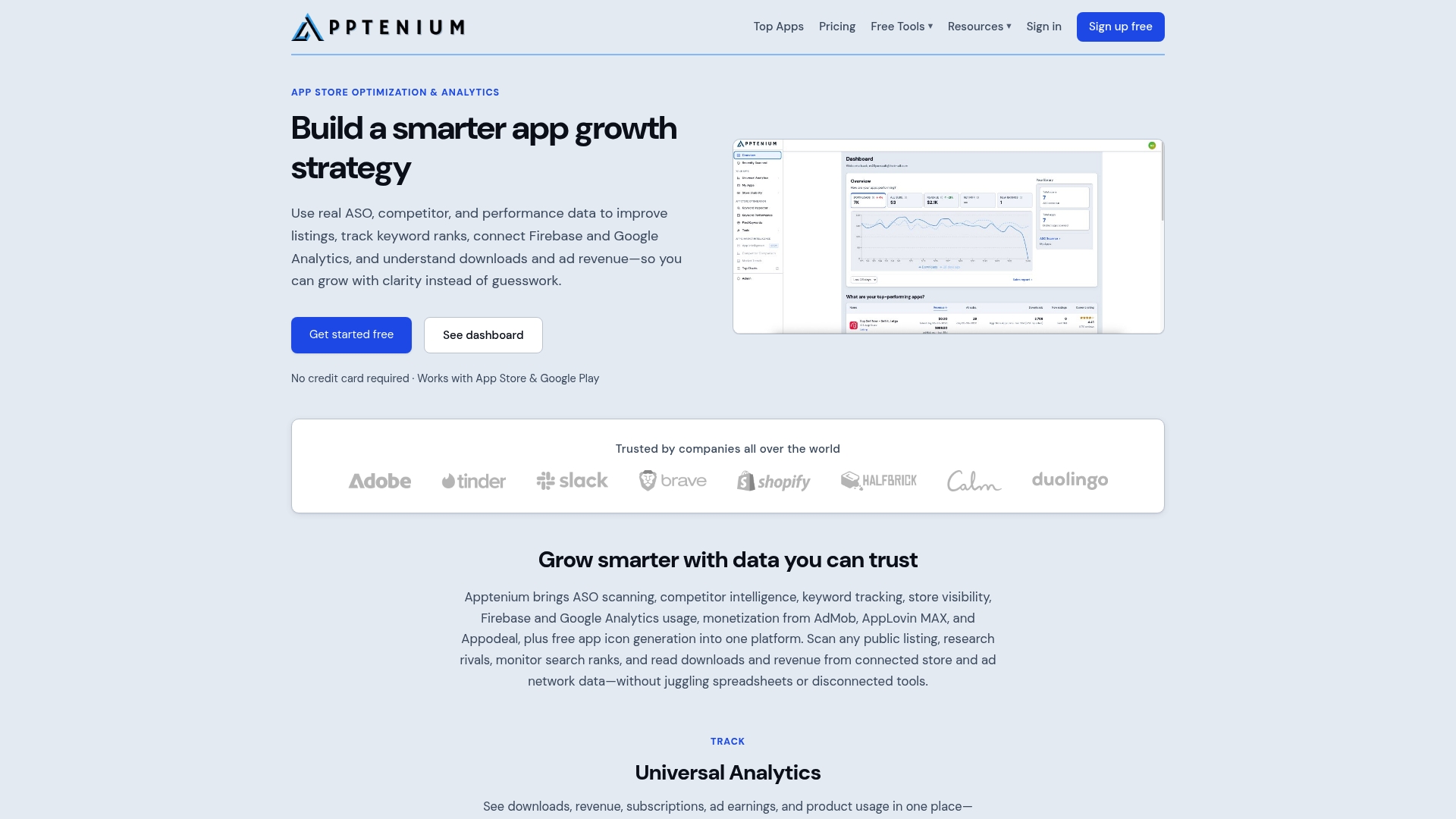
- Automated competitor scans across keywords, metadata, and creatives.
- AI-generated recommendations based on what the scans find.
- Integrations with Firebase, Google Analytics, and ad networks for performance context.
If you want to see how this checklist runs without the manual spreadsheet work, check Apptenium’s pricing, including a free tier with limited monthly scans and a Pro plan at $9.99 per month for unlimited scans.
FAQ
How often should I check competitor app rankings?
Check keyword ranks and metadata weekly, since most changes and tests unfold over one to three weeks. Reserve daily checks for rating drops, critical reviews, and featured placement changes that need same-day attention.
What’s the difference between tracking estimated downloads and actual downloads?
Estimated downloads are third-party approximations and should be treated as ranges rather than exact figures, since no external tool has access to a rival’s real analytics. Use the direction of the trend, not the absolute number, to decide how closely to monitor a rival.
How do I know which competitor changes actually matter?
Combine the size of the change with its likely business impact: a full metadata rewrite paired with a rank lift in a territory you target matters, while a single screenshot swap with no rank movement can wait. Wait for multi-day confirmation before reacting to any single data point.
Should I track competitor social media alongside app store data?
Yes, since social posting frequency and engagement often precede store listing changes by several weeks, giving you an early signal before creatives or metadata shift. A monthly check is usually enough, since social trends move slower than store-level signals.
Can a tool like Apptenium automate competitor tracking?
Yes, Apptenium automates keyword rank tracking, metadata diffing, and competitor intelligence alongside AI-generated recommendations, with integrations into Firebase and Google Analytics. Plans start with a free tier for limited monthly scans, with a Pro plan at $9.99 per month for unlimited scans.