Stop Using Five Tools to Monitor Competitor Updates for ASO

Stop Using Five Tools to Monitor Competitor Updates for ASO
Monitor listing metadata, keyword rankings, installs, ratings, retention, and monetization: these seven signals cover nearly everything that matters when a rival app moves. The fastest practical setup pairs first-party console data, App Store Connect and Play Console, with automated store scans and alert rules, and a platform like Apptenium can centralize that work instead of stitching together five separate tools.
TL;DR:
- Metadata changes like subtitle updates, screenshot edits, or icon swaps are the quickest indicators of competitive testing and should be monitored regularly.
- Sudden jumps in keyword rankings or rating drops often signal behind-the-scenes updates or issues worth investigating before reacting.
- Automated weekly or nightly scans paired with alert thresholds help detect fast-moving signals like rank jumps or ratings drops, enabling timely responses.
- Confirm signal validity over several days and across competitors before acting, giving time for noise or seasonal effects to clear.
- Combining App Store Connect and Play Console data with public scans and automation results provides the most comprehensive and actionable competitor insights.
Table of Contents
- What signals matter: a prioritized checklist for ASO teams
- Set up automated monitoring: workflows, alert rules, and integrations
- How to analyze updates and decide when to act
- Reporting cadence and KPIs to keep in your monitoring dashboard
- Legal and ethical considerations when monitoring competitor app updates
- Best practices for data privacy and compliance during competitor monitoring
- Tools and software recommendations for efficient competitor app update tracking
- Author perspective: what teams usually get wrong, and practical biases to adopt
- How an integrated ASO platform shortens time-to-insight
- FAQ
- Sources
What signals matter: a prioritized checklist for ASO teams
Not every change in a competitor’s listing deserves your attention, so it helps to rank signals by how directly they affect discovery, conversion, and revenue.
- Metadata changes: a new subtitle, updated screenshots, or a revised icon often signal a conversion test; watch for these first since they’re the easiest to copy or counter.
- Keyword rankings: a sudden jump for a competitor on a shared term usually means a metadata or backend keyword update worth investigating.
- Installs and rankings: gross install volume is a lagging indicator, useful for context but slow to react to.
- Ratings and reviews: a rating drop of half a point within a week often points to a bad release or a stability issue worth mining reviews for.
- Retention and engagement: these are leading indicators. A competitor losing daily active users before their install numbers fall is the clearest early warning you’ll get.
- Monetization signals: shifts in subscription pricing, paywall placement, or ad density tell you how a rival is adjusting its revenue model.
Treat engagement and retention as your early warning system, and treat installs as the confirmation that follows weeks later. A screenshot refresh or subtitle edit is worth a quick look; a rating slide combined with falling retention is worth a full triage.
Set up automated monitoring: workflows, alert rules, and integrations
The right setup depends on your team’s size, but the underlying pattern stays the same: scan regularly, alert on the signals that move fast, and log everything else for weekly review.
For a solo developer or small team, a lightweight weekly workflow works:
- Run an automated store scan every Monday for your top five competitors, covering metadata, keywords, and ratings.
- Pull your own App Store Connect or Play Console export and compare conversion and retention against the peer benchmark.
- Flag anything that moved more than a small, defined threshold and investigate before your next release planning meeting.
For a larger team, build a daily architecture instead: automated scans running nightly, webhook alerts pushed to Slack the moment a rating drops sharply or a top competitor changes its icon, and a joined dataset pulling in Firebase or Google Analytics so install spikes can be matched against your own acquisition campaigns.
Reserve immediate alerts for things that change fast and require a same-day response: rating crashes, sudden keyword rank jumps on your priority terms, and new product-page creative from a top rival. Everything else, like a one-day install bump or a minor subtitle tweak, belongs in a weekly digest instead of an interrupt.
Pro Tip: Set your alert thresholds wide enough that a single bad review doesn’t trigger a false alarm. A sustained rating delta over several days is a far more reliable trigger than a one-time dip.
How to analyze updates and decide when to act
A change in a competitor’s listing or metrics only deserves action once you’ve ruled out noise. Run through a short triage before committing resources:
- Check the peer group: is this change specific to one competitor, or is the whole category moving the same way?
- Look for attribution: did the shift follow a release, a seasonal spike, or a paid campaign you can see in the public listing?
- Confirm cohort consistency: does the pattern hold across a few days, not just one data pull?
- Apply a time window: give any single data point at least a week before treating it as a trend.
When the signal is confirmed, match it to an action. A metadata change on a shared keyword is worth running your own product-page test in response. A rating crash paired with falling retention calls for review mining to find the specific complaint pattern before you touch your own roadmap. App Store product page tests need at least five first-time downloads to even appear in Analytics, and Apple’s Bayesian method for confidence scoring often needs several weeks of traffic before a result is trustworthy. That’s the bar to hold yourself to before declaring a competitor’s test a winner worth copying.
Reporting cadence and KPIs to keep in your monitoring dashboard
Match your reporting frequency to the decision it supports. Daily alerts go to whoever owns release response, typically an ASO lead or growth engineer. Weekly summaries go to the broader marketing team. Monthly reviews belong in front of leadership, framed around strategy rather than individual data points.
Keep the dashboard itself focused on a short list of KPIs rather than everything your tools can surface:
- DAU/MAU ratio, your clearest read on whether an app is becoming a habit or a one-time download.
- Uninstall rate, since a quiet increase here often predicts a download slowdown weeks later.
- First-time downloads, the baseline for any product-page test.
- Rating delta over a rolling seven-day window, not a single snapshot.
- Conversion lift from any product-page test, reported with its confidence level attached.
- Proceeds per download, which tells you more about monetization health than gross revenue alone.
Normalize every metric against the peer group before comparing it across apps.
Legal and ethical considerations when monitoring competitor app updates
Monitoring a competitor’s public app store listing, its screenshots, description, pricing, and review counts, is standard competitive research and raises no legal concerns, since that information is published for anyone to see. The line shifts once your methods involve anything a competitor hasn’t made public: scraping behind authentication, misrepresenting your identity to access private beta builds, or attempting to reverse-engineer a competitor’s backend systems.
Automated scanning tools generally operate within each app store’s terms of service as long as they pull from public listing pages and published APIs rather than circumventing access controls. Before adopting any scanning tool, check that it respects rate limits and doesn’t violate the store’s terms, since a violation can affect your own account standing even if you’re the one being scanned rather than the one scanning.
Competitive intelligence gathered this way should stay focused on strategy, informing your own roadmap and positioning, rather than feeding into anything that could be read as unfair interference, like coordinated fake reviews or manipulated ranking signals aimed at a rival. Keep your monitoring practices documented so your team can explain, if asked, exactly what data was collected and from where. That habit protects you and keeps the practice firmly in the category of research rather than anything murkier.

Best practices for data privacy and compliance during competitor monitoring
The data you collect while monitoring competitors mostly concerns the competitor’s app, not individual users, which keeps most of this work outside the scope of personal data regulation. The exception comes when your monitoring setup touches your own users’ data, for example when you join competitor benchmark data with your internal Firebase or Google Analytics exports to see how your retention compares.
In that case, apply the same privacy discipline you’d use for any internal analytics project: store exported data securely, limit access to the team members who need it for analysis, and avoid pulling in more granular user-level detail than the comparison actually requires. Aggregated, anonymized metrics like DAU/MAU or retention curves carry far less compliance weight than anything tied to an identifiable person.
If your monitoring stack integrates with ad networks or third-party analytics providers, confirm each integration’s own data handling terms before connecting it, since you inherit some of their compliance obligations the moment you join their data with yours. A short internal checklist, reviewed whenever you add a new data source or integration, keeps this from becoming an afterthought once your monitoring setup grows past a single spreadsheet.
Tools and software recommendations for efficient competitor app update tracking
Your monitoring stack needs three capabilities at minimum: scanning for public listing changes, access to first-party console benchmarks, and a way to alert the right person when something moves.
App Store Connect and Play Console remain the non-negotiable foundation, since they’re the only sources for your own conversion, retention, and monetization data, and both now expose peer benchmarks that make competitor comparison possible without guesswork. Beyond the consoles, you’ll want a scanning layer that tracks competitor metadata, keywords, and ratings on a schedule, paired with alerting that routes to wherever your team already works, typically Slack or email.
Formalizing the analysis side matters too. Structured prompts, like the competitive analysis frameworks some teams used to standardize how they interpret new data, help keep triage consistent across a growing team instead of depending on one person’s intuition. Joining that analysis with your internal metrics is where the real insight shows up, a point echoed in broader discussions of analytics partnerships and why combined datasets consistently outperform siloed ones. For teams building out their first monitoring cadence from scratch, practical workflow guidance like what’s covered at Gleanit can help establish the discipline before you scale up tooling.

Author perspective: what teams usually get wrong, and practical biases to adopt
The most common mistake we see is reacting to a one-day rank jump instead of waiting for a confirmed trend. A competitor’s position on a single keyword can swing for reasons that have nothing to do with strategy. Weight engagement and retention over raw download counts since those tell you what’s actually sticking. Write down your peer-group definitions and your reasons for responding to a given signal; six months from now, that record is the only way to tell whether your instincts were right.
— Mike
How an integrated ASO platform shortens time-to-insight
Running scans, pulling console exports, and cross-referencing keyword rankings across three or four separate tools eats time you could spend acting on what you find. We built a platform to close that gap by bringing ASO scanning, competitor intelligence, and keyword tracking into one place, so a listing change, a rating shift, or a keyword jump shows up alongside your own performance data instead of in a separate tab.
- Unified scanning and tracking means you see competitor metadata changes and your own keyword movement in the same view.
- Recommendations powered by AI turn a detected change into a copy-ready suggestion for your own listing instead of leaving you to interpret it alone.
- Integrations with Firebase and Google Analytics let you join competitor signals with your own install and revenue data without manual exports.
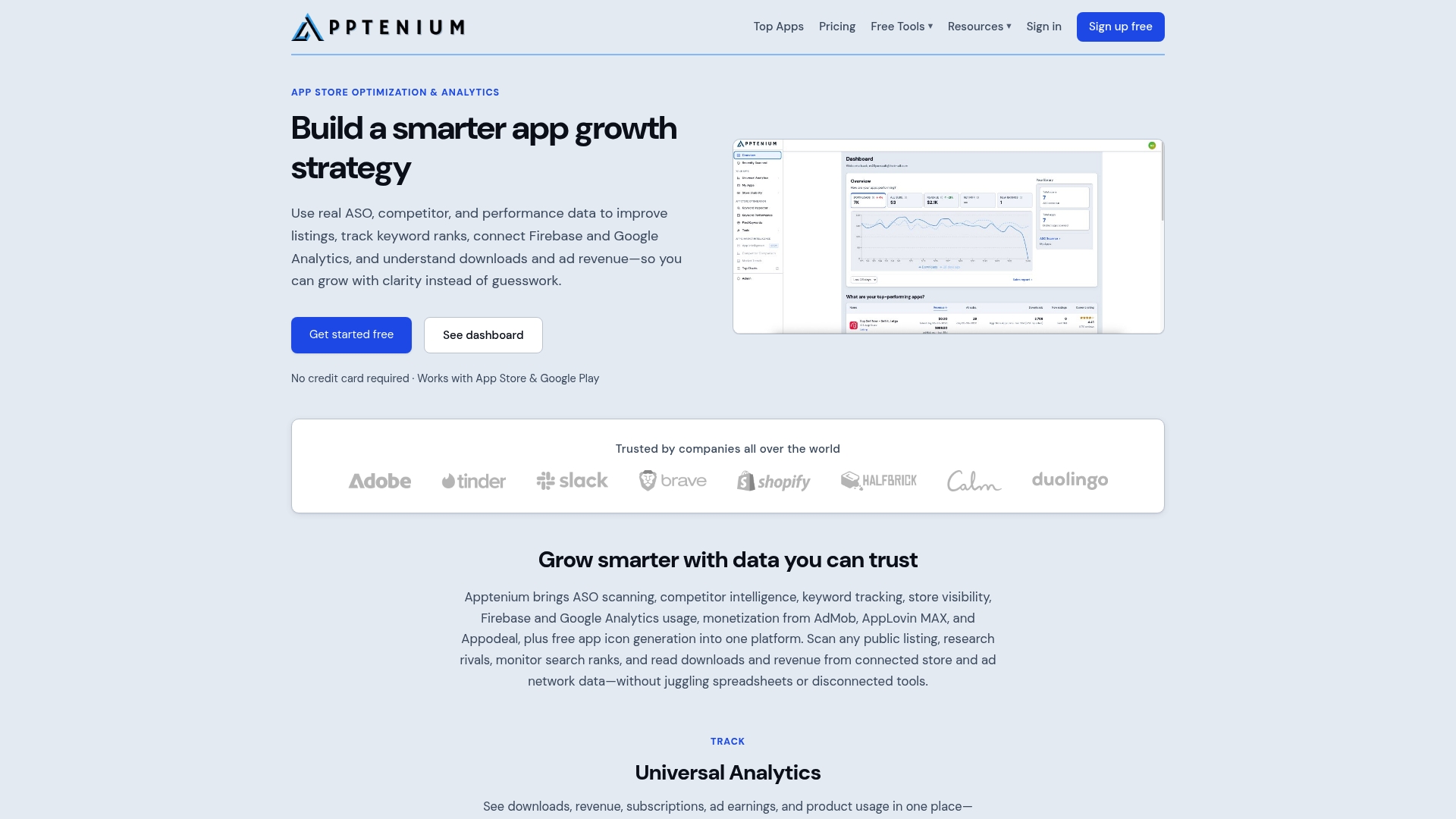
If fragmented tools are slowing down how fast you react to the market, compare our Free and Pro plans and see which fits your team’s monitoring workload.
FAQ
How often should I check competitor app updates?
Daily automated scans catch fast-moving signals like rating crashes or metadata changes, while a weekly review covers slower trends like keyword rank drift. Monthly reviews are the right cadence for strategic decisions based on confirmed, multi-week patterns.
What’s the difference between App Store Connect and Play Console data?
App Store Connect covers Apple’s App Store with peer group benchmarks and over 100 metrics spanning conversion, retention, and monetization. Play Console covers Google Play with its own statistics and “Compare to peers” view, so tracking both stores means working with two separate first-party systems.
Can I legally track a competitor’s app store metrics?
Monitoring a competitor’s public listing, including screenshots, pricing, and review counts, is standard competitive research with no legal issue since that data is published for anyone to see. Problems only arise if your methods bypass access controls or misrepresent your identity to reach non-public information.
How long should I wait before reacting to a competitor’s product-page test?
Apple’s product-page tests need at least five first-time downloads before results even appear in Analytics, and confidence often takes several weeks to build under Apple’s Bayesian scoring method. Treat any result you see on a competitor’s listing with the same patience before assuming it’s a proven winner.
Does Apptenium include competitor monitoring?
Yes, Apptenium’s Free and Pro plans include competitor intelligence alongside ASO scanning and keyword tracking, so you can watch rival listings without a separate tool. Pro unlocks unlimited scans for $9.99 per month, while Free covers a limited number of scans each month.
Sources
First-party console data should anchor every monitoring workflow, with public scans filling the gaps those consoles can’t see for competitors.
- Product page optimization - App Store Connect - Apple Developer
In 2026, Apple expanded App Store Connect with over 100 new metrics and peer-group benchmarks, giving developers exportable monetization and cohort data that used to require third-party workarounds. First-party exports are the ground truth for your own app; third-party estimates are genuinely useful for watching public shifts in a competitor’s visibility, but they should get joined with your internal analytics before you act on them. Keep in mind the practical limits too: API rate limits, sampling gaps in smaller categories, and privacy restrictions mean no single source gives you the full picture.